• About

Prescription for Adventure

~ by Naomi Gaede Penner

Prescription for Adventure

Category Archives: Uncategorized

Kansas Cow Paths: Suggestions for Stops and Starts

15 Monday Oct 2012

Posted by Naomi Gaede Penner in Kansas, Uncategorized

≈ Leave a comment

I never get too much of Kansas. There’s always something I want to see next time.

Here are a few places I recently stopped at (October 2012.)

Braums (across the state) – good hamburgers, so many kinds of ice cream that you won’t know what to do. I tried Pumpkin, Butter Pecan, and Peanut Butter. I bought Pumpkin. http://www.braums.com/

The Bread Basket  (Newton) – Mennonite fare. At least: six soups served daily and three choices of fresh bread. Pie by the slice, cream puffs, and other dessert goodies. Bags of zwiebach, bread, and cookies, along with jars of jam.  http://www.newtonbreadbasket.com/

Faith and Life Bookstore (Newton) – It’s my pleasure to sign books and/or talk here. I always buy more than I sell. The seasonal décor, variety, and Kansas bookcase all draw me in. The frequent eblasts of events are intriguing and enticing. I wish Newton was closer to Colorado! http://www.faithandlifebookstore.com/

Bethel College Life Enrichment (Newton) – terrific programs with a series of three presentations each time. I presented on “Adventure and Alaska.”  http://www.bethelks.edu/academics/convocation-lecture-series/life-enrichment/

Ten Thousand Villages (Newton) –I love that shopping at Ten Thousand Villages (across the United States and Canada) is both a buying and giving opportunity. Ten Thousand Villages is a nonprofit marketing program of the Mennonite Central Committee that creates opportunities for artisans around the globe to earn a fair wage. http://newton.tenthousandvillages.com/about-our-store/

Kansas Aviation Museum (Wichita) – many airplanes and flying artifacts. Accessible control tower. This is where Cessna Aircraft Management held a dinner meeting where I was invited to speak. My presentation was “What Aviation Means to Alaskans.” Wonderful evening. http://www.kansasaviationmuseum.org/

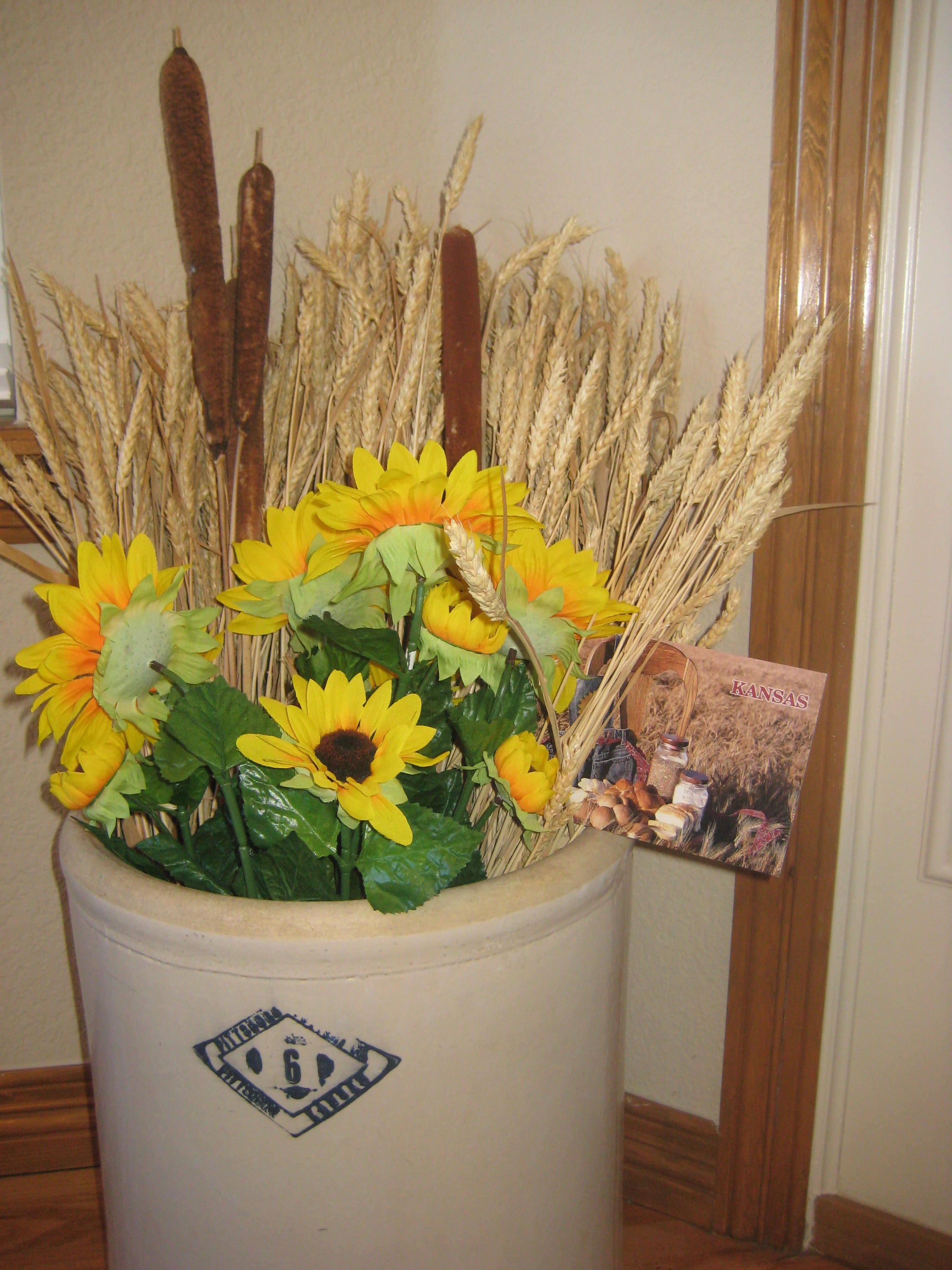
Kansas Originals Market (Wilson – just off 1-70 between Salina and Russell) – Everything-Kansas! Items made by Kansans that represent the state of Kansas: sunflower motifs, quilts, jams, books, stitchery, jewelry, tole painting, woodworking, and so on.  http://www.kansasoriginals.com/

If someone were to visit your state or province, what would you highlight as “must-see”?


Share this:

  • Share on Facebook (Opens in new window) Facebook
Like Loading...

Ninilchik: “peaceful settlement by a river”

30 Thursday Aug 2012

Posted by Naomi Gaede Penner in Uncategorized

≈ Leave a comment

Holy Transfiguration of Our Lord Church – Ninilchik, Alaska

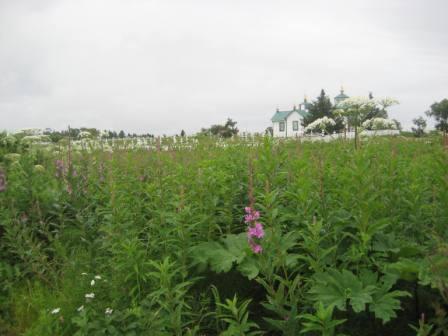
I never tire of making a side trip to the Ninilchik (Alaska) Russian Orthodox Church (Holy Transfiguration of Our Lord Church) on my way to Homer. What draws me to that place? Perhaps it is the idyllic setting of onion- shaped gold spheres against the sunny blue sky which canopies the Cook Inlet and distant white-topped Mt Redoubt and and Mt Iliamna in the Chigmit mountain range. Or perhaps it is a somber drippy gray day with views cut-short and focused on the nearby tall green grass and magenta fireweed; all sparkled with water-jewels. On such a day, the gray streaks in the time-worn white wooden fence pickets are vivid.

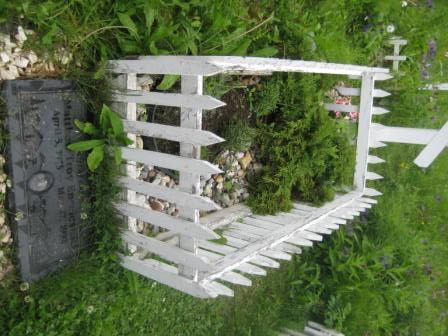
Maybe it is the mysterious-to-me personalized individual cemetery plots, some within stubby picket fences. The Items placed on the burial mounds offer a glimpse of personalities and interests: a bird book, stuffed animal, memento, or a picture. Some plots contain Thumbelina-size landscapes. I can picture loved ones on their hands and knees, slowly and deliberately arranging rocks, shells, sticks, sand, and short vegetation.

Possibly the  lure is the intriguing colony of family lots with names such as Cooper, Oskolkoff, Kvasnikoff, Jackinsky, Encelewski – all descendents of the first settlers who were indigenous Alutiq and Russian fur traders.

On the other hand, my propensity may have to do with my sixth-grade best friend, Karen Isaak, who has a son buried in the cemetery: Matthew Encelewski.  A son born in the same month and year as my own son. A son killed instantly and tragically as a teenager. Regardless if I brake to visit the grave site, I ponder this loss when I drive through Ninilchik.

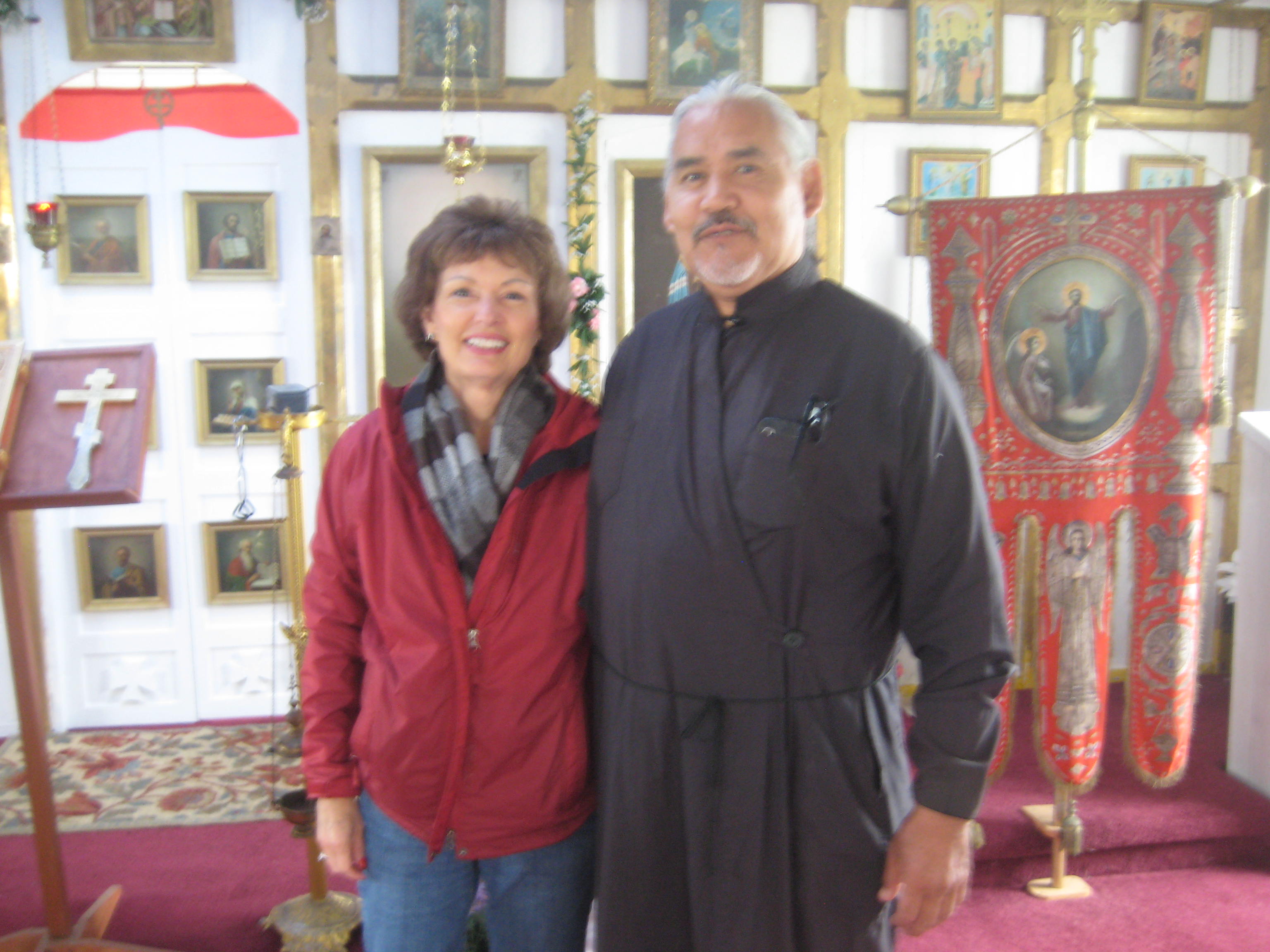
Naomi and Russian Orthodox priest

On a recent trip, I shook the moisture off my umbrella and stepped inside the small church.  A few white candles burned softly; their steady flames startled momentarily by the draft of the opened door. Icons filled the tall walls that rose unproportionally high above the small enclave. A priest sat around the corner softly reading, praying, and chanting – until I moved forward.

Then the large Native priest, with hair in a thick, gray, ponytail against his black robe stood up.  I was caught off guard by his quick questions, wrapped in a broad smile. “Do you know what “orthodox” means?” “Do you know why I’m studying for the priesthood?” “Do you know why the crosses in the cemetery have the angled piece at the bottom?

He took the rapt look on my face as an invitation to continue, and started with the cross. “The top bar represents the sign of mockery that Pilate ordered for Christ’s cross – Jesus of Nazareth, King of the Jews. The middle bar is of course on which Christ’s hands were nailed.  Finally, the slanted foot rest. Russian Orthodox tradition holds that the upper end points to heaven, where the first thief, who regretted his sin went (Today shalt though be in Paradise with me); and the lower end points to where the non-repentant thief went – separation from God.”

That was the simple, yet theologically-deep explanation of the crosses scattered throughout the cemetery.

Just then, he needed to attend other business. I went outside to wander about the crosses, the earthy dioramas, and the tangled undergrowth which makes every effort to hide any remembrance of lives lived, joys shared, hearts broken, and history made.

The Old Village of Ninilchik, which lies down by the peaceful river which flows into the Cook Inlet, is filled with history. At one time there was a walking tour map. Now, the history is awakened by walking — and question-asking of a local shop-owner or resident.  Whether new or old to the Kenai Peninsula, I’d encourage very passerby to pull off the Sterling Highway and pause for a moment of spiritual quiet – no matter the weather.

Matthew Encelewski

  • I contemplated what might be arranged on my burial mounds: a stuffed Golden Retriever, rolling pin, lingonberry (Alaskan cranberry) plants, a picture of my children and grandboy?
  • What items might be placed on your burial mound as a snapshot of your personality and interests?

ŦŦŦŦŦŦŦŦŦŦ

Thank you to Karen Isaak Encelewski and Wayne Leman for your peer critique, corrections, and input.

Share this:

  • Share on Facebook (Opens in new window) Facebook
Like Loading...

A Tourist Mistakes Himself for a Local

14 Tuesday Aug 2012

Posted by Naomi Gaede Penner in Alaska

≈ 2 Comments


With regards to my siblings:  Mark Gaede, Mishal Gaede, and Patti Gaede, who don’t pretend to be locals. They are locals.

A single-prop Cessna 206 at Anaktuvuk Pass, in the Brooks Range — flown by Dwayne King, a local. (2009)

“We left Anchorage for the wilderness,” the travel writer for the Post said in so many words. He was driving to the Kenai Peninsula. The “wilderness”? This man has not been to Galena, Anaktuvuk Pass, Point Hope, Dillingham, …places I’d consider a bit more remote than the Kenai Peninsula – wherein lies my hometown of Soldotna. We don’t even consider our Gaede-80 homestead remote anymore, seeing that it is now surrounded by subdivisions.

The writer went on to say that most people live in Anchorage. I read that three times. Anchorage does have the largest population of any settlement in Alaska, but I got the impression he believed life didn’t really exist anywhere else; well, except in that wilderness of the Kenai Peninsula.

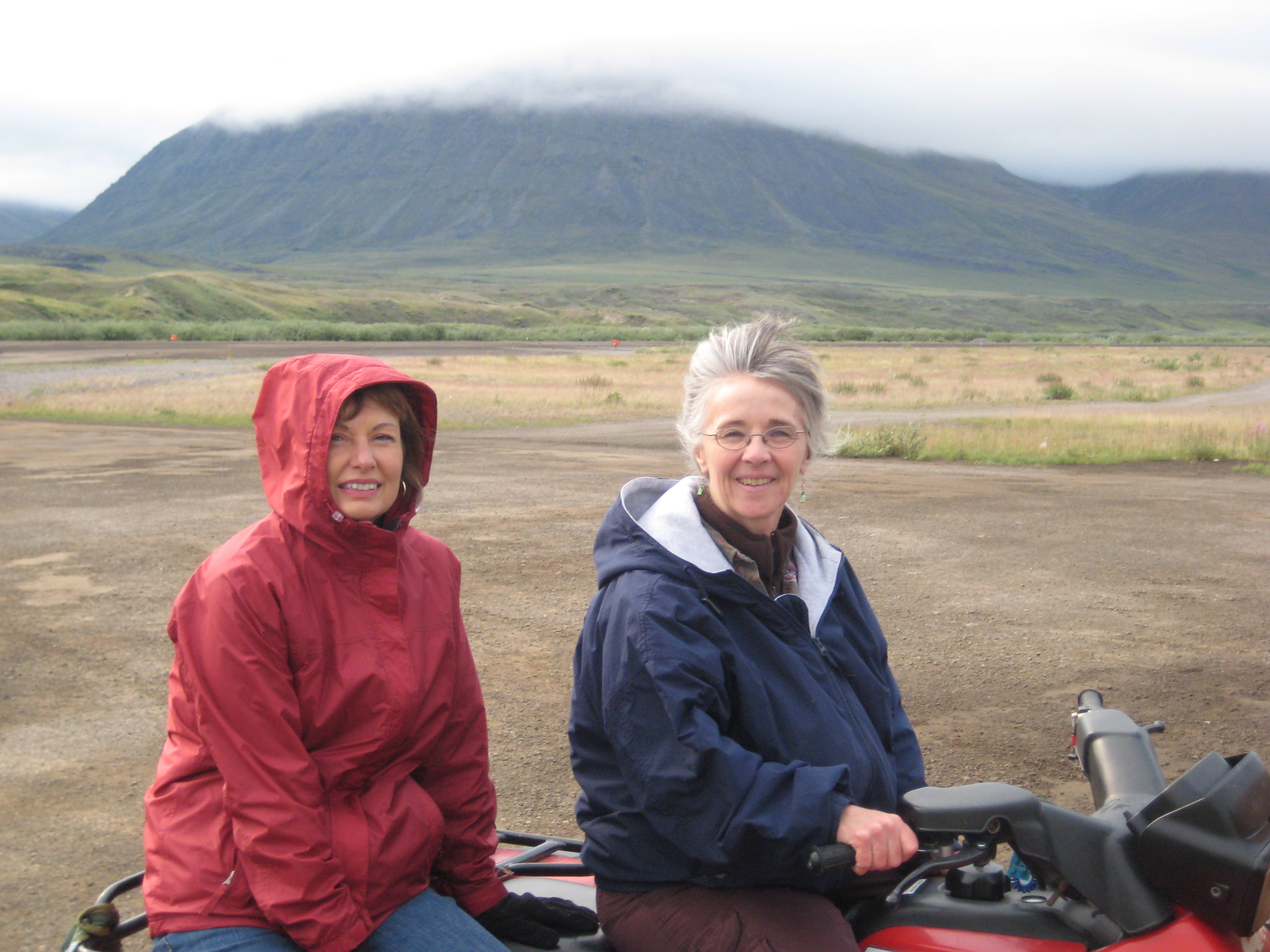
“Few of them (locals) spend much time on cruise ships, or flying over the Brooks Range in single-props. ..” Let’s stop right here. I fail to see the similarity of a cruise ship and flying in a single-prop over one of the most remote areas of Alaska.  My one time on a cruise ship was not like my several trips to Anaktuvuk Pass, located in the middle of the Brooks Range, of which one was in a Piper PA-14 Family Cruiser with a single prop..  It’s true, locals probably avoid cruise ships.  However, you may find some locals on the Alaska Marine Highway.

“But a lot settle down in the Last Frontier because of the nearby (read: ability to get there in a Subaru) wilderness….”  Amazing! Alaskans choose the Last Frontier for accessibility to the wilderness in a car?  Wrong again. The locals define wilderness as a place Subarus cannot access. The sourdoughs didn’t choose a population hub. Bush pilots don’t. Missionaries don’t. School teachers don’t. Commercial fishermen and women don’t. Biologists and seismologists don’t. And …there are indigenous people in Alaska and the Native population does not all reside in Anchorage.

His comments about Anchorage were not complementary. We all know what it means when someone chooses the word “charming” to describe “lack of with-it-ness” and not a “vortex of culture.” I sensed disgust. Again, he suggested the reader not act like a tourist, but a local, and reported jubilantly that he’d found a Japanese sushi bar.  I thought locals ate moose, caribou, smoked salmon strips, halibut, trout, ptarmigan, giant cabbage, and blueberries.

Before using the Travel section for kindling, I took a deep breath and read on. One day he “played tourist.” I read that again. He never started a chainsaw, flew in a bush plane, chopped wood, mended a fence so the moose couldn’t finish off the cauliflower, checked out a tide table for clam digging or set-netting, asked about berry picking, or bought a blue tarp, but he thought he was blending in with the locals.

His final paragraph: “Boy do the locals love their java!” What locals was he talking about? The locals I know love their tall, black rubber boots; a newly sharpened ax; airplane wing covers; fleece; rhubarb; the smell of damp moss on a drizzly day; buying bread that is only a week old; finding a matching set of about anything at the one Home Depot on the Kenai Peninsula; and early August, when the tourists stop clogging the road through town, the road to Anchorage, and Fred Meyer’s parking lot.

It would be an eye-opener for him to read any of my Prescription for Adventure books, where, yes, Alaskans actually fly in a single-prop airplane to the Brooks Range.  There is human life outside Anchorage.  Ask a local.

Here I am in Anaktuvuk Pass, in the Brooks Range, in 2009. I was also in Anaktuvuk in 1962, and 1988. I am not in or on a Suburu.

~~~~~~~~

 What does “a local” mean where you live?

If you’ve been to Alaska, what was your observation about the “locals”?

Share this:

  • Share on Facebook (Opens in new window) Facebook
Like Loading...

Columbia Ward Fish Cannery: 1968/2007/2012

29 Friday Jun 2012

Posted by Naomi Gaede Penner in Soldotna

≈ 1 Comment

When I was 18, my father decided I need to get a job. He had connections with everyone – including someone at the Columbia Wards fish cannery.  I wasn’t asked if I wanted to work there. Dad informed me I’d been hired.

The cannery was about four miles from our Gaede-80 homestead, down Kalifonsky Beach Road. I drove an old blue pick-up, which didn’t go very fast, and which later I discovered was not really attached to the chassis.  All the same, it got me to work.

It was common for college kids from Outside to come work for the summer, so I had peers of sorts. Japanese worked there, too, with the salmon eggs. The cannery was a 40,000-square-foot warehouse. No heat. Cold fish. Fish smell. I wore several pairs of wool socks in my tall black rubber books, a winter coat with a clear plastic apron that wrapped around most of me, and a bandana kerchief on my head.

My job was the assembly line where cans of fish traveled past me and my job was to use a kind of pliers to flip and twist any exposed skin downward or to the sides. The purpose was so the eager purchaser would open the can and find an attractive round of meat.

Working along the conveyor belt took some getting used to. It never stopped and our work was done while the cans traveled in front of us. The constant movement caused a kind of mild motion sickness.

The work was monotonous. The work was cold. We stood all day – or all night – depending on when the fish had come in. To break the boredom, someone down the line, just in front of the lid-stamper, would accidentally flip a can over. Of course, this jammed the lid-stamping machine and we’d all have to take a break while the mechanism was unclogged.

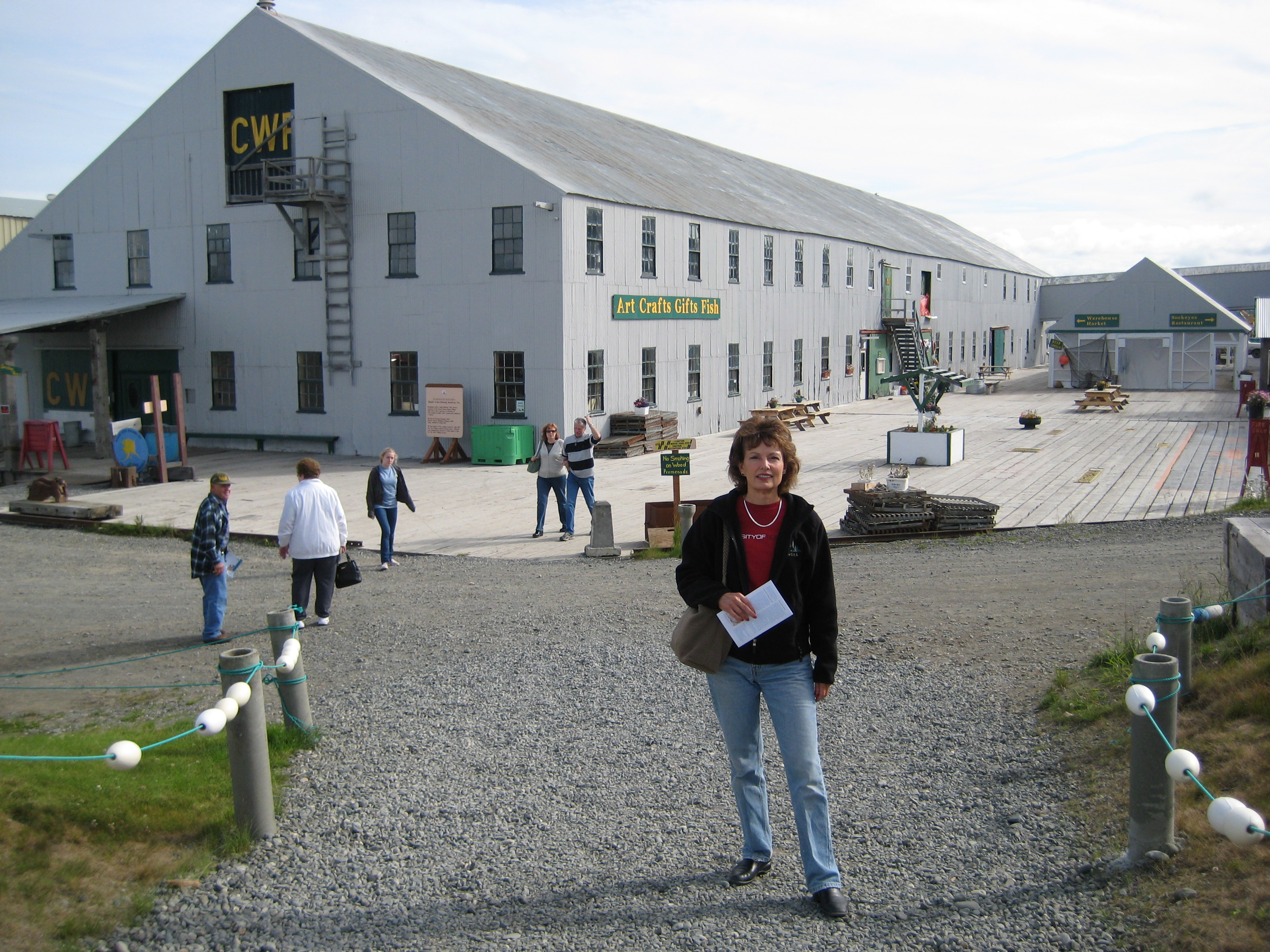
In 2007, the cannery was recognized as a historical landmark and several buildings were put back into use. All the buildings had signs designating their previous use and there was a map with walking tour available at a visitor center. What a step back in time for me! I was so excited to re-walk back into my past. It made a wonderful field trip to take guests.

Just this week I learned that the warehouse is being torn down. I was shocked. On July 13 and 14 timbers from the building will be available for purchase. I plan to be there.

Columbia Wards fish cannery

http://peninsulaclarion.com/news/2012-06-27/deconstruction-of-kenai-landing-warehouse-under-way

What did you do for summer work as a high school or college student?

Was it your idea or your parents?

What are your memories?

Share this:

  • Share on Facebook (Opens in new window) Facebook
Like Loading...

Adventures in Galena, Alaska – 1

01 Tuesday May 2012

Posted by Naomi Gaede Penner in Alaska

≈ Leave a comment

“We just put our winter boots away…bring your mud boots.” That was my last phone conversation with someone in Galena, a village of 500 people, along the Yukon River in Interior Alaska. That was mid-April, 2012. I was to arrive on April 25, during breakup.

Galena, located 270 air miles west of Fairbanks, and accessible only by air or the Yukon River, is the largest Yukon-Koyukon village. In the early 1900s, Galena was established near an Athabascan Indian fish camp and became a supply point for nearby mines. In 1941-42, during WWII, Galena Air Force Station was built.

Why was I going to Galena? I’d spent two impressionable grade school years upriver in Tanana, a village which at that time had 300 people (today around 100.) I was curious about the other villages. I wanted to touch my past, reach back to those nostalgically remembered years, and see what was there now.

My father, the Medical Officer in Charge (MOC) of the Tanana Public Health hospital had flown his J-3 and PA-14 Family Cruiser to make housecalls and medical field trips up and down the river, as well as to other parts of Interior Alaska. I’d listened to his stories, seen his Kodak pictures, watched his 8 mm movies, and delighted in souvenirs and gifts made of beads, woven grass, leather, and fur that he’d brought back from the Native people. He and my mother had a heart for the isolation and cultural adjustments of the missionary families. They’d pack us three kids into Dad’s plane and flown downriver to bring conversation, freshly baked cinnamon rolls, a book they’d just read, a puzzle or toy for the children, news from Outside (anywhere “outside” Alaska), and a listening ear. In those years, no one in Interior Alaska had a TV or telephone, much less internet connection. Communication was via one-way or two-way radio (often a single radio within a village, although additional possible contact if there was a CAA/FAA station in the village. The radio operators were usually the teacher, missionary, or innkeeper), mailed letter, a static-plagued radio station, a dog musher from another village, a bush pilot bringing a verbal account –or perhaps a newspaper or magazine.

Why had I specifically chosen Galena? I’d marketed my Alaska Unit Study Guide to Interior Distance Education o Alaska (IDEA) homeschoolers. IDEA was based in Galena, but served all of Alaska. I’d been to IDEA curriculum fairs in Soldotna, Kodiak, Anchorage, and Fairbanks. I’d called the office in Galena regarding invoices and purchase orders. Along the way, I learned about the Galena Interior Learning Academy (GILA) boarding school in Galena, which was one of three high school boarding schools in Alaska. Since I’d been sent to a boarding school when I was 15, I had empathy for boarding school students – oh – and knew the fun, too! The distinguishing characteristic of GILA is the vo-tech program which provides students the opportunity to graduate with a skill: cosmetology, auto mechanics, culinary, or aviation.  Since my Alaska Study Guide is based on my father’s stories in the book Prescription or Adventure: Bush Pilot Doctor (4th edition: Alaska Bush Pilot Doctor), which is filled with hunting drama, and medical emergencies, and flying mishaps, I recognized that the Guide would be a perfect fit for many of the students.

All in all, my reasons were the lures of exploring more of Alaska, stepping into mirages of my little girl world, marketing, and deliberate moving out of my comfort zone.

My Comfort Zone: neat, tidy, clean, warm, predictable, known, advance planning, adults versus kids, an amount of control over my environment, discussed expectations when teaching/speaking/presenting.

I was headed for adventure all right. This was breakup time: a time when snow melts but the ground is still frozen; a time when daytime temperatures are warm and mud puddles enlarge by the minute. When night temperatures freeze and a layer of bubbled or rippled ice forms on these new lakes. Messy.

Advance planning? My emails had been blocked by the school internet security. The one phone call with a staff member had been disconnected. Why? Perhaps it bounced off the satellite the wrong way. I hadn’t made contact with the school until a week before I was to fly in. 

Prepared? I had my tall, black rubber boots and thick gray woolie socks.

(To be continued)


Share this:

  • Share on Facebook (Opens in new window) Facebook
Like Loading...

Back on the Gaede-80 and Soldotna

18 Wednesday Apr 2012

Posted by Naomi Gaede Penner in Gaede-80 Homestead, Soldotna, Uncategorized

≈ Leave a comment

I’m back on the Gaede-80 Homestead outside Soldotna, Alaska. In 1961, my parents got in on the tail-end of the Homestead Act. They proved up 80 acres. Gaede and 80 rhymed, leading to the nomenclature of Gaede-80. In 2012, there is the Gaede-80 Subdivision off of Gaede Street. Most recently, there is a cluster mail box with Gaede Street addresses.

For years there was confusion about addresses of the buildings on the homestead. There was more than one building per legal parcel; perplexing for city planners who wanted to organize this random state. The electric and gas companies arrived at different numbers for the same building, and the borough showed alternatives. This was even more complicated when we siblings co-owned land.

But Alaska UPS and repair services are smart. They don’t bat an eye when you give them directions of “Go down Gas Well to where Jones goes straight, Gas Wells turns left, and Gaede is to the right. Oh, I think the Gaede sign is down again. Well, yes, there are actually two Gaede Streets because one runs down the property line, whereas the original one, which is still used, went to the Unical gravel pit…No, not the blue house. Go past the cabin and A-Frame to the brown house….. with the moose antlers in front of the drive and the orange wind sock……Yes, we land planes on the road.”

Several years ago, we tired of explaining that this and that building had two or three addresses.  We decided what numbers we wanted where. I made cinnamon rolls. My sister-in-law and I delivered the cinnamon rolls and our request for non-randomness. The borough-manager-of-addresses agreed on this efficiency. Word made its way down to utilities.

No matter what the erraticness, the borough never lost us when they sent out property taxes.

In 2008, we had the homestead replatted and some parcels reassigned. The title search revealed that a parcel we’d thought was mine, and which I’d paid years of property tax, was still titled in all our names. Good thing I hadn’t tried to sell it.

The In 2012, we siblings have our own Gaede-80 land – except for one co-owned piece between two siblings of the four siblings. This is easier to manage; except for the parcels we still use as open-space.

Soldotna. When we arrived in 1961, there was disagreement about how to spell Soldotna or Soldatna. Eventually “Soldotna,” used by the Post Office took preference. Yesterday when I was in town, I saw a local advertisement with a location of “Soldatna.” When we arrived, we were told the name came from a Russian word meaning “soldier.” Now you might hear that it comes from an Athabascan word meaning “the stream fork.”

When we arrived in 1961, no one “Outside” (a term my parents became familiar with when they arrived in Anchorage in 1955), had any idea where Soldotna was. Now when I mention that our family homestead is located outside of Soldotna, I get these responses from people in Lower-48: Great vacation! Drove through it on the way to Homer. Saw bears! Caught huge salmon! Caught enormous halibut! Loved staying in the Freddie’s parking lot. Well, actually, no. They don’t mention that last one. That’s just what Soldotna locals put up with when Fred Meyer’s allows huge campers and enormous RVs to park in their lot. Not easy to drive through in July to buy groceries, but it’s good for business. We get our fishing licenses elsewhere.

Share this:

  • Share on Facebook (Opens in new window) Facebook
Like Loading...

The Country Register -KS “From Kansas Wheat Fields to Alaska Tundra: a Mennonite Family Finds Home

15 Sunday Apr 2012

Posted by Naomi Gaede Penner in Alaska - Tanana, Book Reviews, Kansas, Uncategorized

≈ Leave a comment

Naomi Gaede-Penner was a preschooler when her father, a doctor who had been raised a Kansas farm boy, and her mother, also a Kansas farm girl from the Peabody area, first moved their family to Alaska to pursue a life of providing medicine to underserved areas. In her book, Gaede-Penner tells her family’s true story as a young Mennonite girl transplanted from the flatland prairies of Kansas to a life of Alaska village potlatches, school in a Quonset hut, the fragrance of wood smoke, and Native friends.

Add to the mixture, her father who creates hunting tales and medical adventures with a bush plane, a mother who makes the tastiest moose roasts and has the grit to be a homesteader, thow in a batch of siblings who always keep things interesting and you have a book that keeps you reading. Mixed in with the exotic locale of the Alaskan bush are many everyday activities and experiences that will be familiar to anyone growing up in the 1950s and 1960s as the Gaede children played, learned and experienced a family that grew up with a door always open — to a neighbor, friend or patient in need of a place to stay — or to a new experience as they moved to several places in Alaska, worked with Native Americans in Montana, lived near her father’s family in California and, ultimately, homesteaded in Alaska, ending the many moves that marked the children’s early lives.

Using letters sent by her parents to their families during this time period and the memories of herself and her siblings, Gaede-Penner weaves a tale that provides a fun read filled with many details of living in an area that didn’t become a state until 1959. Mixed in with stories of her father’s adventures flying his plane into the bush, hunting moose and dealing with medical emergencies in rudimentary facilities and her mother making due with the things on hand to make a home for the family of six, are stories of growing up with a strong sense of family and her Mennonite heritage and how those things affected Gaede’s childhood and response to her surroundings. Even though they were often living in an area that could be described as wilderness — where powdered milk and eggs were all that were available and moose roast was the norm rather than the beef or pork of their Kansas roots — the family continued to value their heritage and the role of family and faith which remains important to the siblings today. http://www.countryregister.com/kansas/kansas.html

“We come to Alaska for different reasons — jobs, love, adventure, a new start — or because we’re born here. We stay because we find what we’re looking for in short: home. Home is a sense of fitting in, a feeling rather than a structure of wood and shingles,” Gaede-Penner says. For the Gaede family, it took the hard work and sweat equity of the homestead for them to find home.

Share this:

  • Share on Facebook (Opens in new window) Facebook
Like Loading...
Newer posts →

Enter your email address to follow this blog and receive notifications of new posts by email.

Prescription for Adventure Website:

Prescription for Adventure on Facebook:

Prescription for Adventure on Facebook:

Recent Posts

  • Garden Tales
  • Dr. Elmer and Ruby’s Missionary Trip to Russian Mission, Alaska
  • A Chilly Bucket List
  • The Suntanned Farm Girl
  • Wilderness Wife

My Books

Archives

  • April 2023
  • March 2023
  • July 2022
  • December 2021
  • May 2021
  • October 2020
  • August 2020
  • May 2020
  • July 2019
  • June 2019
  • March 2019
  • January 2019
  • December 2018
  • November 2018
  • March 2018
  • August 2016
  • July 2016
  • June 2016
  • May 2016
  • April 2016
  • March 2016
  • December 2015
  • September 2015
  • August 2015
  • July 2015
  • March 2015
  • January 2015
  • October 2014
  • August 2014
  • June 2014
  • May 2014
  • March 2014
  • February 2014
  • January 2014
  • December 2013
  • August 2013
  • July 2013
  • June 2013
  • April 2013
  • March 2013
  • February 2013
  • January 2013
  • December 2012
  • October 2012
  • September 2012
  • August 2012
  • June 2012
  • May 2012
  • April 2012

Categories

  • Adventures
  • Alaska
  • Alaska – Galena
  • Alaska – Tanana
  • Alaska Earthquake
  • Anna Bortel Church
  • Book Reviews
  • Caring and Compassion
  • Everyday life
  • Gaede-80 Homestead
  • Holidays and Special Occasions
  • Inspiring Adventures
  • Kansas
  • Mark
  • Mark Gaede
  • My Books
  • Outdoor Action
  • Personal Growth
  • School Teachers
  • Sibling Relationships
  • Soldotna
  • Telling Our Stories
  • The Bush Doctor's Wife
  • Uncategorized
  • Womens' Safety and Protection
  • Writing Workshops

Blog at WordPress.com.

Privacy & Cookies: This site uses cookies. By continuing to use this website, you agree to their use.
To find out more, including how to control cookies, see here: Cookie Policy
  • Subscribe Subscribed
    • Prescription for Adventure
    • Join 25 other subscribers
    • Already have a WordPress.com account? Log in now.
    • Prescription for Adventure
    • Subscribe Subscribed
    • Sign up
    • Log in
    • Report this content
    • View site in Reader
    • Manage subscriptions
    • Collapse this bar
 

Loading Comments...
 

    %d