Capturing the Personal Story

Do you want to write or capture your life stories? Have you wanted to help your parents or grandparents chronicle their life experiences? The rewards are gratifying, but the task can seem overwhelming. There’s no one way to tackle the project — and more so—not everyone is a writer.

The good news is that you can write around a theme or interest, rather than a “from the beginning of time” approach.  Do you, your parent, your grandparent  like to quilt? What if you write about the the colors and fabrics chosen, who they were  quilted with, and what became of the finished masterpiece? Do you like to cook or bake? Tell about specific recipes, when they are served, and to whom? Where did the recipe come from? A family tradition? How has it been modified over the years? Do you have a history of car/truck/tractor/airplane purchases? Tell the story of the why, when, how of these marks in your life history. Travel photo books are another medium with the simple “writing” of dates, places, companions, and perhaps motivation for selecting that specific location.

You don’t have to capture every detail of your life, but the capturing process has to be fun — or it won’t happen.

Want help in shaping these mini-stories — or embarking on a full-blown personal story? Register for the workshop below:

Naomi Gaede-Penner, local author of the non-fiction, Alaska, Prescription for Adventure series, can provide you with individualized venues for story-writing and practical tools to make the task manageable and fun. To learn more about Naomi’s published works and read sample chapters, go to http://www.prescriptionforadventure.com. Instructor Naomi Gaede-Penner

Click to access Summer2012_web_201203291114183959.pdf

See page 16.


Rate $48 R/$54 NR Day/Time W; 7-8 p.m.

Location Recreation Center 17007777 May 23 – June 13

My Mother, the Reluctant Adventurer

Life is full of adventures. Some we choose. Some we are dragged into. Some we find ourselves in the midst of.

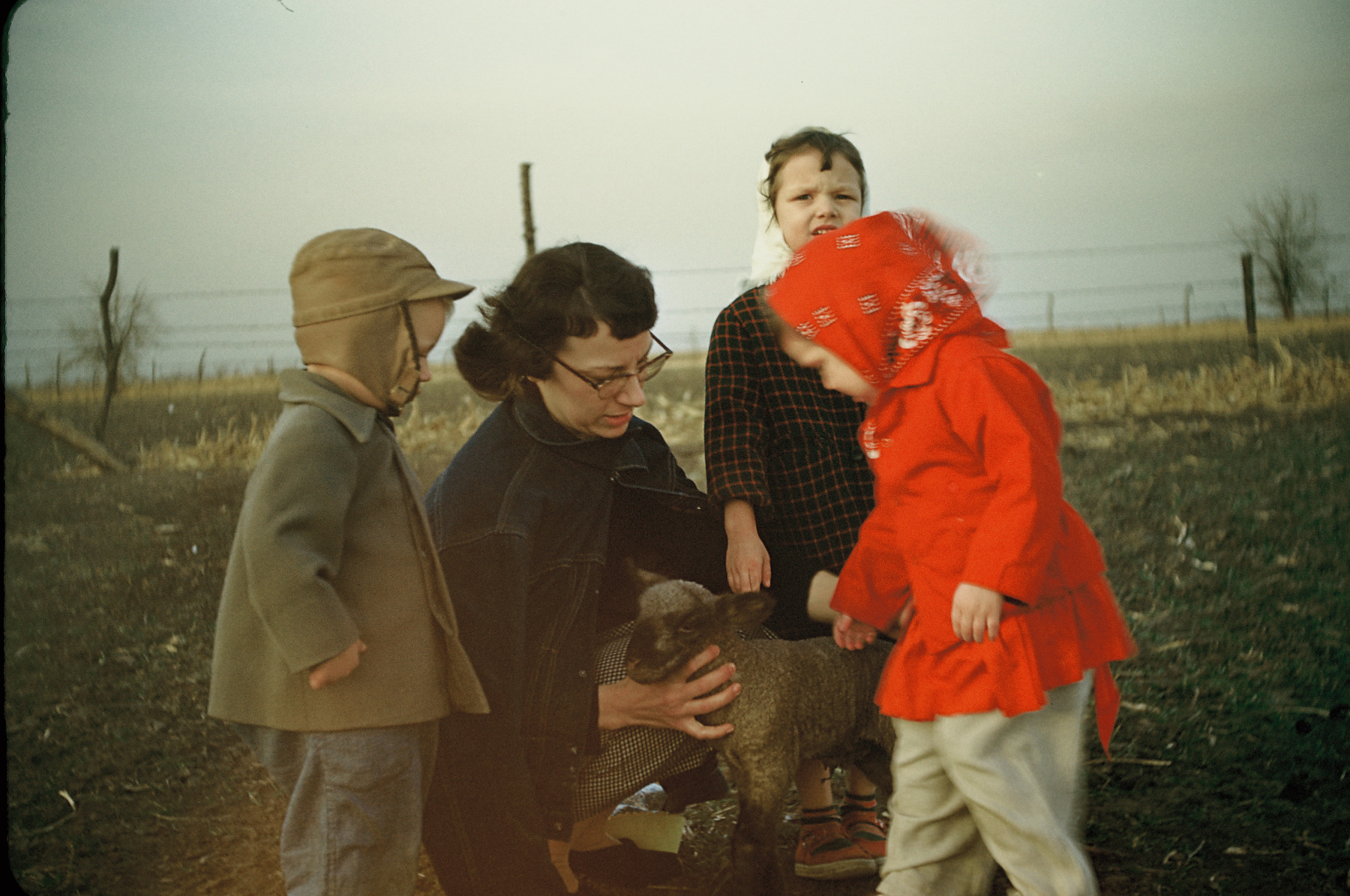
My mother, Ruby Leppke, did not seek adventure. She and my dad, Elmer Gaede, were Mennonite farm kids in Central Kansas. Mom drove a tractor, did farm chores, and butchered chickens. It was no surprise that she won first place in a cow milking contest.

When she and Dad married on April 16, 1943, Dad was working on a diary farm. Somewhere on Dad’s way home from some cornfield, he took an unexpected turn. Instead of walking into a barn stacked with musty hay, crowded with the smells of warm milk and the meows of begging barn cats, he found himself at Kansas University Medical School, anticipating a missionary’s life in South America.

Mom had seen the caption below his picture in the college yearbook, “Seeking worlds to conquer,” but it didn’t occur that that might mean something other than dealing with wheat prices and drought, catching catfish with his hands, and shooting jackrabbits. When he mentioned someday he’d like to fly an airplane, she laughed. His twinkly eyes, sense of humor, and restless ambition attracted her.

They didn’t go to South America. In 1955, with my sister, Ruth, and I standing on the broad backseat of the ’47 Fleetline Chevy, they drove north. On the dusty car trunk my father finger-wrote, “Anchorage or Bust.” The blue and gold KU Jayhawk decal faded from view on the chuck-holed Alcan Highway.

Mom didn’t choose adventure, but she had the resiliency to trade the harvest sun of Kansas for the midnight sun of the far North. Sweltering humidity for ice fog. Milk cows for moose cows. Catfish for salmon.

When the content, Mennonite farm girl arrived at her new home in Alaska, she was given a prescription for adventure.

*****

My mother missed acutely the farm-fresh eggs, milk, roasting ears, pork sausage, and tomatoes. Growing up in the Depression, however, she knew how to scrounge around, make something out of nothing – and improvise. In Alaska, she was quickly introduced to rhubarb. That became her Alaska fruit – even though it is factually a vegetable.

Life is full of adventures. Some we choose. Some we are dragged into. Some we find ourselves in the midst of.

My mother, Ruby Leppke, did not seek adventure. She and my dad, Elmer Gaede, were Mennonite farm kids in Central Kansas. Mom drove a tractor, did farm chores, and butchered chickens. It was no surprise that she won first place in a cow milking contest.

When she and Dad married on April 16, 1943, Dad was working on a diary farm. Somewhere on Dad’s way home from some cornfield, he took an unexpected turn. Instead of walking into a barn stacked with musty hay, crowded with the smells of warm milk and the meows of begging barn cats, he found himself at Kansas University Medical School, anticipating a missionary’s life in South America.

Mom had seen the caption below his picture in the college yearbook, “Seeking worlds to conquer,” but it didn’t occur that that might mean something other than dealing with wheat prices and drought, catching catfish with his hands, and shooting jackrabbits. When he mentioned someday he’d like to fly an airplane, she laughed. His twinkly eyes, sense of humor, and restless ambition attracted her.

They didn’t go to South America. In 1955, with my sister, Ruth, and I standing on the broad backseat of the ’47 Fleetline Chevy, they drove north. On the dusty car trunk my father finger-wrote, “Anchorage or Bust.” The blue and gold KU Jayhawk decal faded from view on the chuck-holed Alcan Highway.

Mom didn’t choose adventure, but she had the resiliency to trade the harvest sun of Kansas for the midnight sun of the far North. Sweltering humidity for ice fog. Milk cows for moose cows. Catfish for salmon.

When the content, Mennonite farm girl arrived at her new home in Alaska, she was given a prescription for adventure.

*****

My mother missed acutely the farm-fresh eggs, milk, roasting ears, pork sausage, and tomatoes. Growing up in the Depression, however, she knew how to scrounge around, make something out of nothing – and improvise. In Alaska, she was quickly introduced to rhubarb. That became her Alaska fruit – even though it is factually a vegetable.

Rhubarb Cherry Pie

3 C. rhubarb, chopped

1 can (14.5 oz) pitted, tart, red cherries, undrained

1 ¼ C. granulated sugar

2 T. tapioca

Combine ingredients and let stand 10- 15 minutes

Prepare two-crust pastry. Roll out and line a nine-inch pie plate. Dump in ingredients. Cover with remaining crust. Pinch edges and trim off excess dough. Roll out left-over dough. Cut into 2×2 inch squares. Sprinkle pie and squares lightly with cinnamon and sugar. Bake at 400º: twenty minutes for squares, forty minutes for pie. Nibble on squares while waiting for pie.

(This story is published in April/May issue of The Country Register – Kansas:

http://www.countryregister.com/kansas/kansas.html)
Adventures in Galena, Alaska – 2

I wanted to sit where I could see the terrain below; specifically, the Yukon River.  I climbed the shallow steps into the ERA airplane and looked ahead. The ceiling was low and even I couldn’t stand up between the single row of seats on either side of the narrow aisle.  Halfway back, I stepped over a hump in the floor and an older Native man informed me, “He doesn’t want us to sit back there. Weight and balance.” I sat down across from the gentlemen and noticed that his fingers were all stubs. Frostbite? My view outside was filled with the high wing and the back of a twin-engine.

About 10 people filled the seats in front of me. A number of passengers started conversations. The tall young man who crouched awkwardly to ensure our seatbelts were fastened, was every bit a commercial pilot in his clean black trousers and crisp white shirt. At that moment, he was also the flight attendant.

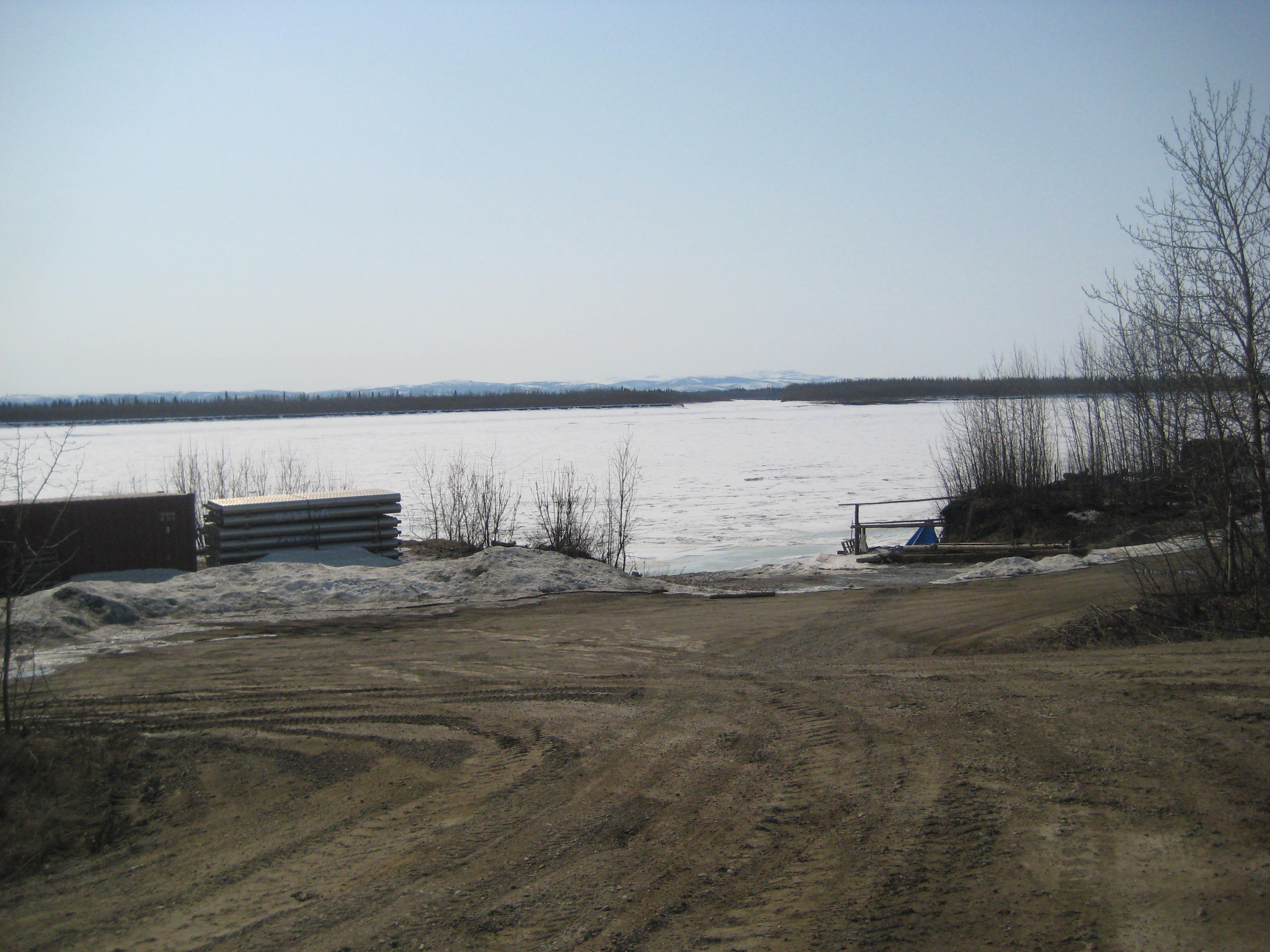
Even though my view was limited, I caught glimpses of the very frozen Yukon River.

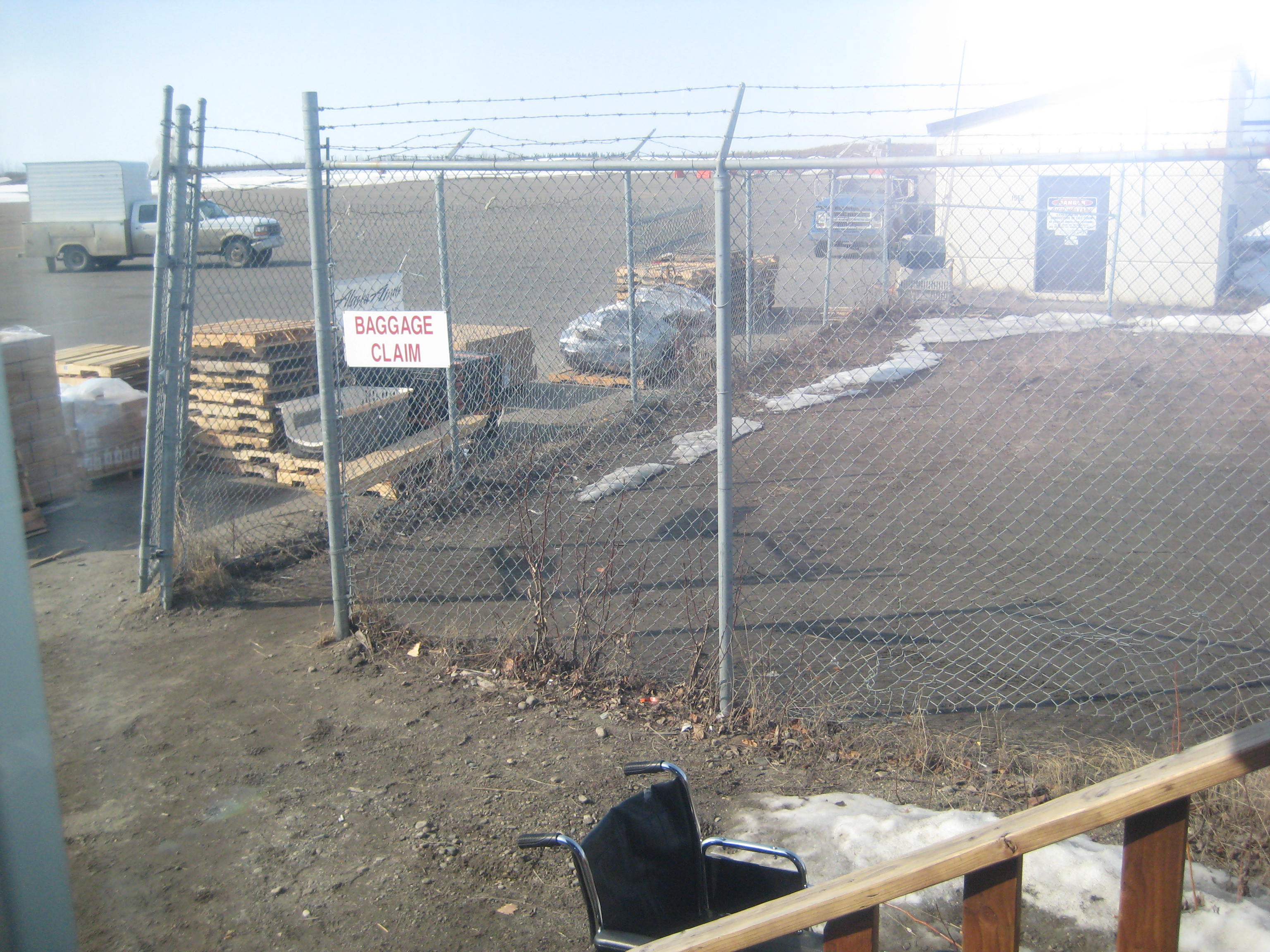
When I deplaned, I wasn’t sure who to look for, but Genny, the school librarian, found me as if we were old friends. My suitcase would arrive in the outdoor chainlink fenced area. “They’ll put it on a pallet,” said Jenny. The other option was the mud.

Genny, the ultimate hostess, tour guide, and chamber of commerce spokeswoman, immediately oriented me to my unfamiliar surroundings.

Galena’s population of 500 is spread around three main parts:

–       The Air Force Base which is now used as Galena Interior Learning Academy (GILA) and is set back from the airport.

–       Old Town, the original townsite which runs along the often mile-wide Yukon River and is comprised of old cabins, outhouses, sled dog houses, the post office, and a docking area for barges.

–       An area upriver, away from the river, which includes the public school, health services, community hall, KYIU radio station, and houses. That evening, when I was invited to dinner by Kim, whose family lives in that area, she said, “We live in the suburbs.” As much as the Galena people told me they didn’t really live in a village, at no point was I convinced.

Scattered within these vicinities are the Alaska State Troopers post, the headquarters for the Koyukuk/Nowitna National Wildlife Refuge, St. Berchman’s Catholic Church and Galena Bible Church, government offices, two B&Bs, and a coffee shop. All in all, Galena is a hub for smaller villages up and down the river and the Interior.

Genny and Kim had set my agenda. Lunch at the school cafeteria, which was also the gym, was top of the list.

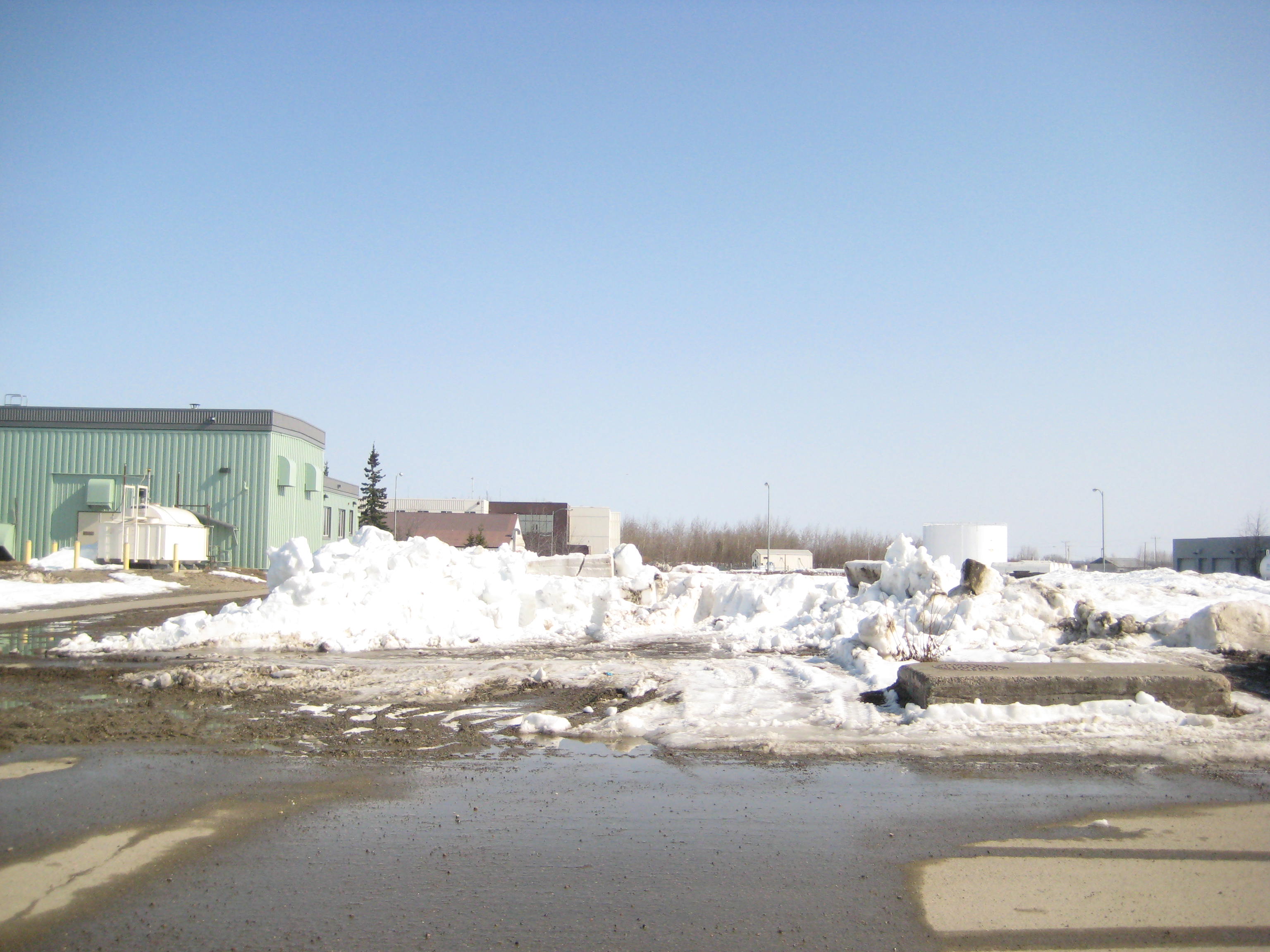
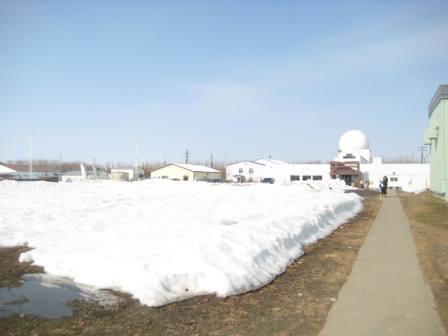
Breakup was in full force. The ground was frozen, but the snow was melting and water had no place to go; consequently, puddles were lake-size. I was ready to put on my tall rubber boots — even though I observed women in crocs and sandals. Some even wore cropped pants and frilly nylon blouses. It was sunny all right, but it was also 40 degrees. I was comfortable in my wool sweater.

Next on the list was to see if I had cell phone coverage. No. That meant they’d verbally tell me when I’d be where, and who would pick me up from where. Or, they could call the B&B if I was there.

The B&B was a double-wide trailer on stilts. It is not unusual for houses and building in the Interior to be on piers. Permafrost semi-thaws with temperatures, but more so if a warm house is placed on top it. The owners did not live in the B&B and I was on my own. The entry was through the garage which smelled strongly of fuel. The bedroom overlooked a frozen lake. “Overlooked” was enhanced by the de-cline of the room. “There’s been some shifting,” said the owner. This shifting was evident in bedroom doors which stayed open unless a shim was wedged beneath them, kitchen cabinet doors that swung open, and an exterior door that didn’t lock. I prayed there would not be an earthquake.

The boiler had a problem. The heat was hot water baseboard. The electrical heater warmed my room nicely. The shower the next morning was chilly. There were no window coverings. Facing the lake was a good thing. The sun didn’t set until after 10 pm. The bed was comfortable.

My 48 hours in Galena was a blur of unknowns, adventures, and fun surprises — were those baby chicks I heard peeping?

To be continued…..

Adventures in Galena, Alaska – 1

“We just put our winter boots away…bring your mud boots.” That was my last phone conversation with someone in Galena, a village of 500 people, along the Yukon River in Interior Alaska. That was mid-April, 2012. I was to arrive on April 25, during breakup.

Galena, located 270 air miles west of Fairbanks, and accessible only by air or the Yukon River, is the largest Yukon-Koyukon village. In the early 1900s, Galena was established near an Athabascan Indian fish camp and became a supply point for nearby mines. In 1941-42, during WWII, Galena Air Force Station was built.

Why was I going to Galena? I’d spent two impressionable grade school years upriver in Tanana, a village which at that time had 300 people (today around 100.) I was curious about the other villages. I wanted to touch my past, reach back to those nostalgically remembered years, and see what was there now.

My father, the Medical Officer in Charge (MOC) of the Tanana Public Health hospital had flown his J-3 and PA-14 Family Cruiser to make housecalls and medical field trips up and down the river, as well as to other parts of Interior Alaska. I’d listened to his stories, seen his Kodak pictures, watched his 8 mm movies, and delighted in souvenirs and gifts made of beads, woven grass, leather, and fur that he’d brought back from the Native people. He and my mother had a heart for the isolation and cultural adjustments of the missionary families. They’d pack us three kids into Dad’s plane and flown downriver to bring conversation, freshly baked cinnamon rolls, a book they’d just read, a puzzle or toy for the children, news from Outside (anywhere “outside” Alaska), and a listening ear. In those years, no one in Interior Alaska had a TV or telephone, much less internet connection. Communication was via one-way or two-way radio (often a single radio within a village, although additional possible contact if there was a CAA/FAA station in the village. The radio operators were usually the teacher, missionary, or innkeeper), mailed letter, a static-plagued radio station, a dog musher from another village, a bush pilot bringing a verbal account –or perhaps a newspaper or magazine.

Why had I specifically chosen Galena? I’d marketed my Alaska Unit Study Guide to Interior Distance Education o Alaska (IDEA) homeschoolers. IDEA was based in Galena, but served all of Alaska. I’d been to IDEA curriculum fairs in Soldotna, Kodiak, Anchorage, and Fairbanks. I’d called the office in Galena regarding invoices and purchase orders. Along the way, I learned about the Galena Interior Learning Academy (GILA) boarding school in Galena, which was one of three high school boarding schools in Alaska. Since I’d been sent to a boarding school when I was 15, I had empathy for boarding school students – oh – and knew the fun, too! The distinguishing characteristic of GILA is the vo-tech program which provides students the opportunity to graduate with a skill: cosmetology, auto mechanics, culinary, or aviation.  Since my Alaska Study Guide is based on my father’s stories in the book Prescription or Adventure: Bush Pilot Doctor (4th edition: Alaska Bush Pilot Doctor), which is filled with hunting drama, and medical emergencies, and flying mishaps, I recognized that the Guide would be a perfect fit for many of the students.

All in all, my reasons were the lures of exploring more of Alaska, stepping into mirages of my little girl world, marketing, and deliberate moving out of my comfort zone.

My Comfort Zone: neat, tidy, clean, warm, predictable, known, advance planning, adults versus kids, an amount of control over my environment, discussed expectations when teaching/speaking/presenting.

I was headed for adventure all right. This was breakup time: a time when snow melts but the ground is still frozen; a time when daytime temperatures are warm and mud puddles enlarge by the minute. When night temperatures freeze and a layer of bubbled or rippled ice forms on these new lakes. Messy.

Advance planning? My emails had been blocked by the school internet security. The one phone call with a staff member had been disconnected. Why? Perhaps it bounced off the satellite the wrong way. I hadn’t made contact with the school until a week before I was to fly in. 

Prepared? I had my tall, black rubber boots and thick gray woolie socks.

(To be continued)


Back on the Gaede-80 and Soldotna

I’m back on the Gaede-80 Homestead outside Soldotna, Alaska. In 1961, my parents got in on the tail-end of the Homestead Act. They proved up 80 acres. Gaede and 80 rhymed, leading to the nomenclature of Gaede-80. In 2012, there is the Gaede-80 Subdivision off of Gaede Street. Most recently, there is a cluster mail box with Gaede Street addresses.

For years there was confusion about addresses of the buildings on the homestead. There was more than one building per legal parcel; perplexing for city planners who wanted to organize this random state. The electric and gas companies arrived at different numbers for the same building, and the borough showed alternatives. This was even more complicated when we siblings co-owned land.

But Alaska UPS and repair services are smart. They don’t bat an eye when you give them directions of “Go down Gas Well to where Jones goes straight, Gas Wells turns left, and Gaede is to the right. Oh, I think the Gaede sign is down again. Well, yes, there are actually two Gaede Streets because one runs down the property line, whereas the original one, which is still used, went to the Unical gravel pit…No, not the blue house. Go past the cabin and A-Frame to the brown house….. with the moose antlers in front of the drive and the orange wind sock……Yes, we land planes on the road.”

Several years ago, we tired of explaining that this and that building had two or three addresses.  We decided what numbers we wanted where. I made cinnamon rolls. My sister-in-law and I delivered the cinnamon rolls and our request for non-randomness. The borough-manager-of-addresses agreed on this efficiency. Word made its way down to utilities.

No matter what the erraticness, the borough never lost us when they sent out property taxes.

In 2008, we had the homestead replatted and some parcels reassigned. The title search revealed that a parcel we’d thought was mine, and which I’d paid years of property tax, was still titled in all our names. Good thing I hadn’t tried to sell it.

The In 2012, we siblings have our own Gaede-80 land – except for one co-owned piece between two siblings of the four siblings. This is easier to manage; except for the parcels we still use as open-space.

Soldotna. When we arrived in 1961, there was disagreement about how to spell Soldotna or Soldatna. Eventually “Soldotna,” used by the Post Office took preference. Yesterday when I was in town, I saw a local advertisement with a location of “Soldatna.” When we arrived, we were told the name came from a Russian word meaning “soldier.” Now you might hear that it comes from an Athabascan word meaning “the stream fork.”

When we arrived in 1961, no one “Outside” (a term my parents became familiar with when they arrived in Anchorage in 1955), had any idea where Soldotna was. Now when I mention that our family homestead is located outside of Soldotna, I get these responses from people in Lower-48: Great vacation! Drove through it on the way to Homer. Saw bears! Caught huge salmon! Caught enormous halibut! Loved staying in the Freddie’s parking lot. Well, actually, no. They don’t mention that last one. That’s just what Soldotna locals put up with when Fred Meyer’s allows huge campers and enormous RVs to park in their lot. Not easy to drive through in July to buy groceries, but it’s good for business. We get our fishing licenses elsewhere.

The Country Register -KS “From Kansas Wheat Fields to Alaska Tundra: a Mennonite Family Finds Home

Naomi Gaede-Penner was a preschooler when her father, a doctor who had been raised a Kansas farm boy, and her mother, also a Kansas farm girl from the Peabody area, first moved their family to Alaska to pursue a life of providing medicine to underserved areas. In her book, Gaede-Penner tells her family’s true story as a young Mennonite girl transplanted from the flatland prairies of Kansas to a life of Alaska village potlatches, school in a Quonset hut, the fragrance of wood smoke, and Native friends.

Add to the mixture, her father who creates hunting tales and medical adventures with a bush plane, a mother who makes the tastiest moose roasts and has the grit to be a homesteader, thow in a batch of siblings who always keep things interesting and you have a book that keeps you reading. Mixed in with the exotic locale of the Alaskan bush are many everyday activities and experiences that will be familiar to anyone growing up in the 1950s and 1960s as the Gaede children played, learned and experienced a family that grew up with a door always open — to a neighbor, friend or patient in need of a place to stay — or to a new experience as they moved to several places in Alaska, worked with Native Americans in Montana, lived near her father’s family in California and, ultimately, homesteaded in Alaska, ending the many moves that marked the children’s early lives.

Using letters sent by her parents to their families during this time period and the memories of herself and her siblings, Gaede-Penner weaves a tale that provides a fun read filled with many details of living in an area that didn’t become a state until 1959. Mixed in with stories of her father’s adventures flying his plane into the bush, hunting moose and dealing with medical emergencies in rudimentary facilities and her mother making due with the things on hand to make a home for the family of six, are stories of growing up with a strong sense of family and her Mennonite heritage and how those things affected Gaede’s childhood and response to her surroundings. Even though they were often living in an area that could be described as wilderness — where powdered milk and eggs were all that were available and moose roast was the norm rather than the beef or pork of their Kansas roots — the family continued to value their heritage and the role of family and faith which remains important to the siblings today. http://www.countryregister.com/kansas/kansas.html

“We come to Alaska for different reasons — jobs, love, adventure, a new start — or because we’re born here. We stay because we find what we’re looking for in short: home. Home is a sense of fitting in, a feeling rather than a structure of wood and shingles,” Gaede-Penner says. For the Gaede family, it took the hard work and sweat equity of the homestead for them to find home.

Always curious about the past

Just finished reading “Doc’s Memoirs” by Wilmer A. Harms M.D. He wrote it for his family, but since he and my father both went to K.U. Med. School at the same time, and Harms  read my “Alaska Bush Pilot Doctor,” he let me in on the family short-run printing. What did I appreciate about this book? Details about med school classes, required white attire, procedures, and internship/residency stresses in the early 1950s.  In 1957, he set up family practice in Hesston, KS. He charged $2.50 for an office call.

When our parents don’t leave us details about their lives, sometimes we can find a different portal into their experiences — from that of their peers.

By the way, Harms has been a resource leader for many Mennonite Heritage Tours to the Ukraine. Going on those tours to the Ukraine, Poland, and Holland have been highlights in my life — and definitely one of my prescriptions for adventure.