• About

Prescription for Adventure

~ by Naomi Gaede Penner

Prescription for Adventure

Author Archives: Naomi Gaede Penner

Tanana Hospital Commemorative Booklet

09 Sunday Sep 2012

Posted by Naomi Gaede Penner in Alaska - Tanana

≈ 4 Comments

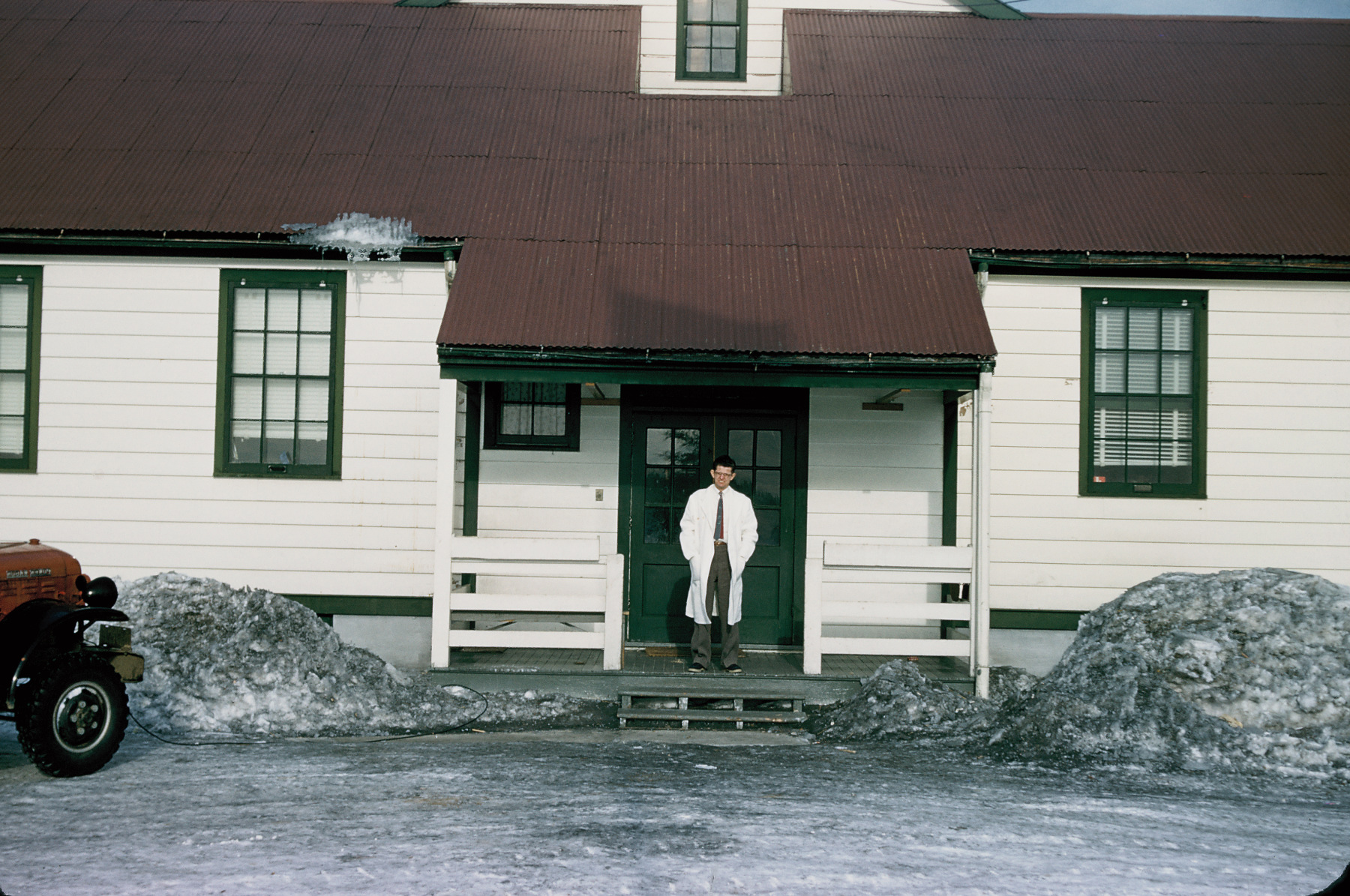
Elmer E. Gaede, M.D., Tanana Public Health Services Hospital, 1958, Tanana, Alaska

From 1957 – 1959, my father was the Medical Officer in Charge (MOC) at the Public Health Services Hospital in Tanana, Alaska. Those were two of my best childhood years. Ever since that time, Tanana has had a special place in my heart — and I return whenever possible. In 2009, the hospital was demolished. This was sad for many people, including me. I felt honored when the Indian Health Services (IHS) asked me to help compile and develop a commemorative booklet. In August 2012, three years of hard labor culminated in the Development, History, Community & Cultural Significance of the Tanana Hospital Complex. This is one of the most meaningful projects I’ve ever worked on. To read these stories, including one by my sister, Mishal  Gaede,  go  to:  http://www.prescriptionforadventure.com/docs/TananaBooklet.pdf

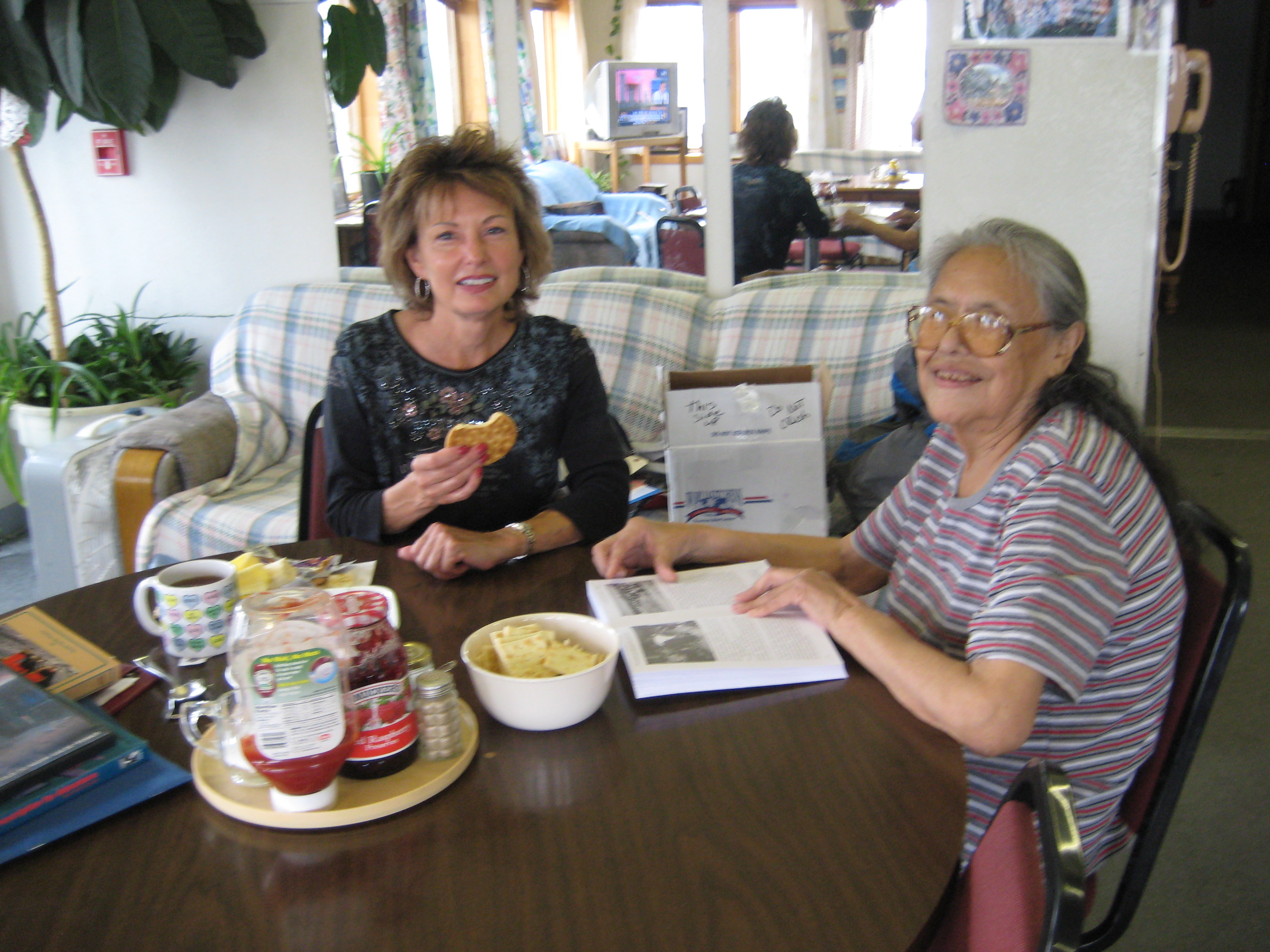
Sharing lunch, an Pilot Boy crackers, with Josephine Roberts, who had worked at the hospital, and who knew my parents. We are eating in what was the Tanana hospital nurses quarters and is now is elder housing. 2009.

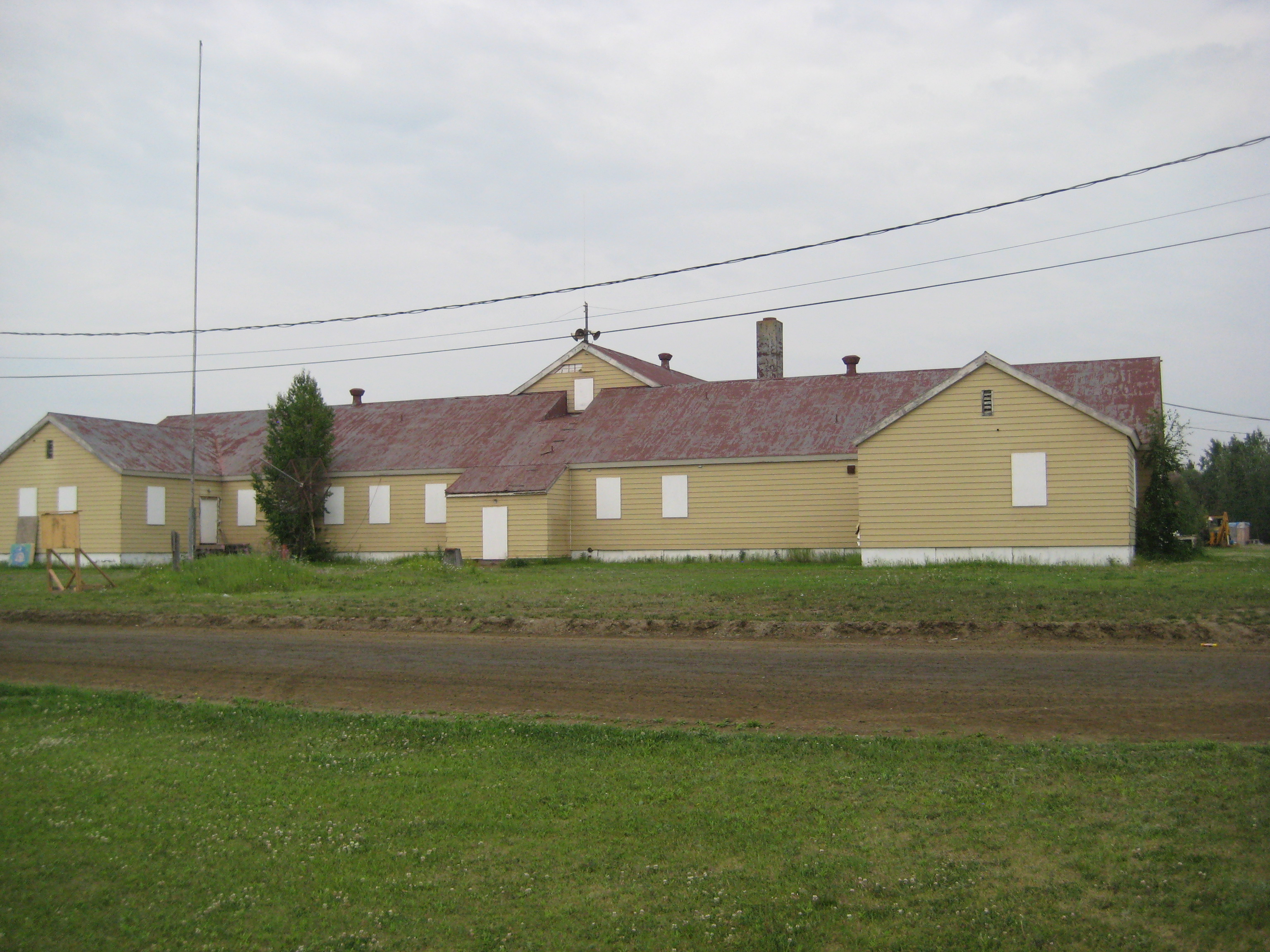
Tanana Hospital, 2009, before it was torn down.

Share this:

  • Click to share on Facebook (Opens in new window) Facebook
Like Loading...

Ninilchik: “peaceful settlement by a river”

30 Thursday Aug 2012

Posted by Naomi Gaede Penner in Uncategorized

≈ Leave a comment

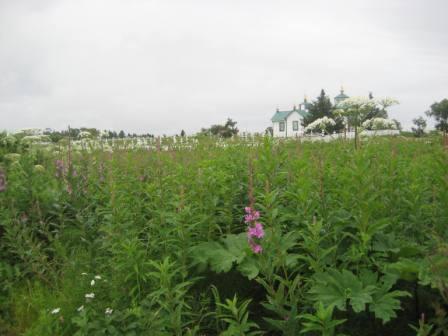
Holy Transfiguration of Our Lord Church – Ninilchik, Alaska

I never tire of making a side trip to the Ninilchik (Alaska) Russian Orthodox Church (Holy Transfiguration of Our Lord Church) on my way to Homer. What draws me to that place? Perhaps it is the idyllic setting of onion- shaped gold spheres against the sunny blue sky which canopies the Cook Inlet and distant white-topped Mt Redoubt and and Mt Iliamna in the Chigmit mountain range. Or perhaps it is a somber drippy gray day with views cut-short and focused on the nearby tall green grass and magenta fireweed; all sparkled with water-jewels. On such a day, the gray streaks in the time-worn white wooden fence pickets are vivid.

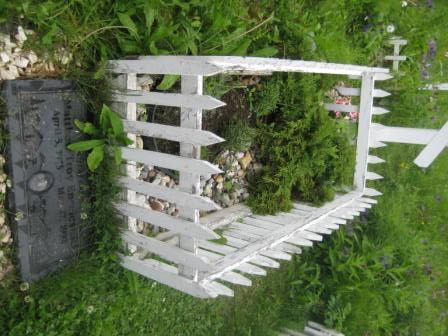
Maybe it is the mysterious-to-me personalized individual cemetery plots, some within stubby picket fences. The Items placed on the burial mounds offer a glimpse of personalities and interests: a bird book, stuffed animal, memento, or a picture. Some plots contain Thumbelina-size landscapes. I can picture loved ones on their hands and knees, slowly and deliberately arranging rocks, shells, sticks, sand, and short vegetation.

Possibly the  lure is the intriguing colony of family lots with names such as Cooper, Oskolkoff, Kvasnikoff, Jackinsky, Encelewski – all descendents of the first settlers who were indigenous Alutiq and Russian fur traders.

On the other hand, my propensity may have to do with my sixth-grade best friend, Karen Isaak, who has a son buried in the cemetery: Matthew Encelewski.  A son born in the same month and year as my own son. A son killed instantly and tragically as a teenager. Regardless if I brake to visit the grave site, I ponder this loss when I drive through Ninilchik.

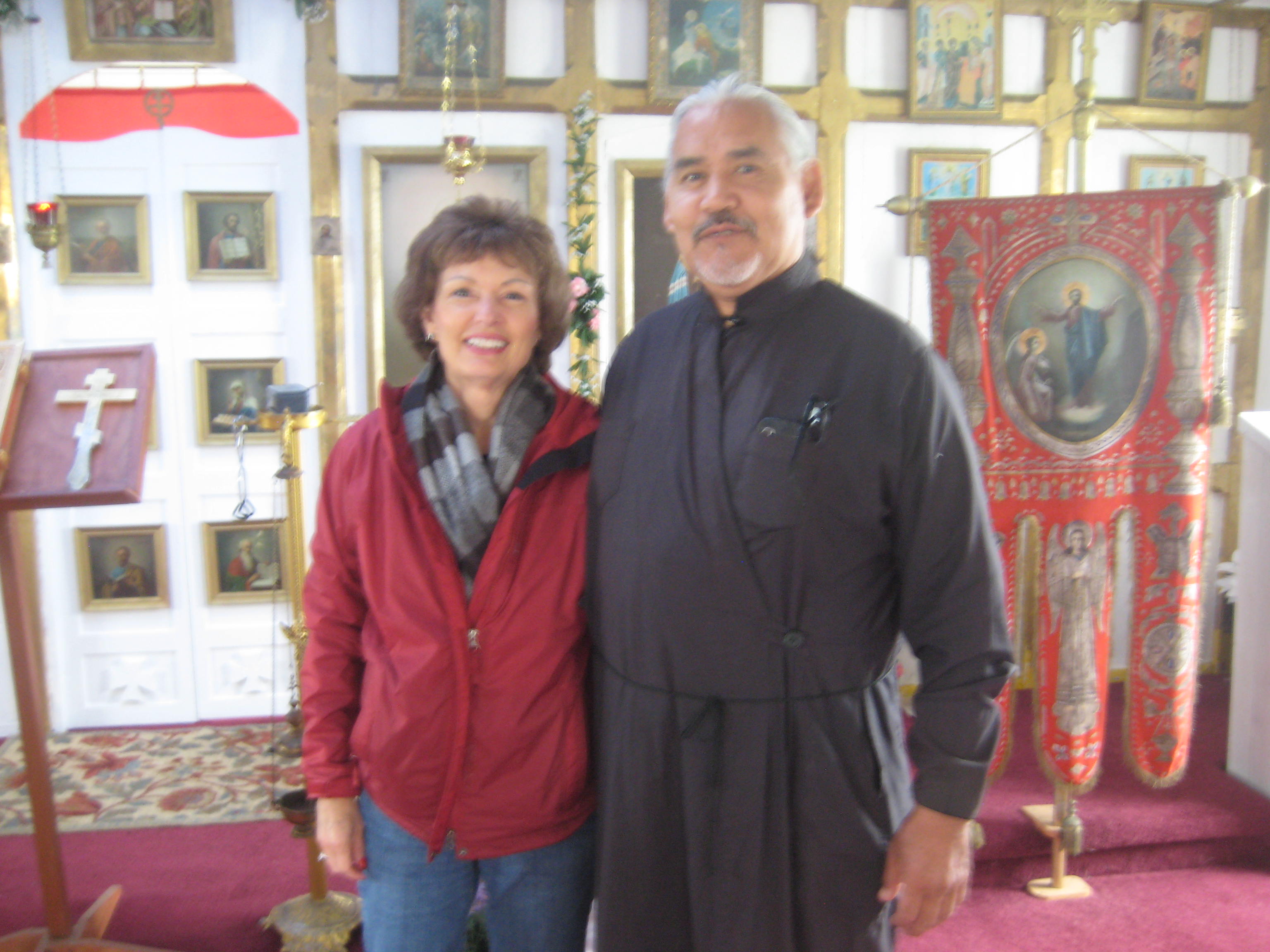
Naomi and Russian Orthodox priest

On a recent trip, I shook the moisture off my umbrella and stepped inside the small church.  A few white candles burned softly; their steady flames startled momentarily by the draft of the opened door. Icons filled the tall walls that rose unproportionally high above the small enclave. A priest sat around the corner softly reading, praying, and chanting – until I moved forward.

Then the large Native priest, with hair in a thick, gray, ponytail against his black robe stood up.  I was caught off guard by his quick questions, wrapped in a broad smile. “Do you know what “orthodox” means?” “Do you know why I’m studying for the priesthood?” “Do you know why the crosses in the cemetery have the angled piece at the bottom?

He took the rapt look on my face as an invitation to continue, and started with the cross. “The top bar represents the sign of mockery that Pilate ordered for Christ’s cross – Jesus of Nazareth, King of the Jews. The middle bar is of course on which Christ’s hands were nailed.  Finally, the slanted foot rest. Russian Orthodox tradition holds that the upper end points to heaven, where the first thief, who regretted his sin went (Today shalt though be in Paradise with me); and the lower end points to where the non-repentant thief went – separation from God.”

That was the simple, yet theologically-deep explanation of the crosses scattered throughout the cemetery.

Just then, he needed to attend other business. I went outside to wander about the crosses, the earthy dioramas, and the tangled undergrowth which makes every effort to hide any remembrance of lives lived, joys shared, hearts broken, and history made.

The Old Village of Ninilchik, which lies down by the peaceful river which flows into the Cook Inlet, is filled with history. At one time there was a walking tour map. Now, the history is awakened by walking — and question-asking of a local shop-owner or resident.  Whether new or old to the Kenai Peninsula, I’d encourage very passerby to pull off the Sterling Highway and pause for a moment of spiritual quiet – no matter the weather.

Matthew Encelewski

  • I contemplated what might be arranged on my burial mounds: a stuffed Golden Retriever, rolling pin, lingonberry (Alaskan cranberry) plants, a picture of my children and grandboy?
  • What items might be placed on your burial mound as a snapshot of your personality and interests?

ŦŦŦŦŦŦŦŦŦŦ

Thank you to Karen Isaak Encelewski and Wayne Leman for your peer critique, corrections, and input.

Share this:

  • Click to share on Facebook (Opens in new window) Facebook
Like Loading...

Adventures as a Student. Adventures as an Alaska Teacher

20 Monday Aug 2012

Posted by Naomi Gaede Penner in School Teachers

≈ 1 Comment

Big Chief wide-lined tablet. Cigar box for pencils, thick pink eraser, crayons. A new dress. A new school, with new teacher, and new classmates. Wide-eyed.

Schools used to start after Labor Day. Now they start mid-August and in some districts, there are year-around schedules. Students spent many hours in school. It’s no wonder teachers have a significant impact on their attitudes and interests. A math teacher may determine the love or hate of math. An English teacher may open unexplored frontiers through a writing assignment. A principal’s rules may keep a young person on track, or stir up rebellion in another. Here were some of my gradeschool experiences:

Miss Bortel: “Let me tell you a story!” “What if we had Pet Day?” Twinkly gray-blue eyes.  Life is an adventure.  I wanted to move into her Quonset hut with my blonde pig-tailed Betty doll. I helped her write her Alaska school teacher stories.

Miss Amundson: “You’ll never learn to tell time.” “You’ll never learn how to count cash.” “Your doll is ugly.” I have a fear of counting out change. I still have my Susie Lou Anna doll.

Miss Regan: Matching olive green sweater and circular skirt. High heels. Red wavy hair. Nice smile. Got me through tough days when I felt so alone, couldn’t see the chalkboard, and cried often in the bathroom stall.

Mr. Knight: Quiet, gentle, smiling. Eased the pain of school trauma the year before. ““Yes you can color when you finish your worksheet.” Linda and I designed and colored many “church pane” pictures.

These teachers left marks on my life. The first two are in ‘A’ is for Alaska: Teacher to the Territory. All four are in From Kansas Wheat Fields to Alaska Tundra: a Mennonite Family Finds Home.  A Reader’s Guide in the back of each book is suitable for a student book report (grades 6-12.) If you’re a teacher, for your own pleasure, read about pioneering teachers in Alaska – no exam when you finish.

~ Who was your favorite teacher? Why? ~

 (First published in the August/September 2012 issue of “The Country Register – Kansas.”)

Share this:

  • Click to share on Facebook (Opens in new window) Facebook
Like Loading...

A Tourist Mistakes Himself for a Local

14 Tuesday Aug 2012

Posted by Naomi Gaede Penner in Alaska

≈ 2 Comments


With regards to my siblings:  Mark Gaede, Mishal Gaede, and Patti Gaede, who don’t pretend to be locals. They are locals.

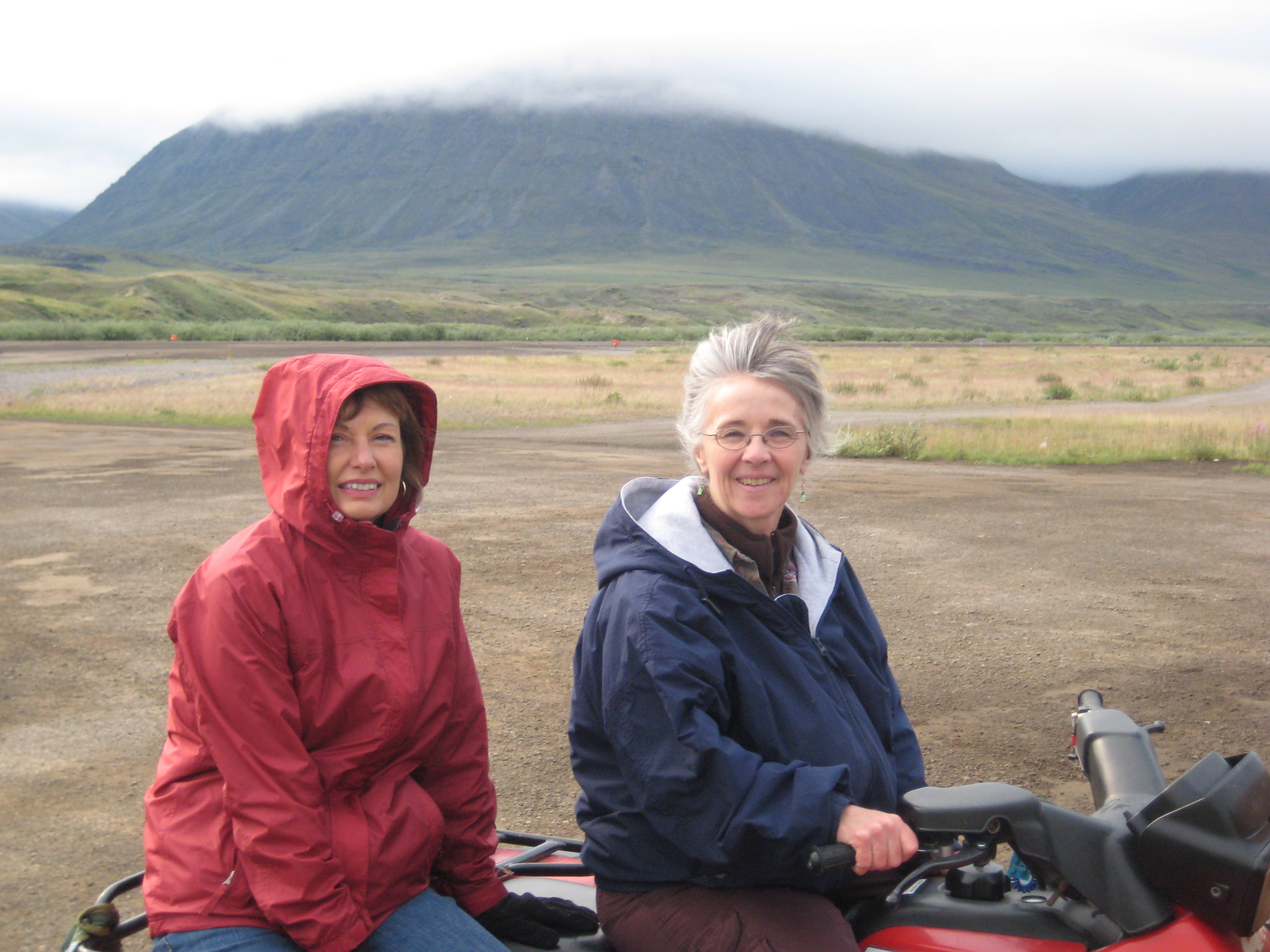
A single-prop Cessna 206 at Anaktuvuk Pass, in the Brooks Range — flown by Dwayne King, a local. (2009)

“We left Anchorage for the wilderness,” the travel writer for the Post said in so many words. He was driving to the Kenai Peninsula. The “wilderness”? This man has not been to Galena, Anaktuvuk Pass, Point Hope, Dillingham, …places I’d consider a bit more remote than the Kenai Peninsula – wherein lies my hometown of Soldotna. We don’t even consider our Gaede-80 homestead remote anymore, seeing that it is now surrounded by subdivisions.

The writer went on to say that most people live in Anchorage. I read that three times. Anchorage does have the largest population of any settlement in Alaska, but I got the impression he believed life didn’t really exist anywhere else; well, except in that wilderness of the Kenai Peninsula.

“Few of them (locals) spend much time on cruise ships, or flying over the Brooks Range in single-props. ..” Let’s stop right here. I fail to see the similarity of a cruise ship and flying in a single-prop over one of the most remote areas of Alaska.  My one time on a cruise ship was not like my several trips to Anaktuvuk Pass, located in the middle of the Brooks Range, of which one was in a Piper PA-14 Family Cruiser with a single prop..  It’s true, locals probably avoid cruise ships.  However, you may find some locals on the Alaska Marine Highway.

“But a lot settle down in the Last Frontier because of the nearby (read: ability to get there in a Subaru) wilderness….”  Amazing! Alaskans choose the Last Frontier for accessibility to the wilderness in a car?  Wrong again. The locals define wilderness as a place Subarus cannot access. The sourdoughs didn’t choose a population hub. Bush pilots don’t. Missionaries don’t. School teachers don’t. Commercial fishermen and women don’t. Biologists and seismologists don’t. And …there are indigenous people in Alaska and the Native population does not all reside in Anchorage.

His comments about Anchorage were not complementary. We all know what it means when someone chooses the word “charming” to describe “lack of with-it-ness” and not a “vortex of culture.” I sensed disgust. Again, he suggested the reader not act like a tourist, but a local, and reported jubilantly that he’d found a Japanese sushi bar.  I thought locals ate moose, caribou, smoked salmon strips, halibut, trout, ptarmigan, giant cabbage, and blueberries.

Before using the Travel section for kindling, I took a deep breath and read on. One day he “played tourist.” I read that again. He never started a chainsaw, flew in a bush plane, chopped wood, mended a fence so the moose couldn’t finish off the cauliflower, checked out a tide table for clam digging or set-netting, asked about berry picking, or bought a blue tarp, but he thought he was blending in with the locals.

His final paragraph: “Boy do the locals love their java!” What locals was he talking about? The locals I know love their tall, black rubber boots; a newly sharpened ax; airplane wing covers; fleece; rhubarb; the smell of damp moss on a drizzly day; buying bread that is only a week old; finding a matching set of about anything at the one Home Depot on the Kenai Peninsula; and early August, when the tourists stop clogging the road through town, the road to Anchorage, and Fred Meyer’s parking lot.

It would be an eye-opener for him to read any of my Prescription for Adventure books, where, yes, Alaskans actually fly in a single-prop airplane to the Brooks Range.  There is human life outside Anchorage.  Ask a local.

Here I am in Anaktuvuk Pass, in the Brooks Range, in 2009. I was also in Anaktuvuk in 1962, and 1988. I am not in or on a Suburu.

~~~~~~~~

 What does “a local” mean where you live?

If you’ve been to Alaska, what was your observation about the “locals”?

Share this:

  • Click to share on Facebook (Opens in new window) Facebook
Like Loading...

Columbia Ward Fish Cannery: 1968/2007/2012

29 Friday Jun 2012

Posted by Naomi Gaede Penner in Soldotna

≈ 1 Comment

When I was 18, my father decided I need to get a job. He had connections with everyone – including someone at the Columbia Wards fish cannery.  I wasn’t asked if I wanted to work there. Dad informed me I’d been hired.

The cannery was about four miles from our Gaede-80 homestead, down Kalifonsky Beach Road. I drove an old blue pick-up, which didn’t go very fast, and which later I discovered was not really attached to the chassis.  All the same, it got me to work.

It was common for college kids from Outside to come work for the summer, so I had peers of sorts. Japanese worked there, too, with the salmon eggs. The cannery was a 40,000-square-foot warehouse. No heat. Cold fish. Fish smell. I wore several pairs of wool socks in my tall black rubber books, a winter coat with a clear plastic apron that wrapped around most of me, and a bandana kerchief on my head.

My job was the assembly line where cans of fish traveled past me and my job was to use a kind of pliers to flip and twist any exposed skin downward or to the sides. The purpose was so the eager purchaser would open the can and find an attractive round of meat.

Working along the conveyor belt took some getting used to. It never stopped and our work was done while the cans traveled in front of us. The constant movement caused a kind of mild motion sickness.

The work was monotonous. The work was cold. We stood all day – or all night – depending on when the fish had come in. To break the boredom, someone down the line, just in front of the lid-stamper, would accidentally flip a can over. Of course, this jammed the lid-stamping machine and we’d all have to take a break while the mechanism was unclogged.

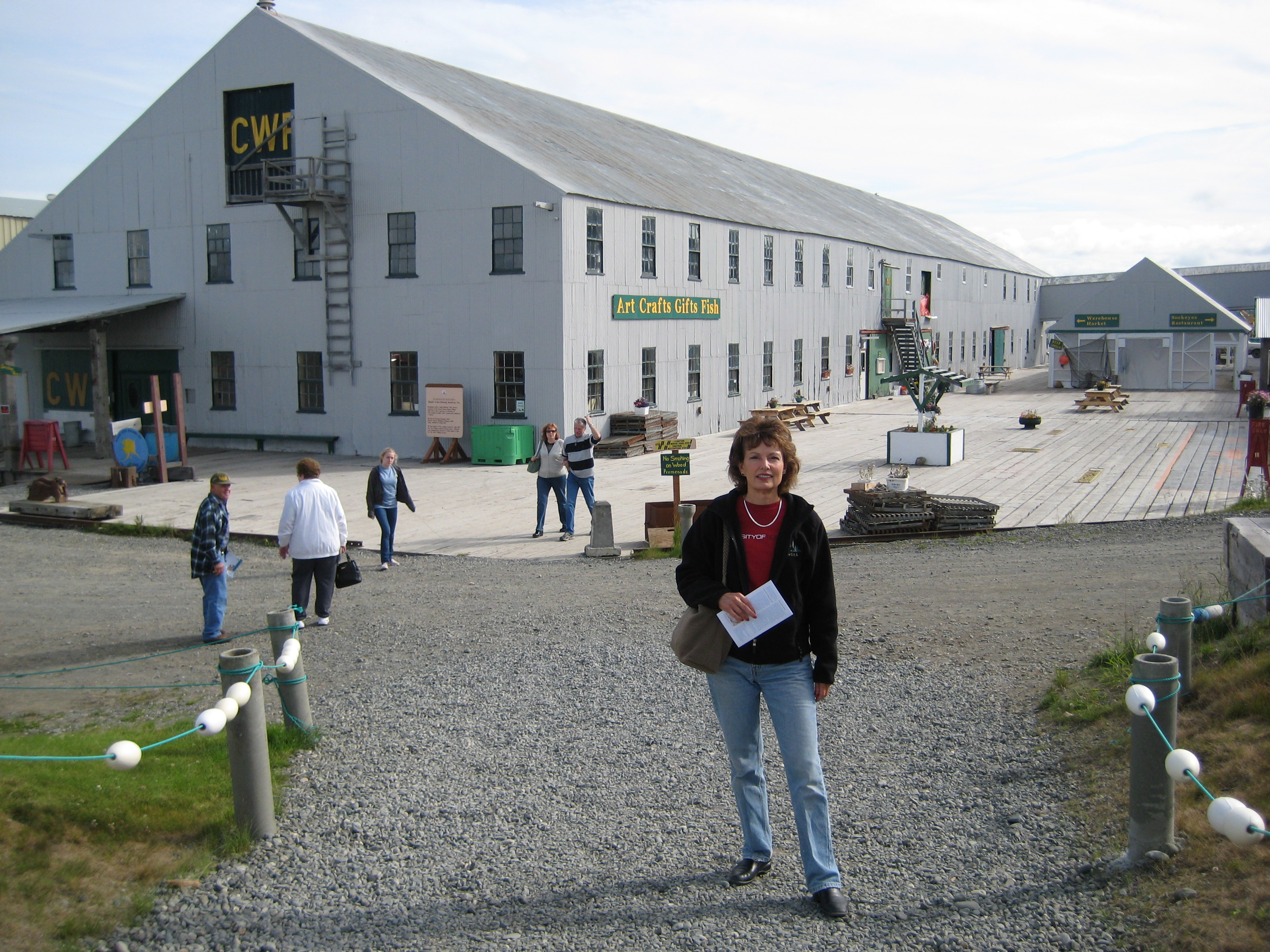
In 2007, the cannery was recognized as a historical landmark and several buildings were put back into use. All the buildings had signs designating their previous use and there was a map with walking tour available at a visitor center. What a step back in time for me! I was so excited to re-walk back into my past. It made a wonderful field trip to take guests.

Just this week I learned that the warehouse is being torn down. I was shocked. On July 13 and 14 timbers from the building will be available for purchase. I plan to be there.

Columbia Wards fish cannery

http://peninsulaclarion.com/news/2012-06-27/deconstruction-of-kenai-landing-warehouse-under-way

What did you do for summer work as a high school or college student?

Was it your idea or your parents?

What are your memories?

Share this:

  • Click to share on Facebook (Opens in new window) Facebook
Like Loading...

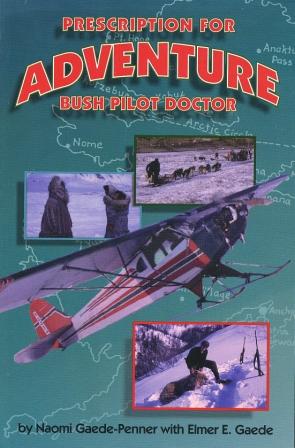
Prescription for Adventure: Bush Pilot Doctor – or – Alaska Bush Pilot Doctor?

19 Tuesday Jun 2012

Posted by Naomi Gaede Penner in My Books

≈ Leave a comment

You may have noticed that Prescription for Adventure: Bush Pilot Doctor, published in 1991, has gone through a few revisions. Even though the book keeps getting better, the various editions have caused a bit of confusion. Let me help by breaking down the differences:

Second edition Prescription for Adventure: Bush Pilot Doctor

  • original text used for the Alaska Unit Study Guide.

Third edition Prescription for Adventure: Bush Pilot Doctor

  • Cover updated
  • Four new chapters
  • Footnotes added
  • Index added
  • Suggested books and websites included

Fourth edition Alaska Bush Pilot Doctor

  • Title changed
  • Cover updated
  • Size of book changed to match other books in the series
  • Two chapters removed
  • Footnotes changed to endnotes
  • Index updated
  • Suggested books and websites updated
  • Reader’s Guide in back of book
  • Lower price than third edition

I love the new cover, the airplane page breaks, and over-all feel of the book. I think you will, too! To examine it more closely, go to http://www.prescriptionforadventure.com/bushpilotdr.html Let me know what YOU think.

If you haven’t read this book, be one of the first to purchase it. The official release date is not until September 1, 2012, but you can purchase it now from my website.


Share this:

  • Click to share on Facebook (Opens in new window) Facebook
Like Loading...

My Father, the Avid Adventurer

08 Friday Jun 2012

Posted by Naomi Gaede Penner in Holidays and Special Occasions

≈ Leave a comment

I grew up listening to my father’s supper table stories. He was a doctor; more than that, he was a bush pilot doctor in Alaska.  Never knowing when he’d be called out, these stories were told after he’d gulped down his food. Told after he’d spread yellow mustard on the reheated moose roast, or after he’d swallowed that last bite of cauliflower – fresh from Mom’s garden and smothered in thick Velveeta-cheese sauce.

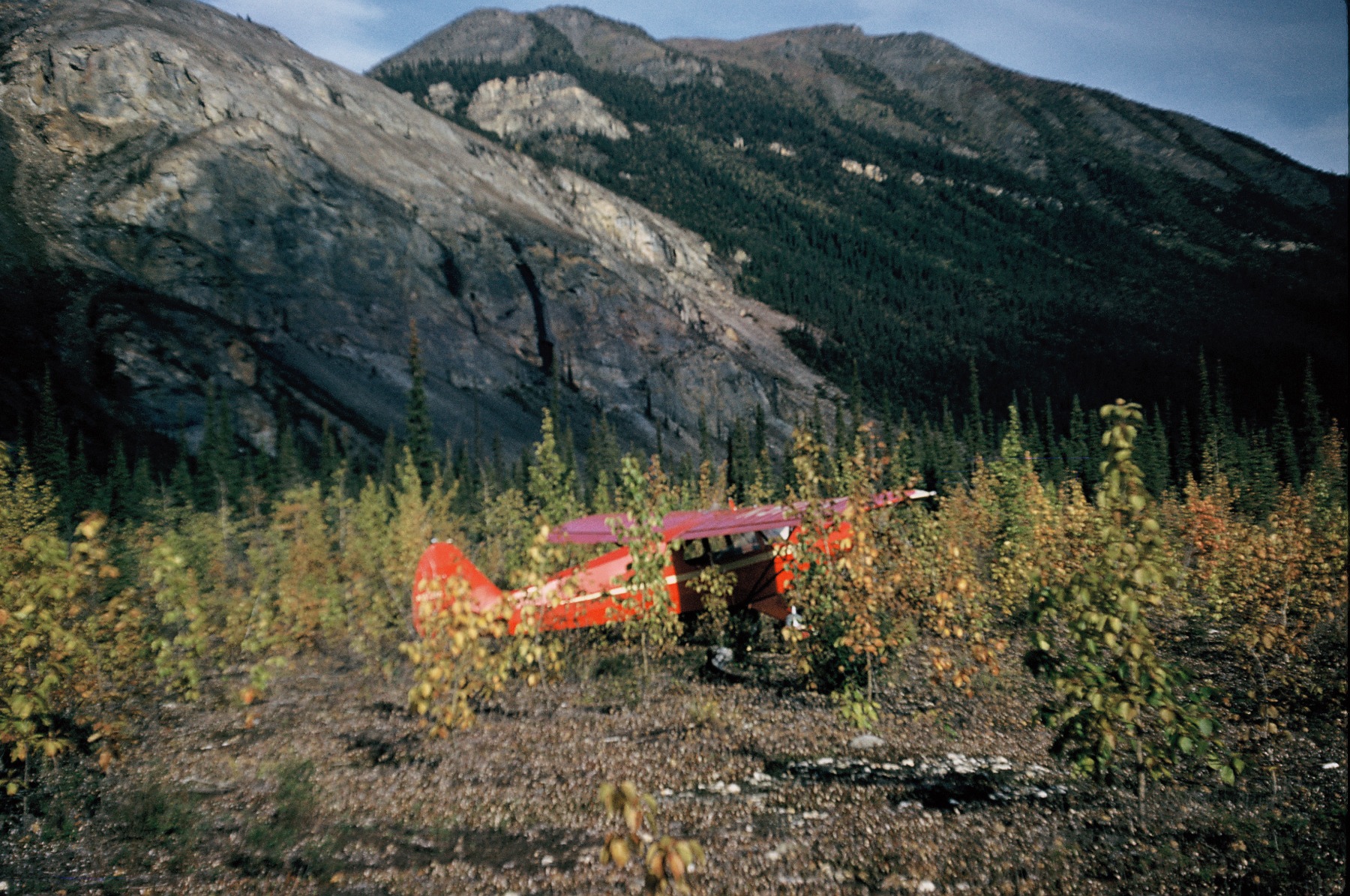
We heard about the fly-in housecall when a distressed woman tried to crawl out of his Piper PA-14 airplane and go home – when he was 2,000 feet above the Yukon River.  We listened wide-eyed when he described how the low brush on the suitable mountainside strip grew, but he’d committed to land and thrashed down among the eight feet tall saplings. The polar bear hunt on an ice flow along the Arctic coast was supported by his 8 mm movies.

A miscalculation.

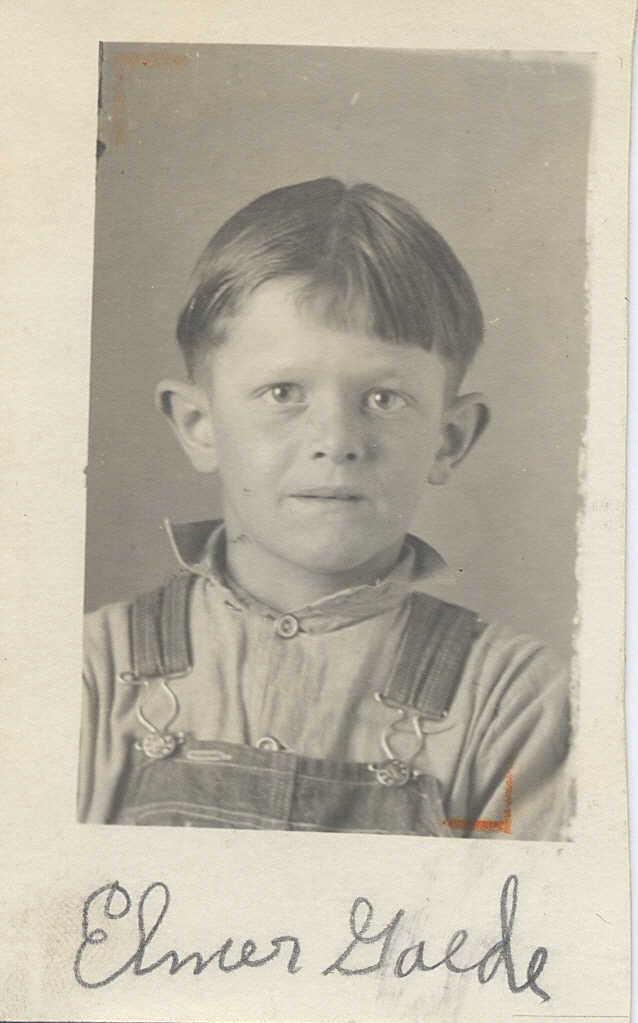
All these stories came from a Hillsboro, Kansas farm boy who had grown up shooting jackrabbits, catching catfish with his hands in a muddy creek, jolting on a metal tractor seat across crop fields in the humid-thick Kansas heat, and picking June bugs off the back porch screen door on his way in for supper.

Just a Kansas farm boy.

As a young man he wondered what lay over the horizon. He yearned for adventure.  After trading his suspendered over-alls for a graduation gown from K.U. Medical School, his eyes turned north. He found adventure in Alaska.

I learned from him to reframe amusing, annoying, simple – or terrifying – incidences into stories, rather than leaving them as coincidences, aggravations, or unwanted crisis. They weren’t hard-luck, depressing, self-pity stories, but humorous, “would you believe it?” stories; the kind told around a table-clothed Midwest table that tickled the fancy of listeners while they forked in fried chicken, mashed potatoes, and strawberry shortcake; or on a drizzly Alaska evening with halibut, cranberry nutbread, and rhubarb pie.  These mini-dramas elicited teasing, arguments about real facts, and left the listener in a good mood, or at least challenged to see life in a fresher way.

Dad and I turned his oral stories into written stories. They showed up in Alaska Flying, Fairbanks Daily News-Miner, Christian Medical Society Journal, and other publications. I thought writing a book wouldn’t be that more difficult. I was naïve. I was uninformed. I was determined. It seemed appropriate to name the book: Prescription for Adventure: Bush Pilot Doctor.  This book is now into its fourth edition as Alaska Bush Pilot Doctor.

*****

Learning doesn’t need formal instruction. It comes from following someone around, listening in the shadows, working side-by-side, and observing interpersonal interactions and personal reactions.

  1. What did you learn from your father?
  2. How did you learn it?
  3. What are people learning when they watch you?

*****

Published in the June/July issue of “The Country Register – Kansas,” a delightful publication for stitchers, crafters, and all people living in, or driving through Kansas.http://www.countryregister.com/kansas/currentissue.html

*****

Naomi Gaede-Penner is the author of the non-fiction Prescription for Adventure series:  Alaska Bush Pilot Doctor, From Kansas Wheat Fields to Alaska Tundra: a Mennonite Family Finds Home, ‘A’ is for Alaska: Teacher to the Territory, ‘A’ is for Anaktuvuk: Teacher to the Nunamiut Eskimos, and The Three Boys. To browse or order her books and to see her own adventures, visit www.prescriptionforadventure.com.  Find her on Facebook: Prescription for Adventure.

Share this:

  • Click to share on Facebook (Opens in new window) Facebook
Like Loading...

Galena, Alaska – IV

05 Tuesday Jun 2012

Posted by Naomi Gaede Penner in Alaska - Galena

≈ 1 Comment

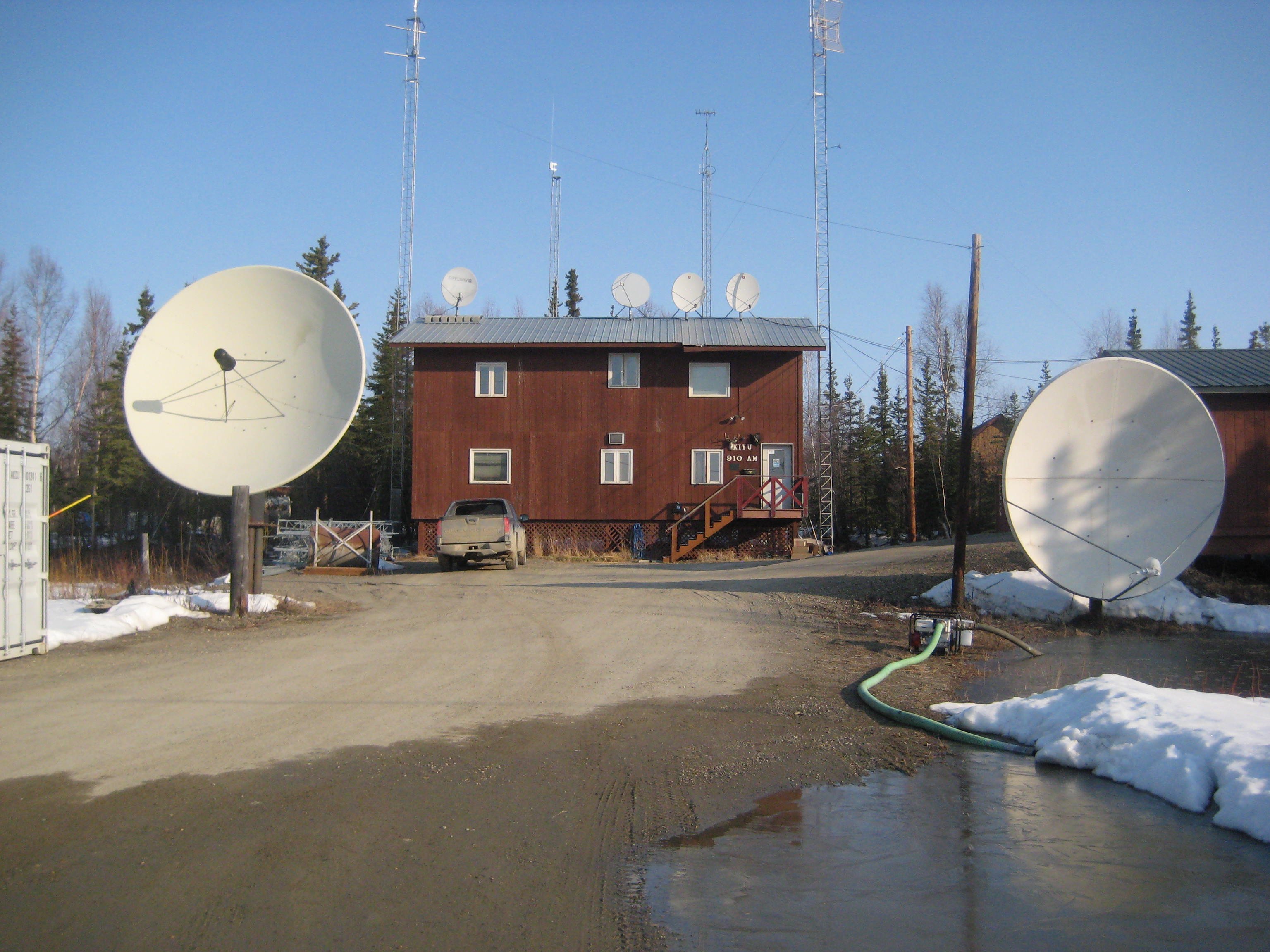
The mud was still frozen when I walked to KIYO Galena radio station at 9:15 a.m. on April 25, 2012. Frosted-stiff grass poked through the icy puddles-turned-lakes. Jeremy wanted to interview me. Jeremy was a newcomer disc jockey from Washington, not the state, but D.C. How he’d found his way here was a mystery; furthermore, how he’d acculturated to this village without Starbucks, light rail transit, horns honking, bright city lights, and a sea of suits and ties was beyond me. To me, everyone is a story. I interviewed him first. The interview with me was a fun conversation. I appreciated the opportunity.

Guest teaching was up next. I arrived at an aviation class with a power point of plane crashes – mostly my dad’s – and excerpts from Alaska Bush Pilot Doctor about flying situations: bobber gas gauge, wobble pump, broken ski cable, and so on. I wished my brother Mark was there. He’d actually know about all this aviation stuff; I just collect pictures, stories, and facts —and write about them.

The journalism students interviewed me for the school paper, “The Hawk.” They asked good questions, such as “What do you hope to accomplish while you’re here?”  Uh……have an adventure? Nope. Better answer: to find out about Galena Interior Learning Academy.  “Do you mind telling us how old you are?” Yes.

The day raced on. Language Arts class kept me hopping with Five Senses Writing, journalism WWWWH applications, and Personification.  Two girls joined me in the cafeteria. I wasn’t going to starve for conversation or food in this village. The Fox (missionary) family invited me to share supper with them in their home. It was my pleasure. I’d brought gifts for their girls – little Naomi and Ruthie. Names just like my sister and me.

Genny hadn’t missed a beat. With only a weeks’ notice, not only had she organized my shuttle services and lunches stops, but she’d put together a Meet and Greet at the library.

When I opened the library door, there was a man standing with his back to me. He could have been any man; any man in blue jeans and a baseball cap, but he wasn’t. He had graying red curls edging beneath his cap. Could it be? I walked slowly around him. His big smile and twinkling brown eyes confirmed it. Chris Sommers! He’d been the cutest little Athabascan Indian boy in my Tanana Day School class. Tanana, a village upriver from Galena, had supplied me with plenty of life-long memories, and he wasn’t the only classmate I’d heard about over the decades.

My sister, Mishal, works for Tanana Chiefs in Fairbanks, and flies up and down the Yukon River and keeps track of people’s where-abouts. She thought Chris lived in Galena, and was even the chief of the village.

I’d bumped into one of his younger sisters when I was in Tanana in 2009.

I certainly surprised her when I saw her walking down Front Street and called out, “Are you a Sommers”?

“How do you know?”

“There aren’t that many red-haired Natives up and down the river; and, in Tanana, back in ……….the only red-heads were from the Sommers’ family.”

“Yeah.”

Well, that started a conversation and she, two men, and I sat down on a backless wood bench facing the Yukon and talked about that year’s river breakup that had flooded Tanana.

Then there was their sister Marie. In my estimation, she’d been the prettiest girl in the Tanana Day School; prettiest of all in grades 1-8. Her smile can be seen on the cover photo of ‘A’ is for Alaska: Teacher to the Territory. (First girl on the left.)

I wished I could have talked to Chris longer. Didn’t he have three girls? Didn’t they all graduate from college? Colorado? Ah…..success stories I would have liked to have heard.

My time in Galena ran out. The memories won’t. I’m already thinking about next year’s jumping off trip from Fairbanks. Hmmmm…..Tanana?  Again? I hear the school teacher graduated from the school there and went back to teach. Why? What drew him back? I’m sure there’s a story.

Share this:

  • Click to share on Facebook (Opens in new window) Facebook
Like Loading...

Tarzan and Jane in Alaska

30 Wednesday May 2012

Posted by Naomi Gaede Penner in Adventures, Outdoor Action

≈ 1 Comment

How did my father know there was a zipline in the wilderness of Tanana, Alaska? Who had revealed the secret? Was it a hidden treasure from the Fort Gibbons’ era of 1899 to 1923? How had it remained when the wilderness had stealthily taken back reminders of the 1,000 people who had lived at the military outpost along the Yukon River? Potato and hay fields, telegraph poles and a lookout tower, were long gone

by 1957, when my father accepted the position of Medical Officer in Charge at the Public Health Services hospital for the 300 people in the village.

I followed him into the thick woods that smelled of spruce and damp earth. “Watch me,” he said.

He threw off his red wool jacket, pulled himself up the tree-post, and pushed off a narrow wooden ledge. My eyes grew wide. A second later he was standing on the ground.

“I want to do that!” I said.

He grinned, loped back in his characteristic half-walk half-run, and boosted me up to a crooked slat nailed onto the tree. I reached for the next slat until I was up to the take-off ledge. My small hands clasped the bar that connected to a long cable…….and pushed off. Air whooshed through my short hair and adrenalin pounded in my veins. My feet hit the soft mossy tundra and I ran with the force of impact – until the bar stopped at a level spot in the cable line.

I laughed. “I want to do it again, Daddy!”

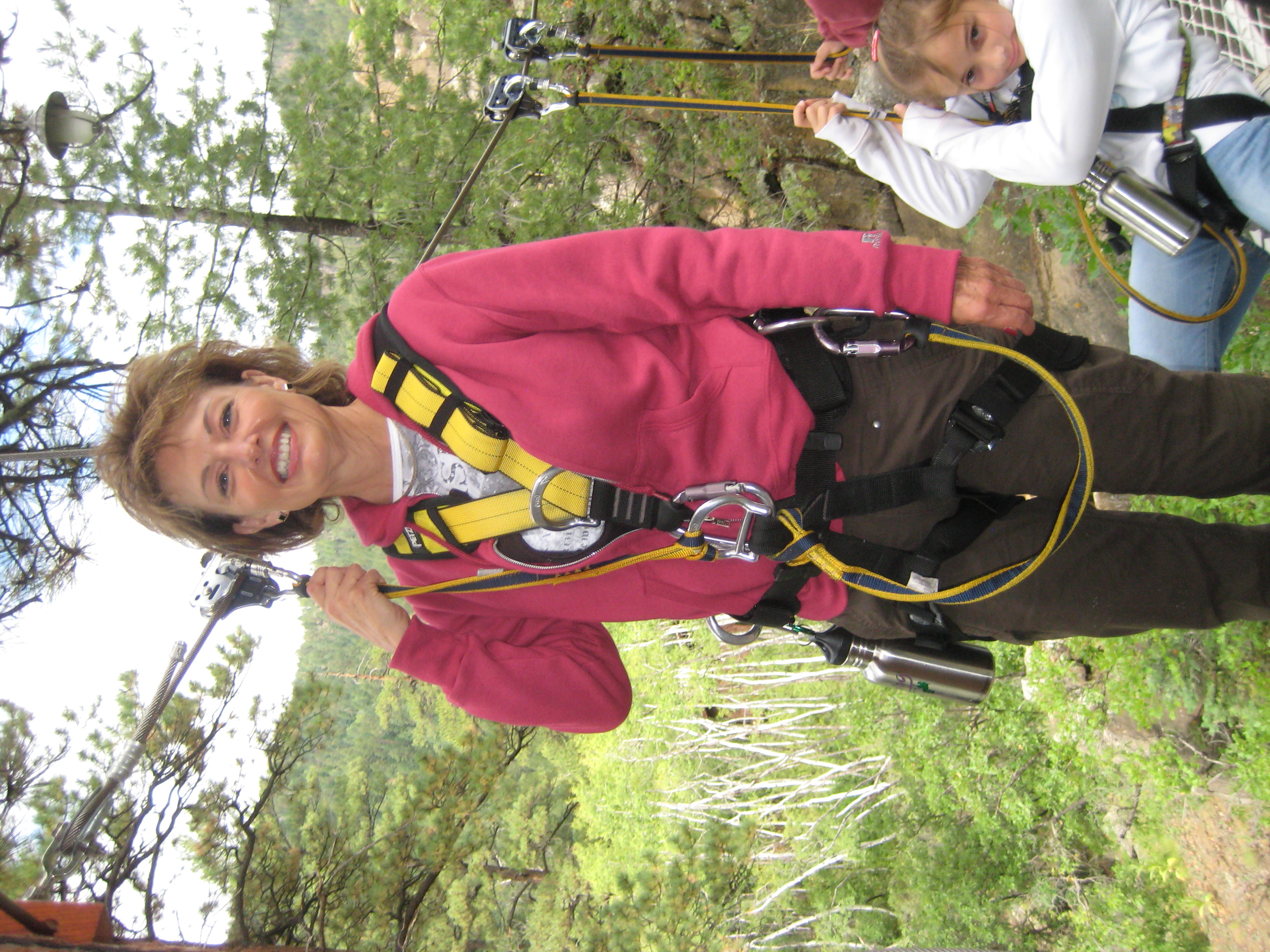
In 2009, I boarded the train at Durango. Halfway to Silverton, CO is Soaring Tree Top Adventures. The staff outfitted our group with harnesses. A strap with snap-clip hung off the middle, ready for action. Then, I stood in line and listened to the safety and environmental lectures. Before I knew it, the real action had started at the front of the group. When my turn came, the sky-ranger attached the snap-clip to the heavy cable that led to the next platform. Off I went! Wind whooshed through my hair and adrenaline pounded in my veins. Over and over I climbed to the next platform, pushed off, and soared between trees and over the river. Twenty-four zip spans later, the pounding hadn’t stopped.

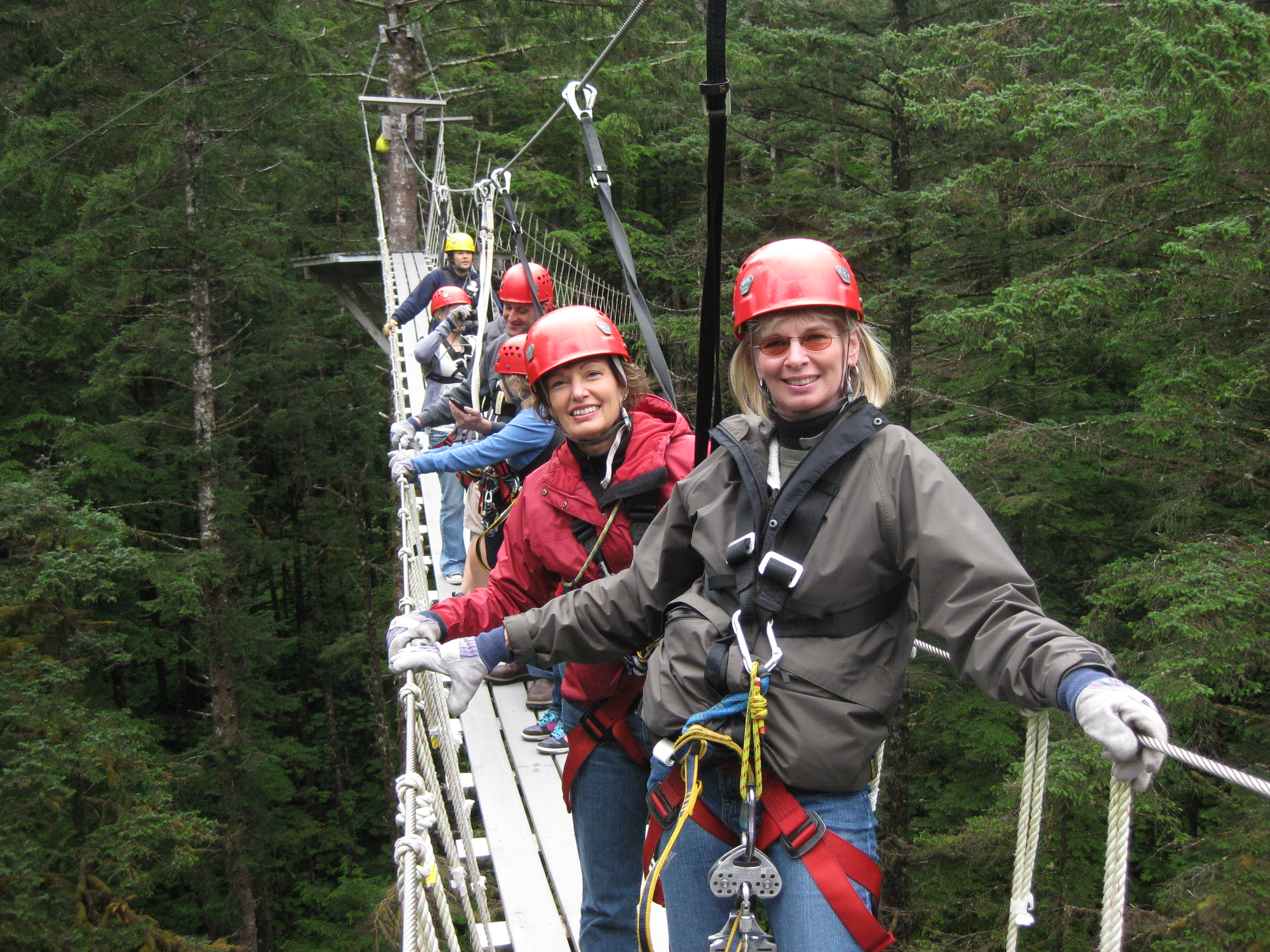
In 2010, I caught the Alaska Marine Highway from Whittier to Juneau, AK. A short boat ride took me across Gastineau Channel to the site of the old Treadwell Mine on Douglas Island. A jolting army truck hauled our small group up the hill to the base camp of Alaska Canopy Adventures. I put on a helmet and gloves – and hiked a rain forest trail between moss-covered trees, moss-covered old mining equipment, and moss-covered everything. I climbed a platform for a short practice run. Then it was time to soar. Air whooshed through my hair and adrenalin pounded in my veins. After 10 spans and two aerial suspension bridges, I turned to my sister and said, “I want to do it again!” Dad would have said the same.

More than 120 ziplines exist in the 50 United States. They vary from fast and furious high-speed adventures to scenic canopy tours. In Alaska, ziplines are the number one growing segment of tourism. Icy Strait Point zipline in Hoonah, AK boasts the wildest ride with a length of 5,330 feet, 1,300 foot vertical drop, 60 mph speeds – in 1.5 minutes. Six people strapped to seats launch at once. That’s more whooshing and adrenaline than I want!   http://www.icystraitpoint.com/

But, I’m looking for something in Colorado this summer.

What would you recommend?

Where have you been?

Where was your wildest ride – or most enjoyable soaring tour?


  • Soaring Tree Top Adventures – Colorado

http://www.soaringcolorado.com/

Alaska Canopy Adventures

http://www.alaskacanopy.com/


Share this:

  • Click to share on Facebook (Opens in new window) Facebook
Like Loading...

Adventures in Galena, Alaska – 3

19 Saturday May 2012

Posted by Naomi Gaede Penner in Alaska - Galena

≈ 1 Comment

Yes, those were baby chicks. Six of the tiniest, fuzziest little things. Three were shades of yellow and three had contrasting black splotches. Kim’s husband had purchased them in Fairbanks and the little cheepers had made their big flight the day before.

“Will they lay eggs?” I asked.

“Yes. Other people here have them.”

“Will they stay outside in the winter?”

“Yes – with a heat lamp. And, they’ll lay eggs even when it’s 50 below.”

I love chickens. They remind me of my Grandma Leppke’s Kansas farm where I followed her around when she fed chickens and gathered eggs. Sometimes I bravely snatched an egg beneath a full-grown flapping chicken.

I love chickens. They remind me of when we lived in Browning, Montana and my mother bought each of us four kids an Easter chick, painted in Easter colors, and they lived in a box in the kitchen. We didn’t love them as much when their fuzziness disappeared and prickly feathers emerged. One Sunday, Mom gathered up the chickens and stuck them in our VW van. They weren’t going to Sunday School. They were being dropped off at an Indian family’s home, on the way to our country church. From the looks on the parent’s faces, they would love having the grown-up chickens.

Later that evening, I met with six boarding school girls. Oftentimes people in the Lower 48 think all Alaska Natives are Eskimos. In reality, there are seven primary groups, of which two Eskimo groups, Athabascan Indian, and Aleuts form the majority. These girls were from around the state, and although with different heritages, they shared the commonality of isolated living environments in the villages they’d come from – not that I didn’t think Galena was isolated.

I was to interact as an author – whatever that means. I wanted to connect specifically with Galena so, I read the story “Breakup Takeoff” from Alaska Bush Pilot Doctor. The hero is Don Stickman. Don was an Athabascan Indian pilot from Nulato, a village a short distance downriver from Galena. I’d read through the phone book at the B&B and saw the name Stickman listed. Someone from his family lived in this village. I also chose it because it had to do with the Yukon River breakup — which had not yet occurred by Galena—but was anticipated.

After reading the story, we went on a Five Senses Walk. Five Senses Writing makes a story come alive and helps the reader feel as though she or he is right there – with the characters.

We paid attention to the road surface beneath our feet. Muddy? Smooth? Gravel-bumpy? Sloshy? We put our noses into the air, like a dog sniffing a scent. We smelled car exhaust, tundra awakening from the winter, and the aroma of woodstove smoke. We grabbed a handful of springtime snow, snow that had melted and frozen repeatedly. No longer was it flakey. Nor did it melt instantly in the warmth of our hands. It was grainy – like sand. Closing our eyes helped us focus on our senses. Walking with our eyes closed brought our attention to the warmth and chill of the evening sunshine filtering through the birch trees as we passed between the shadows and the open spaces.

This subdued and reflective focus lasted only so long. The invigorating air combined with long evening shadows compelled the girls to dash about and play shadow tag with one another. Giggles and shouts filled the air.

We hadn’t tasted the snow or mud or old leaves. But when we arrived back at the meeting house, we sipped hot chocolate. Our sensory experience was complete.

“What is the most comforting smell to you?” I asked.

“Wood smoke,” replied one girl quickly.

The short list was added to. Every smell mentioned had to do with the outdoors. These were true Alaskan girls. They resonated with the outdoors — no matter the frigid temperatures or lack of sunlight. It wasn’t the sense of warmth or sight. It was the life of the outdoors.

Wood smoke evokes memories in me of Mom’s propensity for wiener roasts — on a Yukon River shoreline, a Cook Inlet beach, or over a homestead burn barrel. I flashback to brush piles on the Gaede-80 homestead when my parents turned a wilderness into a home. I can still hear the clang of the woodstove door when Mom started the morning fire, while I remained buried beneath my flannel sheets.

Snow. Fresh air. The Big Dipper in a clear sky. Hot dog roasts. Mossy tundra. Even though one of the girls confided that she really was a city girl, she’ll always find her roots, her center, and her rejuvenation in the uncontained outdoor spaces. That’s just the way it is. That’s why I’ll never be a city girl – even if there are urban chickens.


Share this:

  • Click to share on Facebook (Opens in new window) Facebook
Like Loading...
← Older posts
Newer posts →

Enter your email address to follow this blog and receive notifications of new posts by email.

Prescription for Adventure Website:

Prescription for Adventure on Facebook:

Prescription for Adventure on Facebook:

Recent Posts

  • Garden Tales
  • Dr. Elmer and Ruby’s Missionary Trip to Russian Mission, Alaska
  • A Chilly Bucket List
  • The Suntanned Farm Girl
  • Wilderness Wife

My Books

Archives

  • April 2023
  • March 2023
  • July 2022
  • December 2021
  • May 2021
  • October 2020
  • August 2020
  • May 2020
  • July 2019
  • June 2019
  • March 2019
  • January 2019
  • December 2018
  • November 2018
  • March 2018
  • August 2016
  • July 2016
  • June 2016
  • May 2016
  • April 2016
  • March 2016
  • December 2015
  • September 2015
  • August 2015
  • July 2015
  • March 2015
  • January 2015
  • October 2014
  • August 2014
  • June 2014
  • May 2014
  • March 2014
  • February 2014
  • January 2014
  • December 2013
  • August 2013
  • July 2013
  • June 2013
  • April 2013
  • March 2013
  • February 2013
  • January 2013
  • December 2012
  • October 2012
  • September 2012
  • August 2012
  • June 2012
  • May 2012
  • April 2012

Categories

  • Adventures
  • Alaska
  • Alaska – Galena
  • Alaska – Tanana
  • Alaska Earthquake
  • Anna Bortel Church
  • Book Reviews
  • Caring and Compassion
  • Everyday life
  • Gaede-80 Homestead
  • Holidays and Special Occasions
  • Inspiring Adventures
  • Kansas
  • Mark
  • Mark Gaede
  • My Books
  • Outdoor Action
  • Personal Growth
  • School Teachers
  • Sibling Relationships
  • Soldotna
  • Telling Our Stories
  • The Bush Doctor's Wife
  • Uncategorized
  • Womens' Safety and Protection
  • Writing Workshops

Blog at WordPress.com.

Privacy & Cookies: This site uses cookies. By continuing to use this website, you agree to their use.
To find out more, including how to control cookies, see here: Cookie Policy
  • Subscribe Subscribed
    • Prescription for Adventure
    • Join 25 other subscribers
    • Already have a WordPress.com account? Log in now.
    • Prescription for Adventure
    • Subscribe Subscribed
    • Sign up
    • Log in
    • Report this content
    • View site in Reader
    • Manage subscriptions
    • Collapse this bar
 

Loading Comments...
 

    %d