• About

Prescription for Adventure

~ by Naomi Gaede Penner

Prescription for Adventure

Category Archives: Uncategorized

Bah Humbug: Christmas Letters

14 Monday Dec 2015

Posted by Naomi Gaede Penner in Alaska - Tanana, Holidays and Special Occasions, Uncategorized

≈ Leave a comment

naomi80-R2-E112

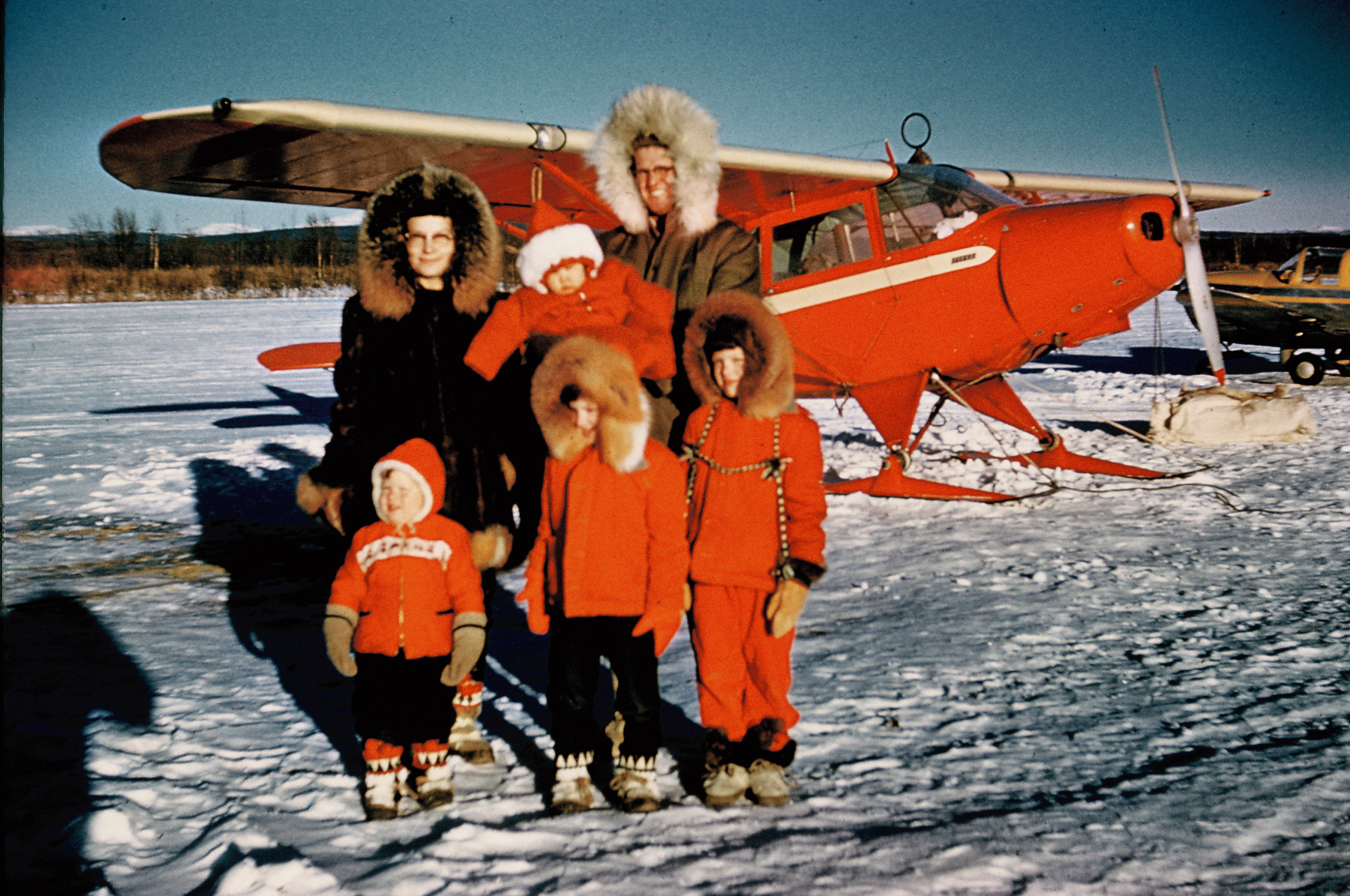
Our Christmas picture with our Christmas letter

“Jennifer was promoted to CEO…Jim’s latest iPhone app swept the nation… after we sailed on our yacht for three months in the Caribbean, we took our private jet … had to return because, Jayden, age 14, was enrolling at Yale… Mia, is at the top….

 “I was sick most of January, and then in February, I had a cough I couldn’t get rid of. As if that wasn’t enough, I got pink eye, and then a hang nail wouldn’t heal, …I got the flu – and the bathroom was never the same…”

Although Christmas Letters are not as common now as years ago, the mention of Christmas letters makes some people roll their eyes. Indeed Christmas Letters get a bad rap. Today, people typically send e-cards with snowflakes that appear at the click of a snowman, or Shutterfly and Costco cards with photos and a brief sentiment.

My son and his wife send calendars with photos on each monthly page – a story of their year that brings smiles to eager recipients.

Dave and Judi create a one-page collage of around-the-year photos. Family warmth and laughter wafts off the page.

Myra, succinctly describes her family’s year with a half-page of word pictures: Kansas Reflections – 2008: Small town festivals…Chiggers…Wheat fields in every direction…Pond with canoe rides, croaking frogs and wandering turtles…Wimpy garden..,Laughing grandchildren. I anticipate receiving her mini-stories and always wish for more.

The first Christmas Letter I have of my mother’s is from 1958, when my parents, Elmer and Ruby Gaede, served under Public Health Services in Tanana, Alaska. The typed and carbon-copied letter has a section for each month, and was sent to family members in Kansas, Oklahoma, and California.

ps_2011_06_01___12_04_49

JANUARY

“The first week in January, Ruby’s face and hands healed from burns received from an oven explosion. Mark had monkey-ed with the oven knob, it was his way of celebrating is second birthday.

Elmer went on a caribou hunt with the village chief using our plane. They returned with one caribou.

Our coldest temperature thus far was 52 below.

One day, just after take-off Elmer noticed one plane ski was hanging straight down. We all expected a crash on landing but God intervened and upon stalling the plane on landing the disabled ski came up so he landed safely.”

I followed suit, designing my own Christmas Letters. Like a time capsule, I am reminded that that year my husband completed his master’s degree in civil engineering and went to work for Penner Construction. I graduated with a teaching degree. Our Peke-a-poo that looked liked a Golden Retriever, turned two. We moved into our first house. We had our first child.

Decades later, I have a history of our family, not an in-depth memoir, but certainly the primary experiences we’ve shared, along with documented memories.

My eyes light up, not roll when Christmas Letters start to arrive in my street-side mailbox.

I am inspired when I read about someone –

  • leading a Bible Study in a women’s prison.
  • helping with a meat-canning relief project.
  • using his or her experience and skills to rebuild after a flood or tornado disaster.
  • volunteering in an inner-city thrift shop.
  • keeping the faith in the midst of loss, fear, and the unknown.

I am motivated to explore new places when someone describes –

  • a good-deal off-season trip to Iceland.
  • hiking in Death Valley during the winter months.
  • taking a train through the Canadian Rockies in autumn.

When I write Christmas letters, I reflect on the past year.

  • What am I grateful for?
  • What attitude or behavior do I need to change for the coming year?
  • Can I find humor in situations I took too seriously?
  • Is there something in my life that might inspire or comfort someone else?

When I spy a Christmas Letter in my stack of mail. I make myself a cup of tea, turn on the fireplace, and anticipate a visit with a friend. I’m not disgusted when the only time I hear from someone is at Christmas; I’m thrilled by decades of Christmas Letter connectivity.

My mother’s last Christmas letter closed with a handwritten note: Lovingly, Ruby G. unless God does a miracle-healing, this will be my last Christmas letter.

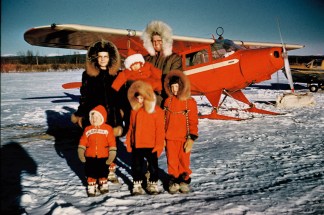
The Christmas photo that accompanied my mother’s 1958 Christmas letter became the cover for my second book, “From Kansas Wheat Fields to Alaska Tundra: a Mennonite Family Finds Home.”
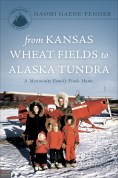
KS Wheat Fields-AK Tundra Book Cover

The Christmas Letters of Past, Present, and Future have added up in good ways – both sent and received.

This article was first printed in “The Country Register” (Kansas), Dec 2015/ Jan 2016 issue.)

Find and purchase  Prescription for Adventure books, at www.prescriptionforadventure.com or by calling 303.506.6181.  Follow  Prescription for Adventure Facebook.


Share this:

  • Share on Facebook (Opens in new window) Facebook
Like Loading...

Mom’s Moose – Immigrates from California to Alaska

07 Friday Aug 2015

Posted by Naomi Gaede Penner in Uncategorized

≈ 1 Comment

A number of years ago, I wanted to send Dad’s polar bear back home – to the family homestead in Alaska. Dad had shot the bear in 1958 when we were living in Tanana, Alaska, where he was a physician at the Alaska Native Service Public Health Hospital. He’d gone to Point Hope with an Inupiat Eskimo employee and guide. After Dad died, the bear had come to live with me – in Colorado.

I thought I could just have the bearskin hitchhike on one of my brother’s driving trips back north. At the last minute, I’d checked with the Canadian border crossing. They didn’t care if it was driven through Canada – as long as it didn’t remain in Canada. The United States customs was much stickier. They immediately hyperventilated because it is illegal to shoot polar bears – now. They demanded proof of when it was shot, where, and by whom. I replied that I could send them my book, “Alaska Bush Pilot Doctor.” They required extensive paperwork – which would take six months to approve – if it was approved. I gave up. The polar continues to live with me.

Having this drama as a historical backdrop to relocating animals, dead ones, from the Lower 48 back to Alaska, I was concerned about relocating Mom’s Moose head, which over the years had wandered from Alaska to Kansas to California.

Mom's Moose

Mom’s Moose

I mentioned this to my California cousin, Don Gaede, because Mom’s Moose was presently at his mom’s house. He happened to mention it to our relative, Jim Gaede. Jim Gaede suggested the Doerksen fruit truck that goes to Alaska every summer. Don relayed the suggestion back to me. I contacted Matthew Doerksen, Ben Doerksen’s son, in Alaska. He thought the predicament of traveling across the borders with a moose head was amusing – and actually a non-issue. He said to contact his Uncle Dan Doerksen.

I emailed Dan and Wanda Doerksen. “This will work,” they said. (Nothing like Mennonite connections.)

Who are the Doerksens and what is “the fruit truck”?

“Over 30 years ago, my brother Ben lived in Alaska and got hungry for some fresh California fruit. We sent him a box of peaches. His friends and neighbors found out about the fruit and wanted some too.

Ben's Logo

Ben’s Logo

That’s how Tree Things was born. We now deliver to 9 various locations throughout Alaska in a 4-day period, five times each summer. We sell fruit only in Alaska. We do not have a nation-wide business. You indeed are special to us.”

www.treethings.net

After several years of sending a few boxes of peaches to Ben and his friends, Dan and Wanda were taking 50 boxes of peaches to the San Francisco airport and putting them in a container heading to Anchorage, Alaska.  Before long, Ben’s business had expanded to several towns. In 1982, he died unexpectedly. Dan and Wanda continued the business, but with driving an 18-wheeler up the Alaska-Canada (Alcan) Highway five times over the summer, with driving times of four to five days.

That’s a brief history of the Doerksen fruit truck.

Here’s more of the current history-making story

May 6, 2015, Wanda:

Dan is finally really looking at the size of your moose. It is not so much the weight but the size it takes: W-57 inches, L-65 inches, H-51inches. It is the equivalent of 1 ½ pallets.

May 25, 2015, Don:

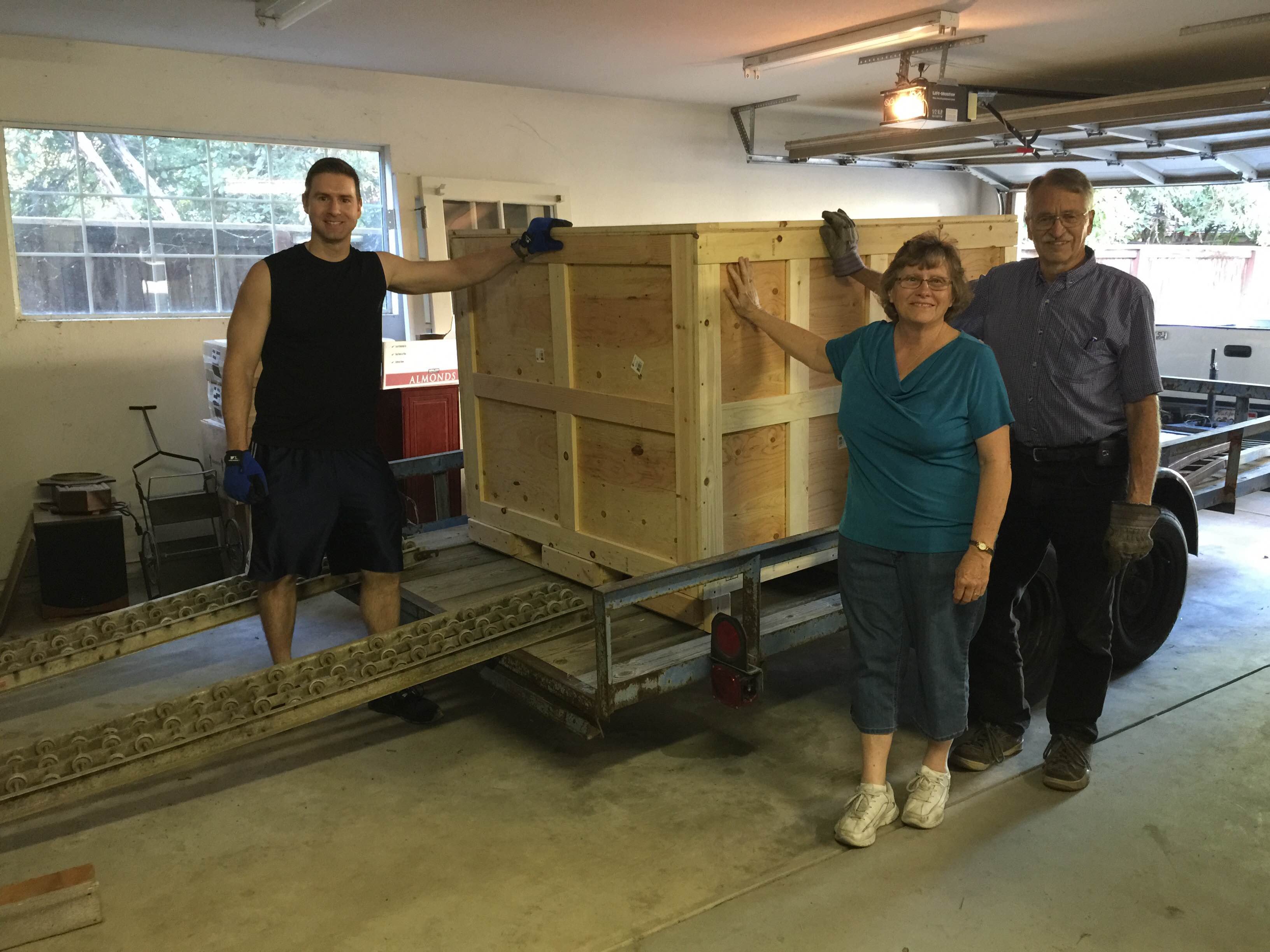
Great news, Dan came here this afternoon with his trailer, and with the help of Justin, we got the moose crate up on the trailer.

The Moose delivered to Dan and Wanda

The Moose delivered to Dan and Wanda

June 3, 2015, Wanda:

(morning)

Dan loaded the box with the forklift into the truck and off they went. He was heading to Kingsburg to get berries and somewhere else for peaches. I heard the moose sigh with relief to make the long trip home. 🙂

(late morning)

Dan goofed. He discovered he did not have enough space to take the moose. He drove back to Reedley and brought the moose to the truck yard. He is shocked for miscalculating but we figured the moose was dead and would not mind a little more warm rest. He will leave Wed June 24 and arrive in Anchorage Monday June 29.

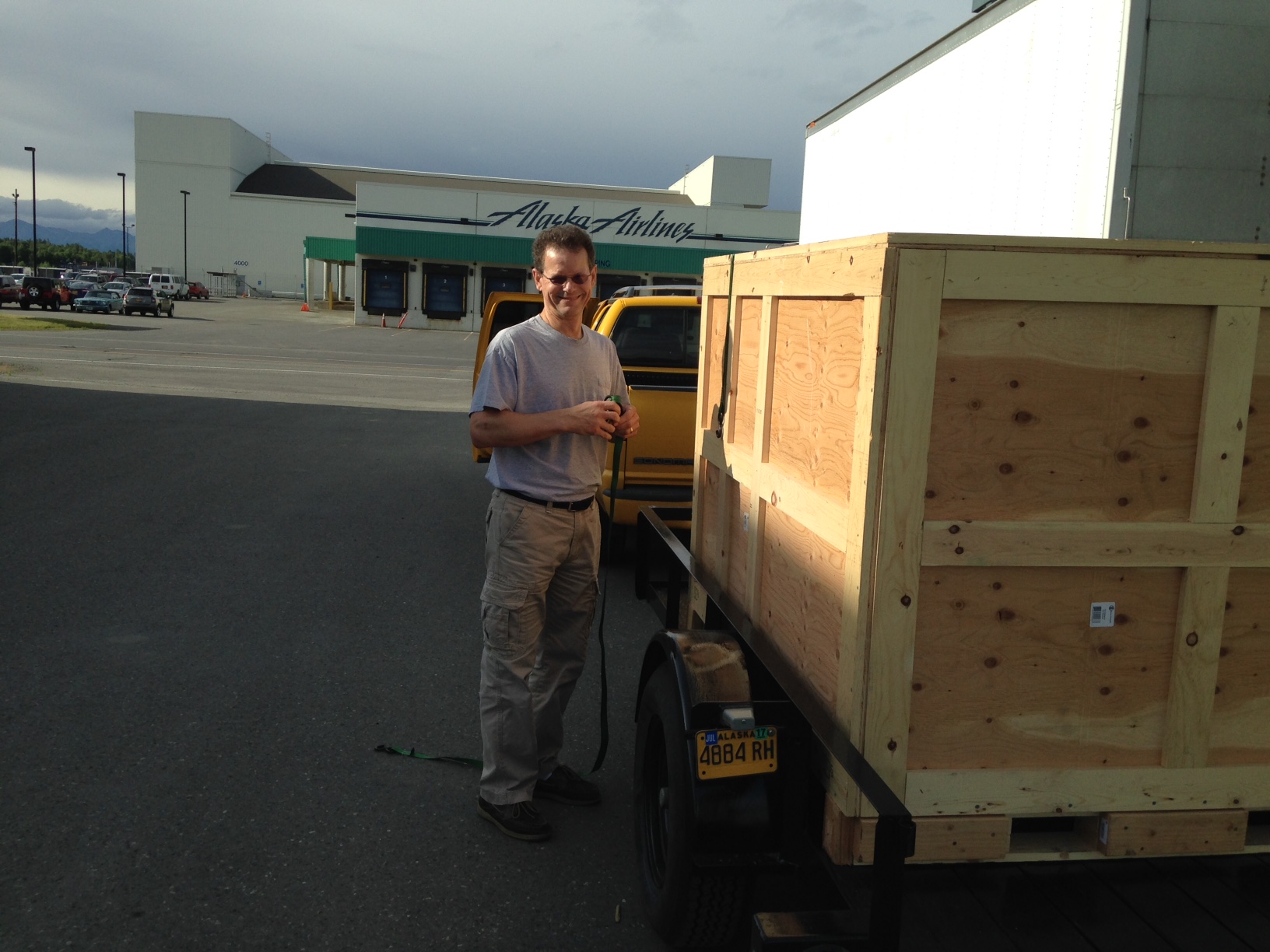
On June 29, 2015, Dan and his sister Nadine headed north with Mom’s Moose, surrounded by cherries, berries, oranges, and other fruit. On July 6, my brother, Mark, met the crew in Anchorage, loaded the crate onto his utility trailer, and hauled Mom’s Moose back to the Gaede homestead.

Mark Getting the  Moose Crate in Anchorage

Mark Getting the Moose Crate in Anchorage

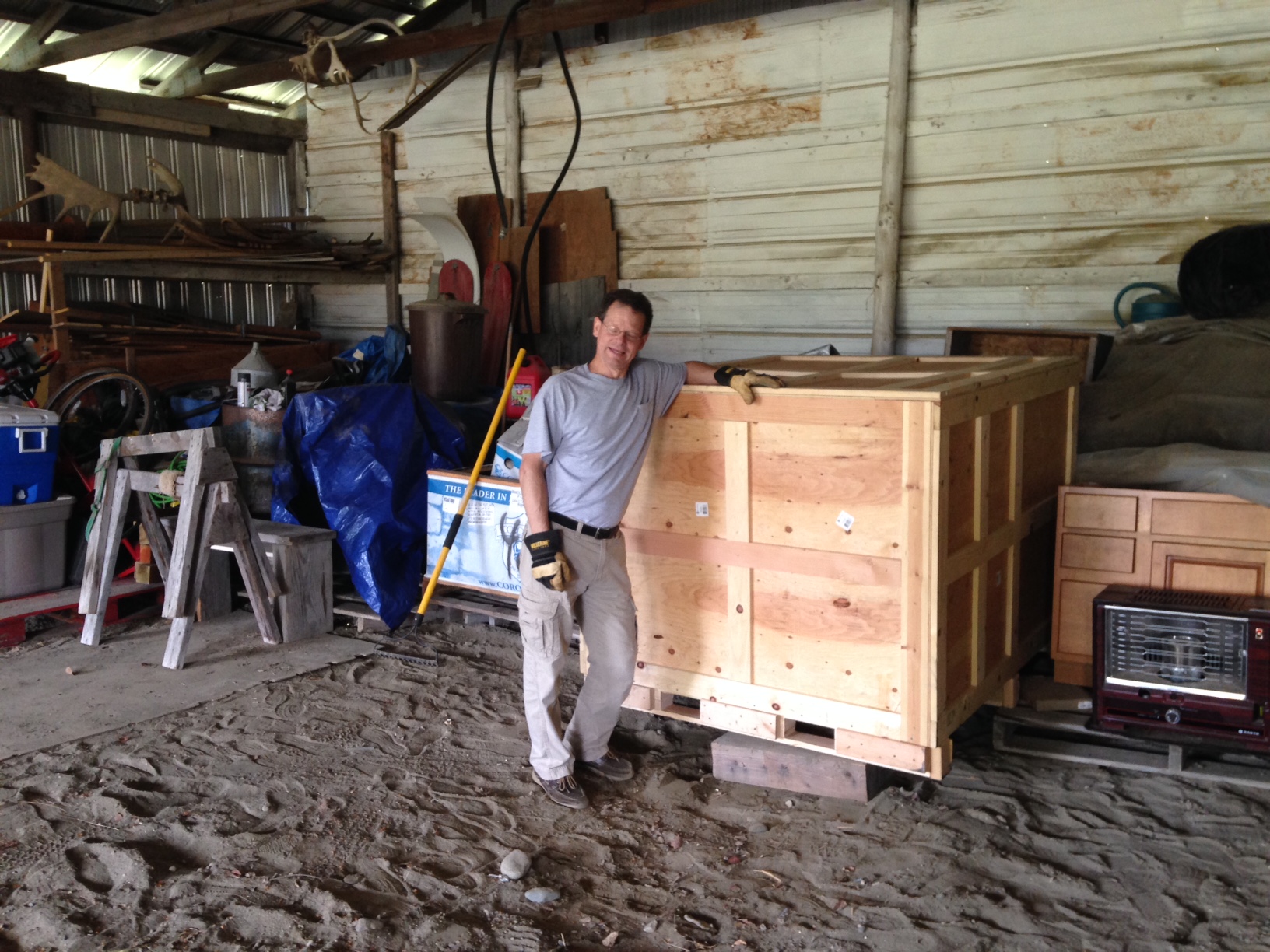
Fifty-seven years later, the moose is back in its natural habitat – but most likely needing to reacclimatize after being in warmer climes for decades.

The Moose arrives back home -- on the Gaede-80 Homestead

The Moose arrives back home — on the Gaede-80 Homestead

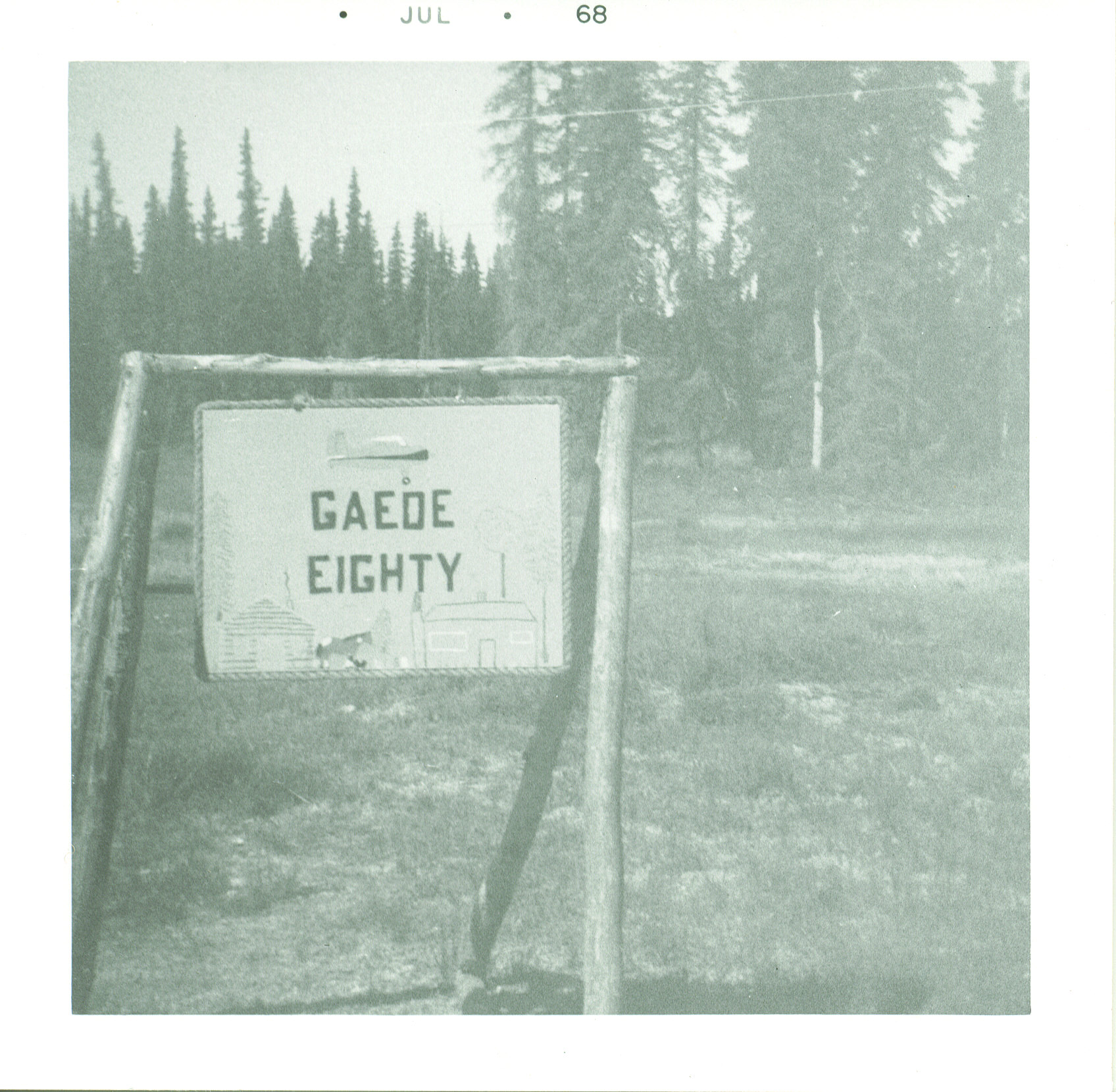
Oh, and there’s a bit more to the story. When Ben Doerksen first arrived in Alaska, around 1969, he looked up my father, Dr. Elmer Gaede. Within short order, Mom had him sleeping under our Gaede-80 Homestead roof, rather than in his pick-up, and she was feeding him tender moose roasts and cauliflower straight from her garden. In November 1974, Dad delivered Ben’s son, Matthew, in Soldotna. The Doerksens and Gaedes go way back, helping each other out. Those are the stories that bring the true smiles.

Share this:

  • Share on Facebook (Opens in new window) Facebook
Like Loading...

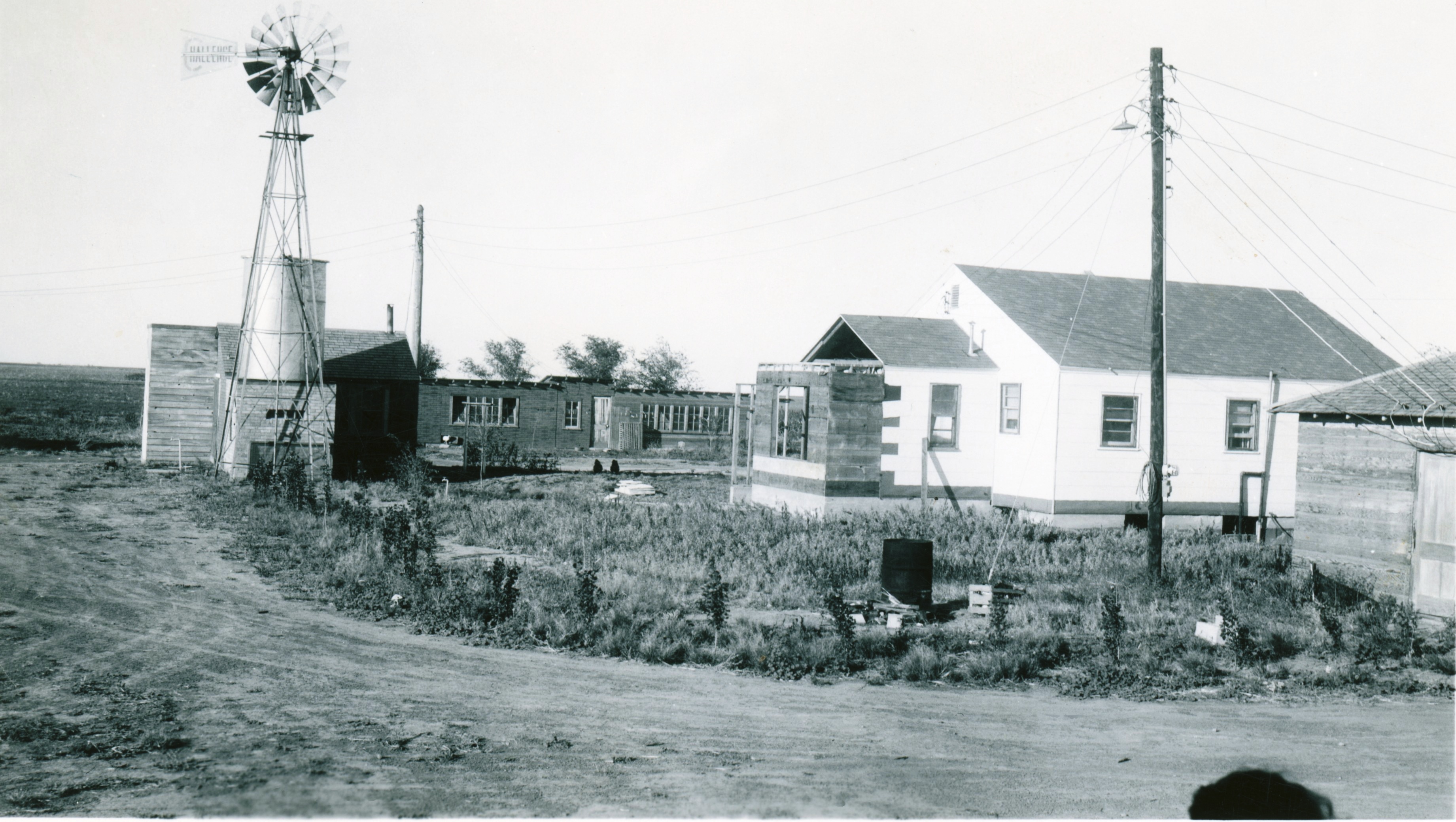
Dust Storms, Stock Tanks, and a Sticker Patch

14 Tuesday Jul 2015

Posted by Naomi Gaede Penner in Kansas, Uncategorized

≈ Leave a comment


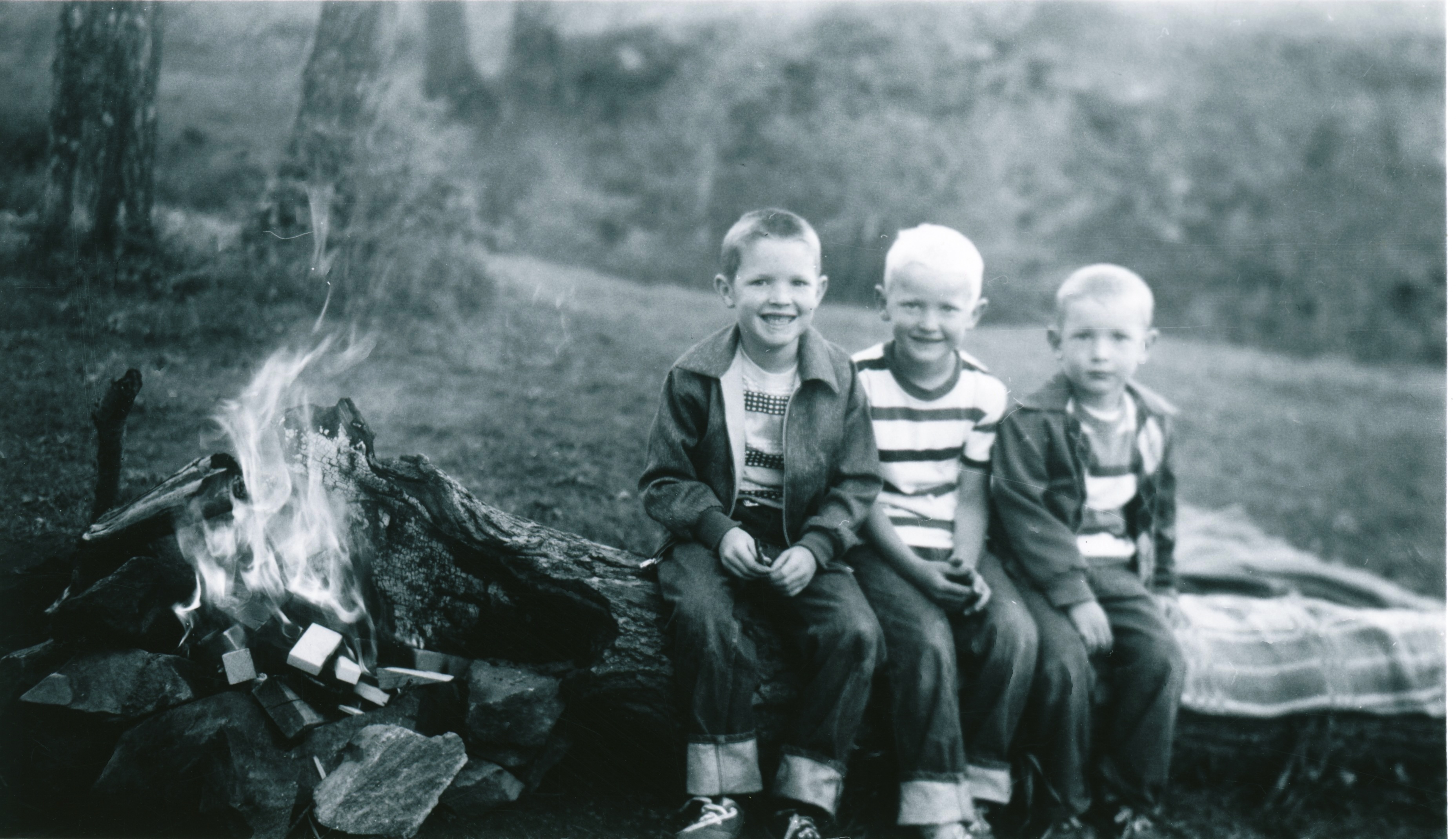
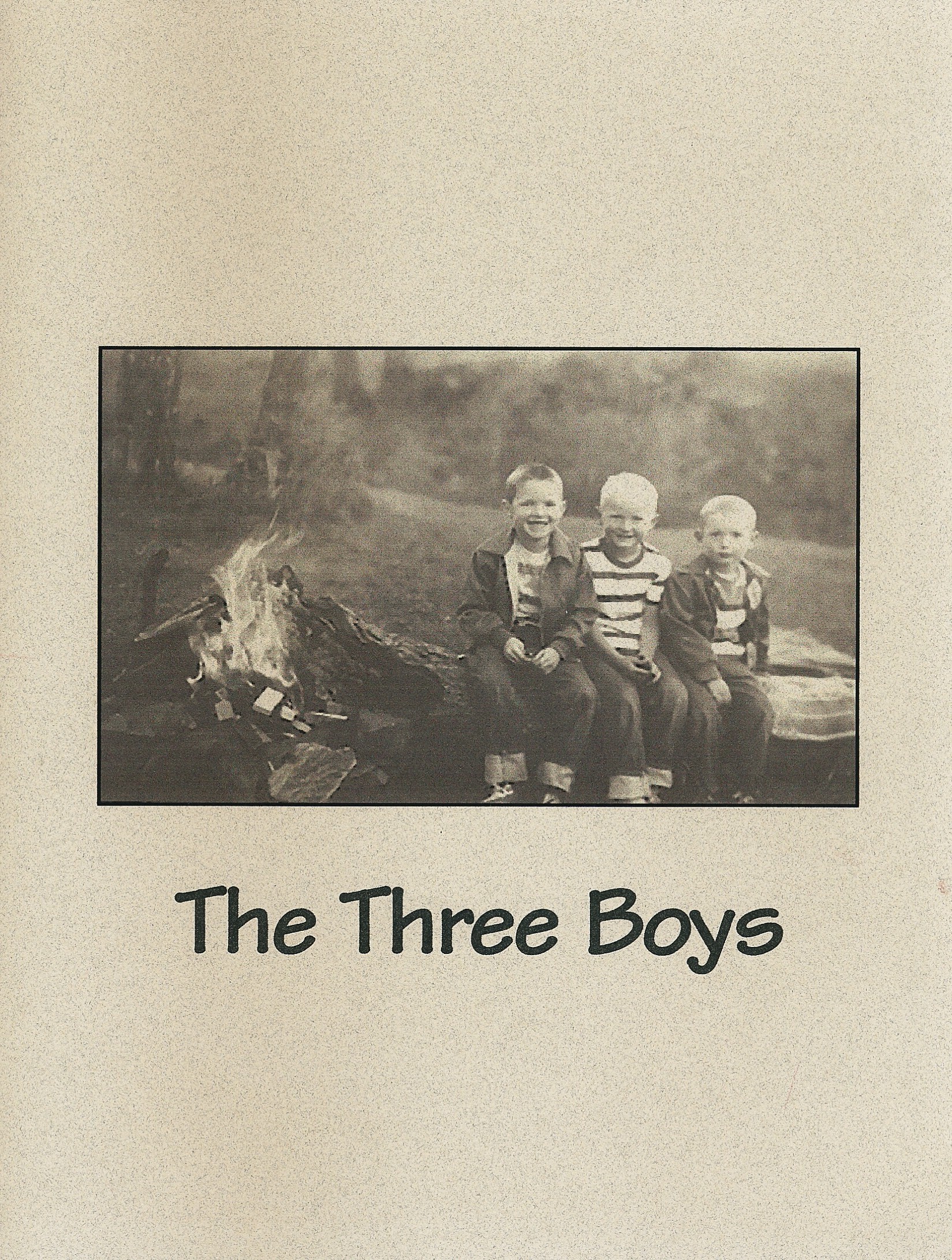
The Three Boys

The Three Boys

My husband, Bryan, had two close-in-age brothers: Rod and Duane. These three boys generated an abundance of stories that were retold at family gatherings and re-laughed by everyone. When Bryan died, I didn’t want my children to lose these memories, so I turned the oral tales into a written history in The Three Boys.

Western Kansas Farm

Western Kansas Farm

One Sunday, on the country road home from church, ominous blackness shrouded the car. The three boys, ages three, five, and seven, were terrified of these dust storms that plagued Western Kansas in the ‘50s. The storms could be seen on the horizon, and as they moved closer, they darkened the sky at midday, roared around outside, seeped into the house, and clogged the air. On this occasion, the boys couldn’t imagine how Dad could see to drive. They looked at each other, wide-eyed and speechless; then crowded together in the backseat and shut their eyes tightly. They knew they’d never see home again.

It seemed Dad derived some strange enjoyment from teasing the boys about the “Rollers,” as they were referred to. Dad would say, “Ahh, those dust rollers! Kids go in and never come out!”

Dad had a stock tank in which the boys learned to swim. The tank was situated across the yard, and had a fence through it so the cattle could drink on one side and the boys could swim on the other. Cow slobber mingled about and the bottom was so slippery from green slime-stuff that it was impossible to stand up. Of course the three boys tried, and naturally this was a source of amusement to watch one another fall and splash about. Besides the fascinating flora of green slime, there were occasional glimpses of cow faces beneath the water.

Now, between the tank and the house lay a sticker patch. Although the three boys were tough farm kids and constantly ran around barefooted, this sticker patch was to be avoided at all costs.

On this particularly afternoon, Bryan and Rod deviously devised a plot against their unsuspecting, younger, and gullible, brother. At the decided moment, the older boys looked to the west, in the direction of the dust storms, and Bryan yelled loudly, “Oh! Look! It’s a roller!”

Duane, popped up out of the water, tried to gain footing on the mossy tank, and screamed in fright. In a flash, he bolted over the tank edge, and headed straight for the house – not in the safe and circuitous pathway, but right through the sticker patch! Pain was added to his mental anguish. Shrieking, he stumbled into the house. Bryan and Rod laughed and laughed, then merrily claimed the tank for themselves.

When Mom questioned Duane as to the source of his wild panic, he was unable to articulate the harassment of his brothers. Consequently, with no punishment and with much hilarious gratification, the two older brothers continued to taunt their little brother throughout the summer. They took no care that someday he’d grow up, become more articulate, less gullible, and ready for payback. They were only kids. Their thoughts were of the moment.

  1. What are your summertime memories of childhood?
  2. What pranks did you play on your siblings?
  3. What consequences did you experience?

This was first printed in “The Country Register” (Kansas), June/July 2015.)


Share this:

  • Share on Facebook (Opens in new window) Facebook
Like Loading...

Mom’s Moose – on the Loose and Returning Home

23 Monday Mar 2015

Posted by Naomi Gaede Penner in Alaska, Alaska - Tanana, Gaede-80 Homestead

≈ 3 Comments

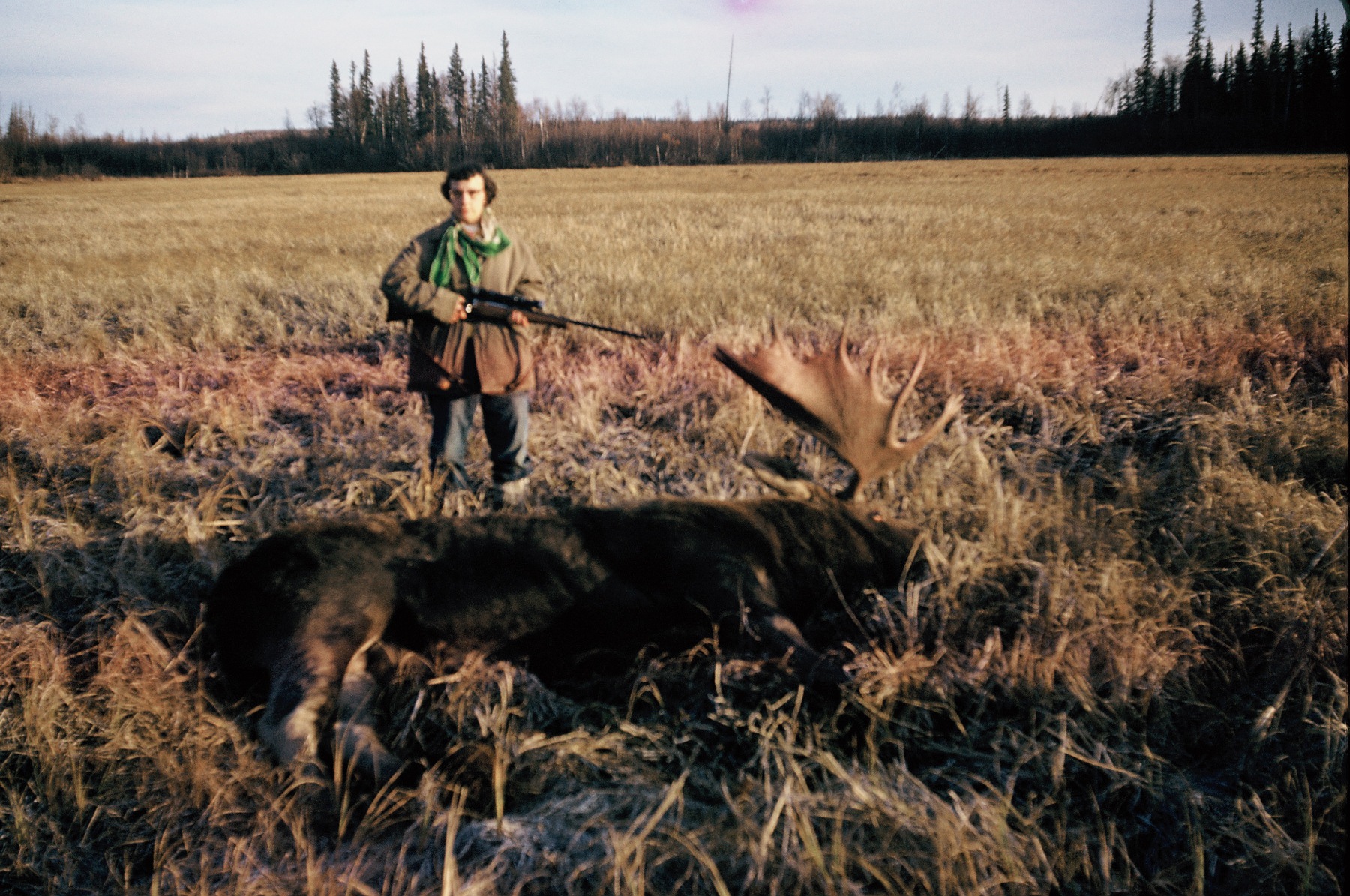
Mom the Huntress

Mom the Huntress

(Elmer E. Gaede, September, 1958, near Tanana, Alaska)

 I suspected the bull was around the bend of heavy brush, about 100 yards ahead. We edged forward, hugging the brush along a large cornhusk-colored meadow. I could smell him. Standing up and leaning forward, I broke cover. There he was, looking right at us. Without delay, he tossed his antlers and lowered his huge head. He was going to charge! The ground shook as he pounded toward us. I backed up and nearly knocked my wife, Ruby, off her feet.

“Get ready!”

The moose picked up speed. Ruby froze.

“Shoot, Ruby! Shoot!” I yelled.

She stood paralyzed in his path. By now he was only 50 yards away. Too close for comfort. Franti­cally, I focused my gun on the monster. Just as I pulled the trigger, I heard another shot ring out. Only 37 yards away from us, the moose crashed to the earth. I didn’t know what was trembling more, the ground from the impact, or Ruby as she turned to me with terrified eyes.

We both stood gasping for breath.

“You did great,” I encouraged her. “Now finish him off.”

She managed to lift the rifle and with two shots stilled the quivering animal. My heart pounded and I could nearly hear Ruby’s. She had every reason to be panicked.

I immediately went to work gutting the 900‑pound hunk of meat. Ruby had never seen this stage of moose‑hunting, although she had cut up and packaged pounds of meat after they had been hauled home. She appeared to have recovered her sense of speech, along with some curiosity, and commented about the innards of the moose.

“He’s like a camel,” she said in amazement. “Just look at all that blood and liquid. And look at his heart – the size of my head.”

I knew she was comparing him to the cows and pigs she’d seen butchered on her family’s farm in Kansas.

The evening darkness and gnawing mosquitoes hurried us; and I decided we couldn’t complete our task at that time.

“We can let him cool down overnight, and then tomorrow morning Roy and I will skin him and pack out the meat.”

I hated to leave her trophy so abruptly, but she didn’t want to spend the night in the wilds.

Within five minutes of a sandbar takeoff in my PA-14 tail-dragger, we were back in Tanana. I was jubilant and raring to re-talk the hunt, but Ruby walked home silently, wearily. We put the children to bed and she crawled into a hot bath. She needed some time alone – and to warm up. If I ever wanted her to hunt with me again, I knew I’d better grant her that opportunity.

The next morning, my friend, Roy, and I flew to the hunting site. Seven hours later, all four quarters of Ruby’s moose were back in Tanana. This part of the hunt was familiar to her. She and I would be busy for many a night picking hair off the meat, cutting it into various cuts and sizes, and wrapping it for the freezer.

I was mighty proud of Ruby’s hunting adventure. Since I hadn’t taken my movie camera along to document her story, I decided we should mount the head.

Mom's Moose

Mom’s Moose

This was Ruby’s first, but not last moose hunt. She had proven she could bring home the moose and cook it, too. After this, she never really took to hunting with the airplane, but later, when we relocated, she was more than willing to get up early or drive at dusk, with two guns between us.

The head mount was sent to Ruby’s parents, in Kansas. Later, it was transferred to Elmer’s parents in Reedley, California. In a third move, it resided at Elmer’s brother’s, in Fresno, California.

(Naomi Gaede Penner, March 2015)

Several years after Dad’s brother died, his wife, Marianna, decided to move to a retirement community. The moose would not be moving with her. She and her family decided it should be returned to the Elmer and Ruby Gaede family. We siblings agreed – it needed to migrate “home,” to the Gaede-80 Homestead, outside Soldotna, Alaska.

California Acclimatized Moose

California Acclimatized Moose

All four generations of the Harold and Marianna Gaede family were distraught. The moose had been a part of their lives – for decades – and every Christmas it was decorated with ornaments. Knowing their pal would no longer be a part of their celebrations; they each had their picture taken in front of the moose at their annual Christmas get-together in December 2014.

The re-transplantation could not happen with a quick trip to UPS, a Large Priority mailing box, or Fed Ex at the front door. In fact, nothing about this process would be easy – but it would be a story-maker.

Here’s how it went:

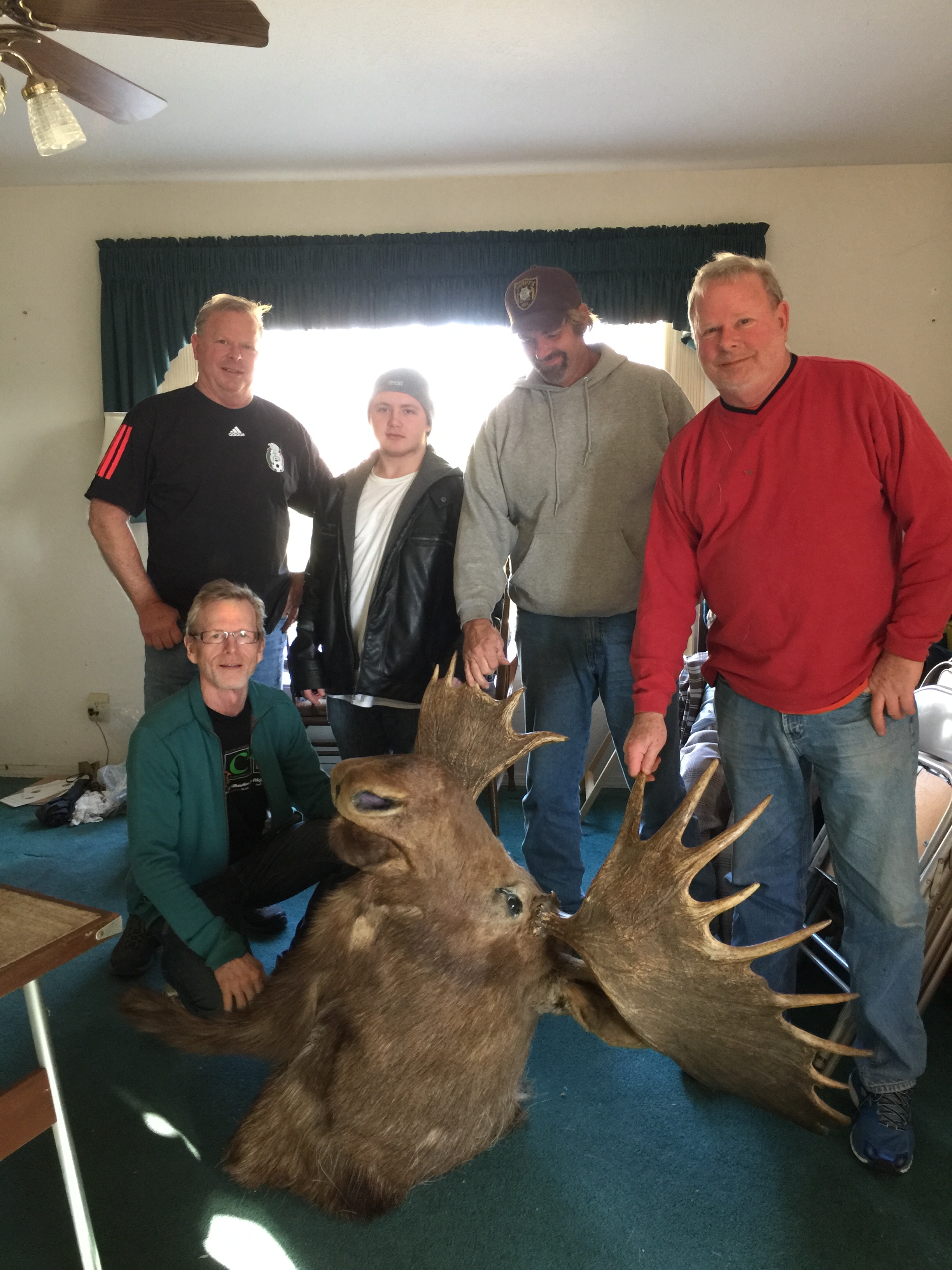
Step #1: Remove the moose from the wall.

Tackling a Moose

Tackling a Moose

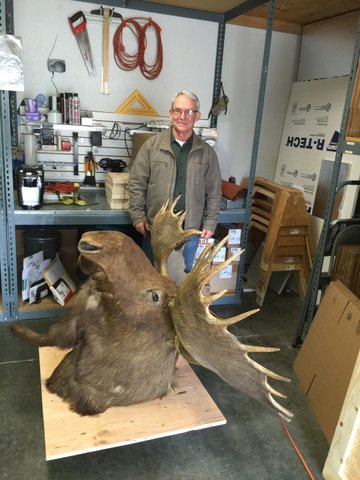
The head mount weighed approximately 100 to pounds and was bolted into the wall. Don, Ken, and Paul Gaede, along with friends, tackled the project with ladders and humor. After 15 minutes of unscrewing the bolts and holding onto the antlers, the moose landed – on the floor.

The Moose has landed

The Moose has landed

Step #2: Figure out how to crate the moose.

Don contacted a packaging company and got a bid for just over $500.00.

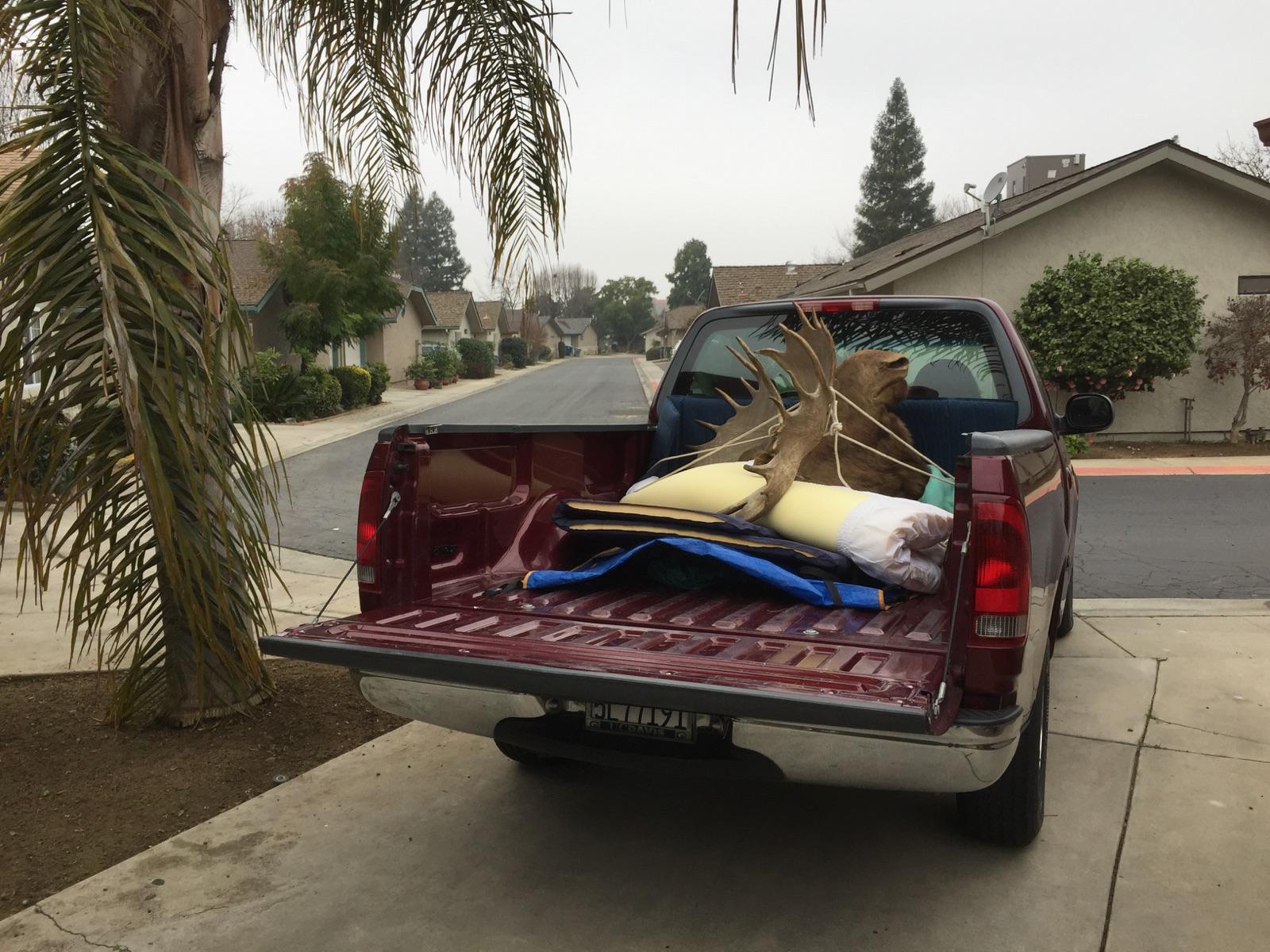
Steps #3: Haul the moose to the packaging store.

Don’s son had an F-150.

Justin's truck

Justin’s truck

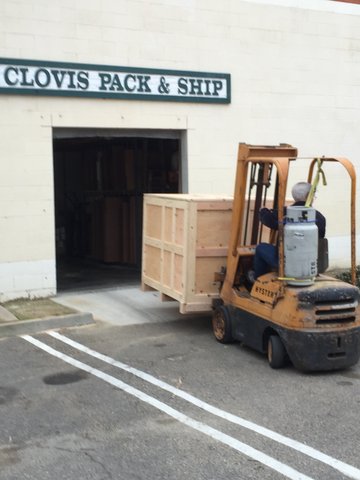
Step #4: Crate up the moose.

How to crate a moose

How to crate a moose

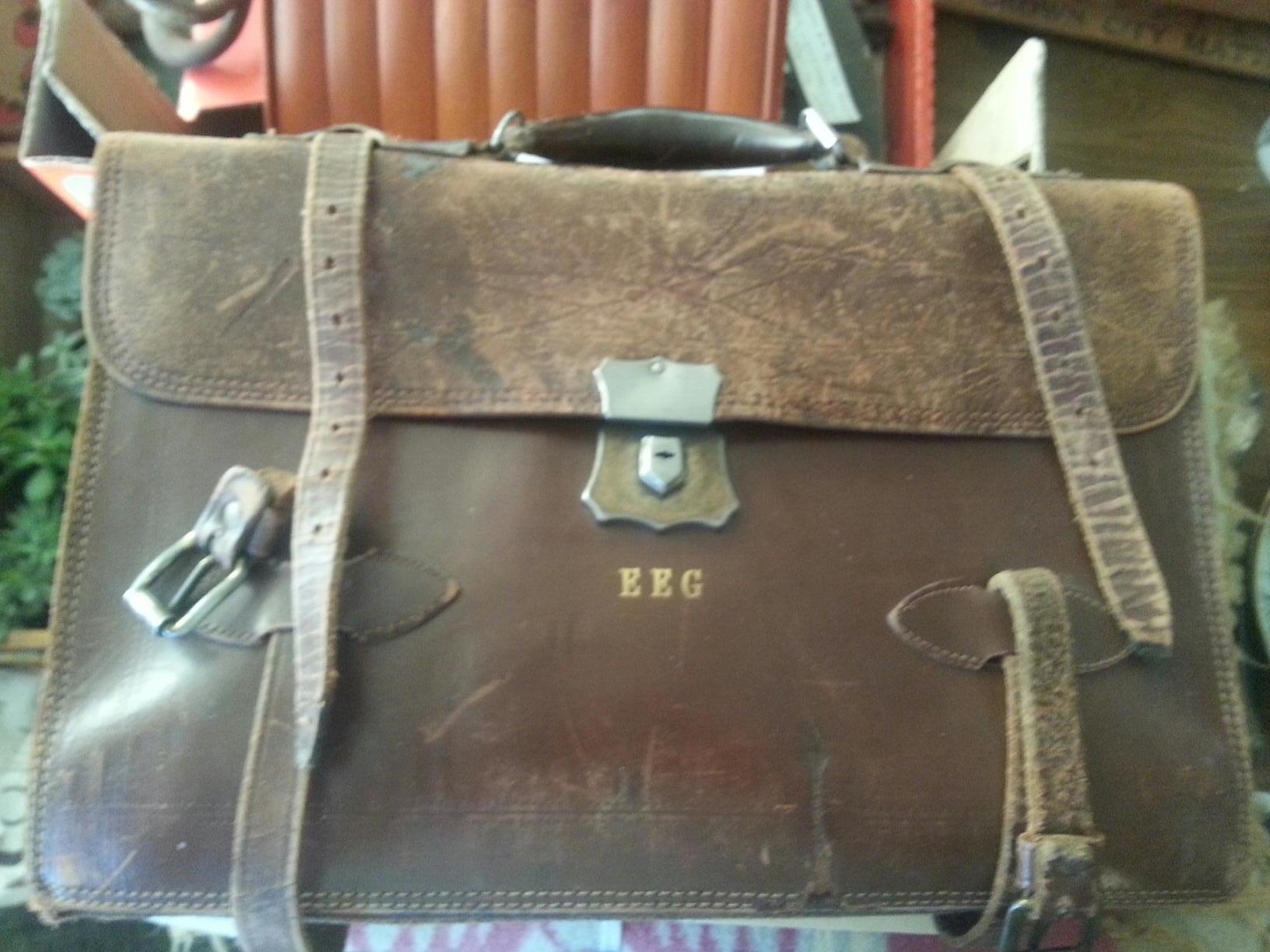
Not only did the moose get crated up, but during the packing process for Aunt Marianna, the cousins found a briefcase monogrammed with EEG (Elmer E. Gaede), which we siblings readily accept for our archives. This got packaged with the moose head.

EEG Briefcase

EEG Briefcase

Step #5: Haul the moose to temporary storage.

“FYI, I’m having trouble transporting the moose head to the packing company and thence to my garage; Justin’s pickup bed is too small.  Will keep you apprised.” Text from Don to Naomi.

This project kept growing...

This project kept growing…

Don rented a U-Haul truck for $95.00.

During the loading process, a community security guard stopped by. He’d never seen a moose before, much less one that large.

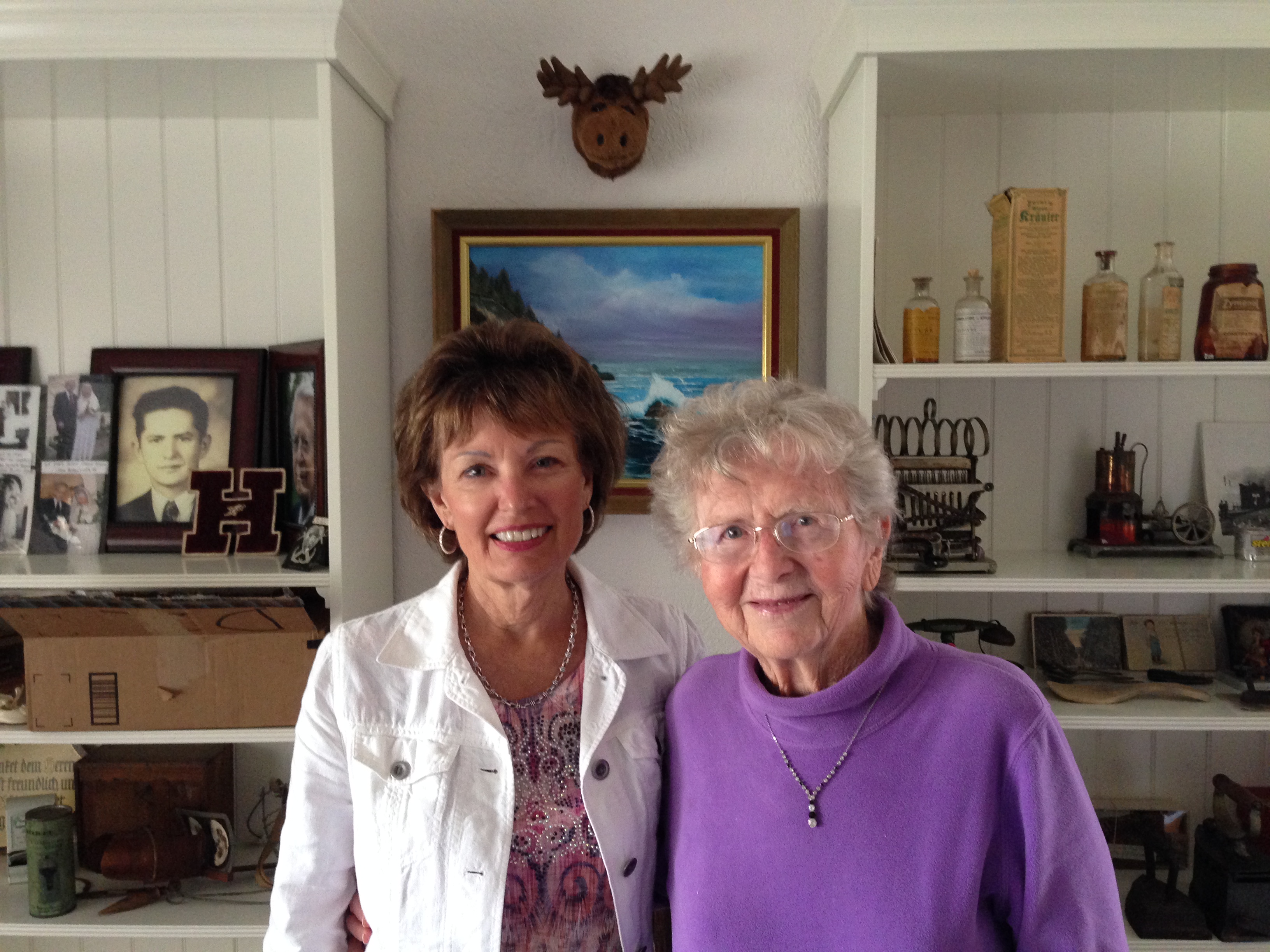
Step #5: Replace Mom’s Moose with a companion moose for Aunt Marianna.

I did a search on amazon for “toy moose” and found a furry-faced smiling moose head.

Mini Moose

Mini Moose

IMG_2195

Step #6: Transport the moose from California to Alaska

(To be continued)

Share this:

  • Share on Facebook (Opens in new window) Facebook
Like Loading...

Tasting a Memory

24 Friday Oct 2014

Posted by Naomi Gaede Penner in Uncategorized

≈ 1 Comment

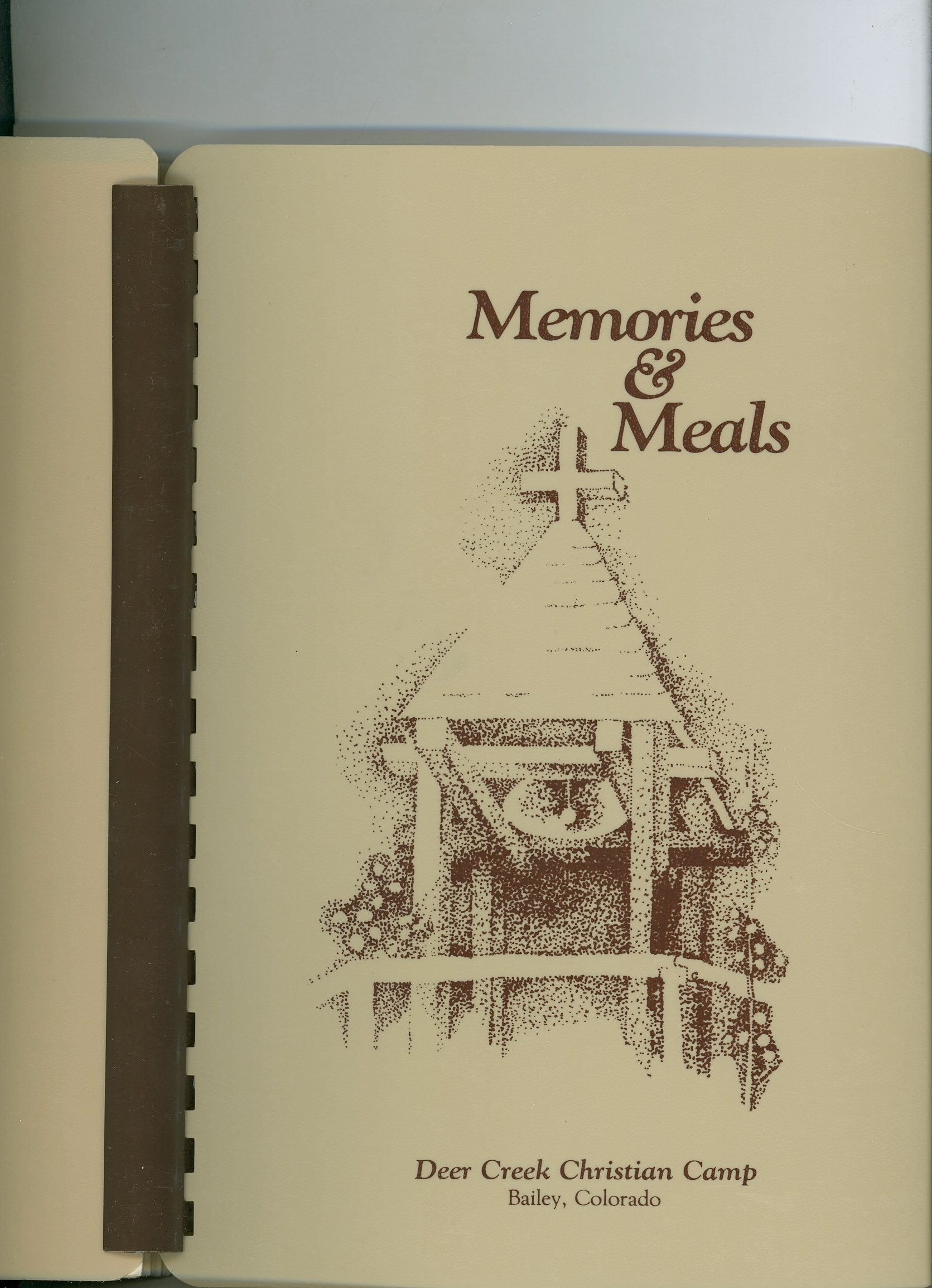
Memories & Meals -- Cookbook, History, Stories

Memories & Meals — Cookbook, History, Stories

“My mother made potatoes that were boiled and then fried. They were so crisp!” He describes the food, and then shares the memory of his mom whistling hymns while she bustled about the kitchen.

My daughter tells me, “Mom, I made Flat Pancakes for supper.” I can hear her smile through the email. We’re both thinking the same thing: my mom/her grandma, brightening our kitchen during her visits each January; flour-dusted hands, wispy hair, and a flowery apron.

Food memories journey across oceans and generations. In 1996, I toured the Molotchna Colonies, in the Ukraine, where our Mennonite, Gaede family had lived until the late 1880s. We were served Rollkuake with watermelon. The fried fritters tasted as flat, and familiar, as those I’d eaten during my childhood in Kansas and Alaska. In 2014, I still enjoy them, with watermelon juice squishing out my mouth, and flashbacks to my young daughter in her apron, wanting to flip the sizzling dough strips.

How does one separate food from memories? It’s as slippery as separating egg yolks and whites. And why try? Not unscrambling these elements, adds to the flavor.

I have three books that make me salivate – and reminisce.

• My Grandma Agnes Gaede’s cookbook, from Reedley, California. Grandma collected recipes in a brown spiral Golden West theme book with narrow rule, purchased for 49 cents. Pasted and taped inside are recipes cut from magazines or handwritten. I find icebox cookies, sponge cakes, coffeecakes, chiffon pies, meatloaves, and casseroles. Nothing is gluten-free, salt-free, fat-free, lactose-free, or sugar-free.

• Memories & Meals, which I edited, is the history of Deer Creek Christian Camp near Bailey, Colorado. The history is mixed generously with recipes. There’s Hot Chicken Salad served at Ladies’ Retreats, Sloppy Joes at Kids’ Camps, and Norwegian Coconut Cookies for Ski Camps. When Deer Creek recipes are served at gatherings of previous camp attenders, laughter and reminiscing burst out between mouthfuls.

• The Three Boys. This book was drafted during a family Pheasant Festival. For decades, Penner men and boys (now young women) have flocked to the Penner farms in Western Kansas for November pheasant hunting. Within the Colorado Penner group, no one has wanted to prepare the birds. Since I grew up with wild meat in Alaska, all fingers have pointed at me.

Saving and re-telling the stories

Saving and re-telling the stories

During one such event, I recorded stories repeated by my late husband and his two brothers about their childhood in Kansas and Colorado. We didn’t want to lose the comical recollections of the three boys in a stock tank looking at cow’s faces under the water, rolling their over-sized Dachshund down the stairs – to see if he’d land on his feet, and bicycle crashes with trombones. The final chapter featured the last meal my children had with their Grandpa Penner – when he ordered pie – first.

As dessert to the main course of stories, at the end, I added The Three Boy’s mother’s recipes for German Chocolate Cake, New Year’s Fritters, Cream Cheese Brownies, and so on. Some of her handwritten recipe cards were copied directly.

What can you do with food memories and recipes? You can use them for amusing holiday conversations or for collecting into your own memory-and-meals family or friends book.
Questions to ask around your holiday table. (Include all the generations for a spicier blend.)
– What is your favorite friends/family homemade food? Why?
– Who makes it? Only grandma? A group of the women? The men at the grill? _______who always experiments?
– Where did the recipe come from?
– Have ingredients changed over the years? Or due to availability? Or because of preference?
– What’s the story around the recipe? Where were you when you first tasted it? Who else was there? What was the occasion?
– When is it typically made? Holidays? Camp-outs? Ski trips? When _____comes to visit?

More suggestions for gathering memories.
The Three Boys http://www.prescriptionforadventure.com/threeboys.html

(This was first printed in “The Country Register” (Kansas), Oct/Nov. 2014)

Share this:

  • Share on Facebook (Opens in new window) Facebook
Like Loading...

Back to School: Mukluks and Mittens

31 Saturday Aug 2013

Posted by Naomi Gaede Penner in Alaska - Tanana, Uncategorized

≈ Leave a comment


  1. What are your grade school memories?
  2. What was your school building like?
  3. Who were your favorite friends?
  4. Did you wear anything specific to school?
  5. Have you revisited any of your schools?

 Flying from Fairbanks to Tanana

Flying from Fairbanks to Tanana

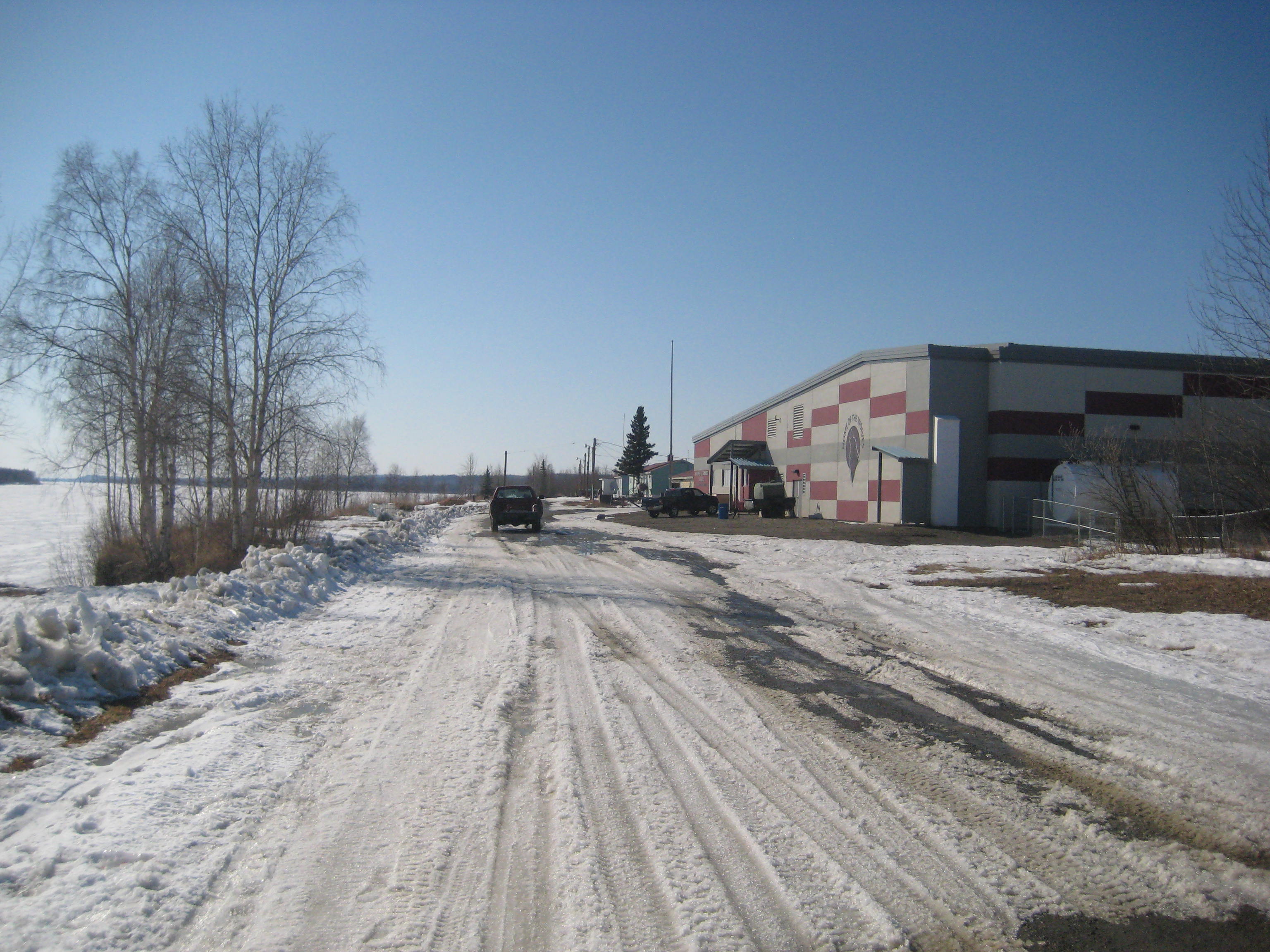
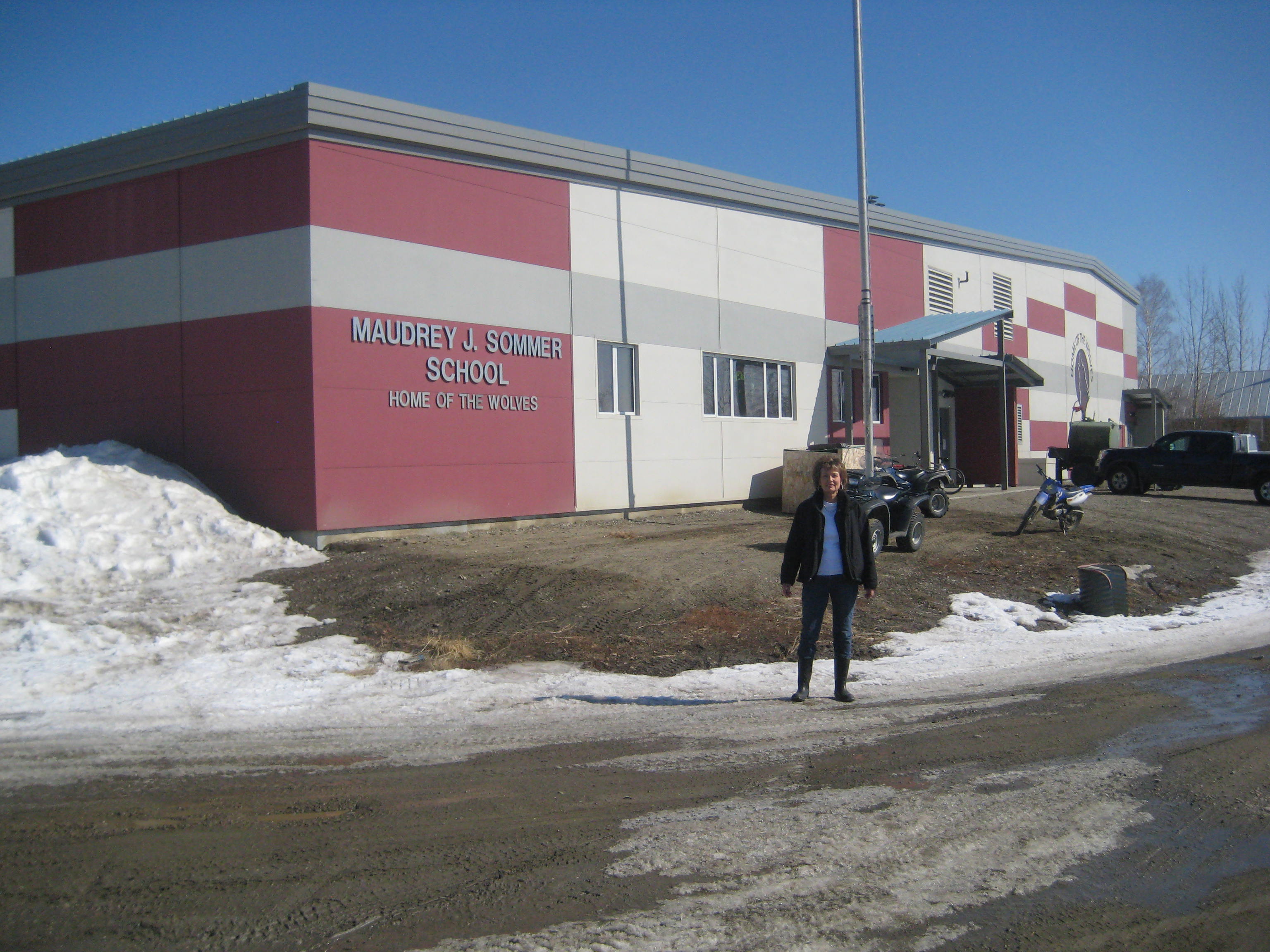
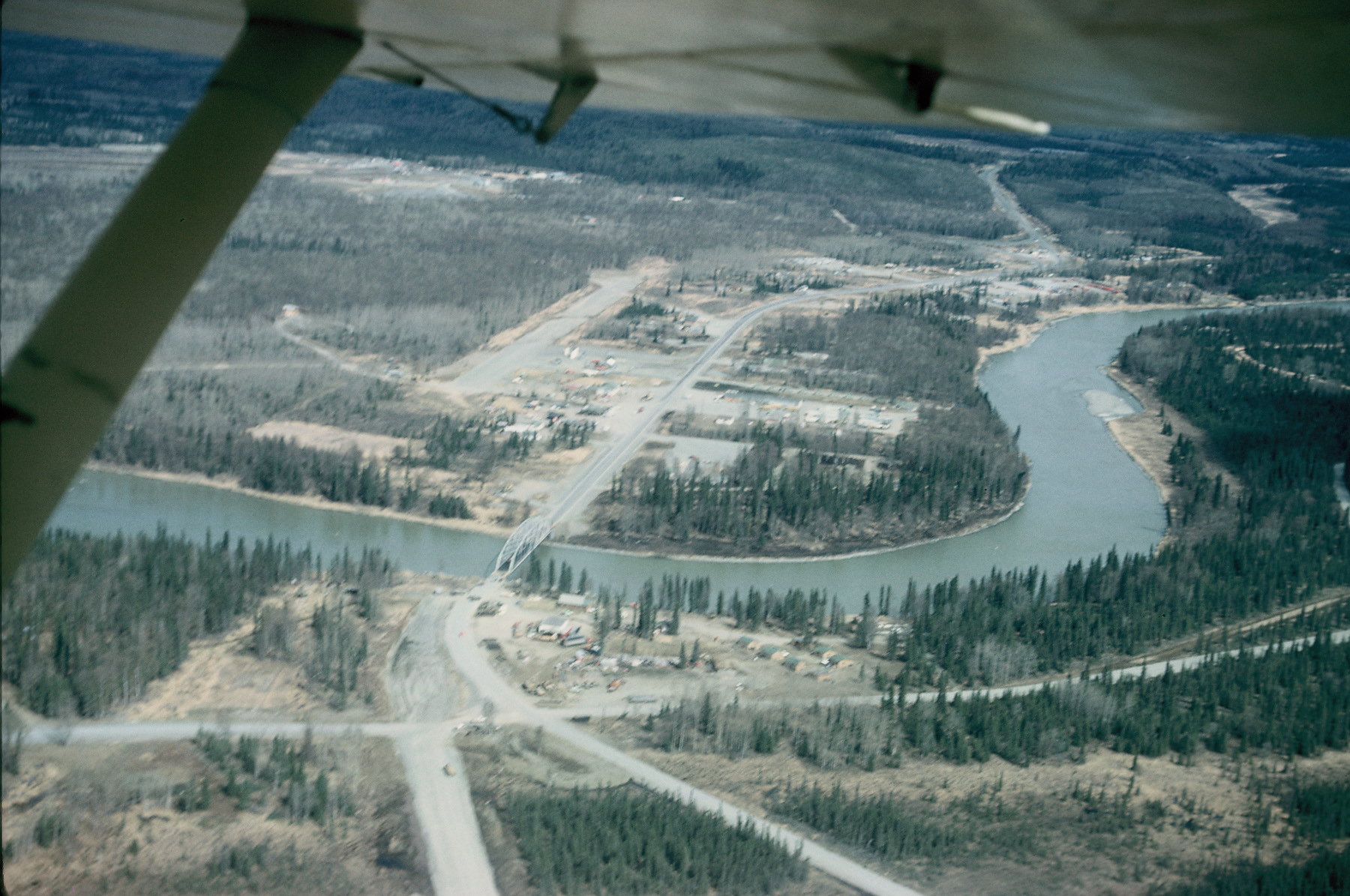
On May 2, 2013, I flew out of Fairbanks, Alaska to visit the school I’d attended in third grade — When my father had been the Public Health Service physician at the hospital.  An hour and 20 minutes later the Piper Navajo touched down at Tanana, an Athabascan Indian village along the still-frozen, mile-wide Yukon River. The road to the school was a mix of semi-frozen mud, icy snow, and puddles with a light glaze of frost. I was glad for my tall rubber boots.

Front Street in Tanana, looking forward the school

Front Street in Tanana, looking toward the school

My purpose was to show slides to the students and share the history of their school; and, I was curious to see how the school facility had weathered over time – and what memories would be evoked by walking the hall again.

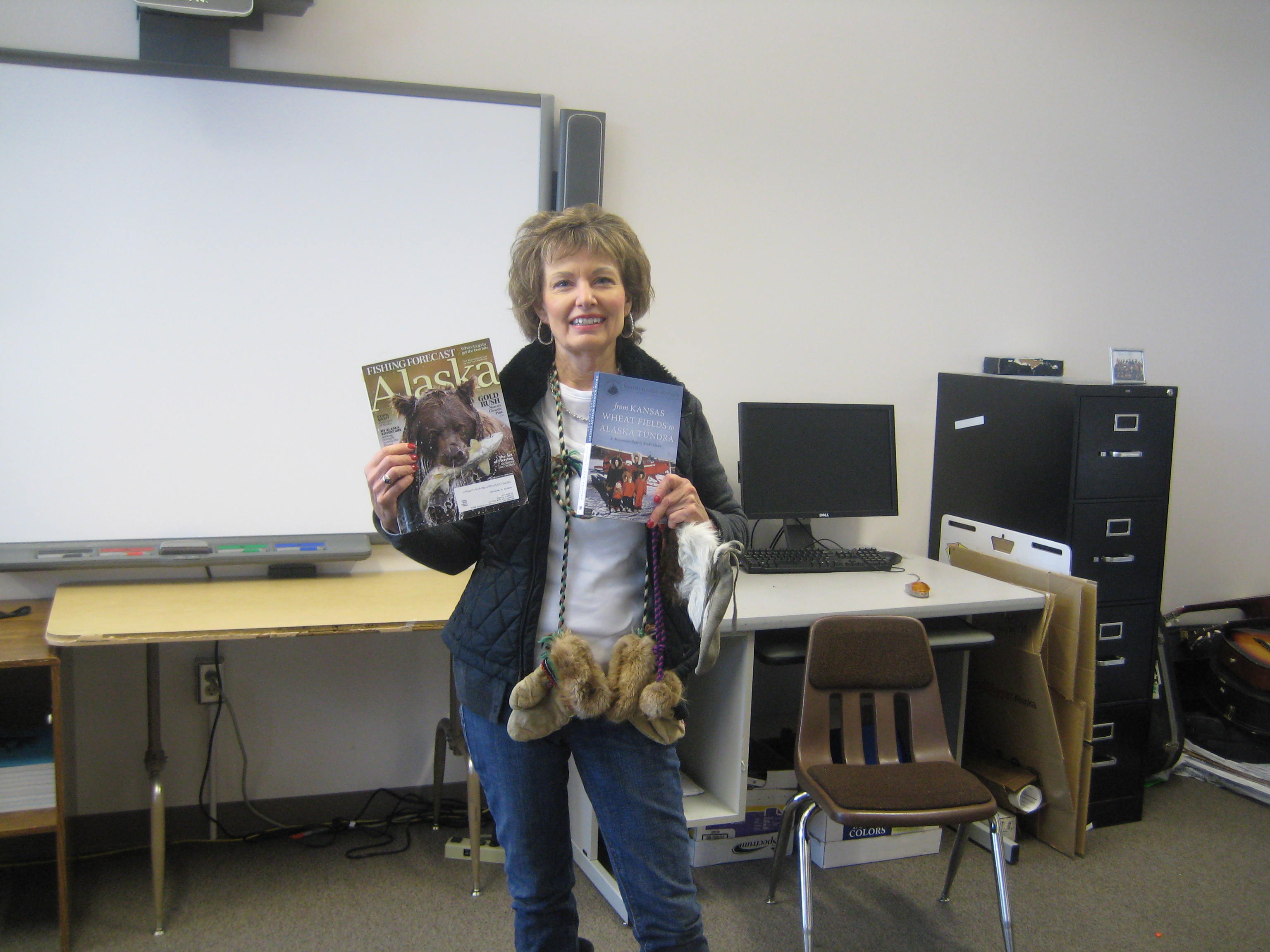
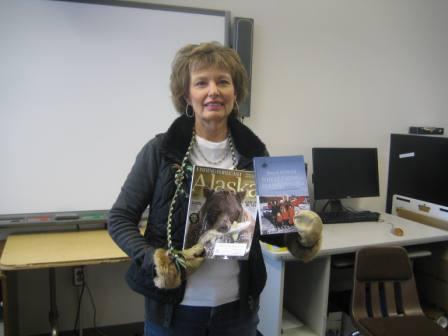
To get the students’ attention, I pulled out the moose skin and rabbit-trimmed mittens, and the moose skin mukluks, I’d worn as a little girl in the village. I held up my book, From Kansas Wheat Fields to Alaska Tundra, which showed our family picture with me wearing those items.

Wearing my mukluks and mittens for our Christmas picture in Tanana

Wearing my mukluks and mittens for our Christmas picture in Tanana


They were hooked. I jumped in with questions. Their hands waved with answers and their eyes twinkled with fun.

My childhood mukluks and mittens

My childhood mukluks and mittens

“How many people live in Tanana today?  After a group discussed reply, they agreed: Either 206 or 207.

“Before this school was built, where was school held?”

No one raised a hand.

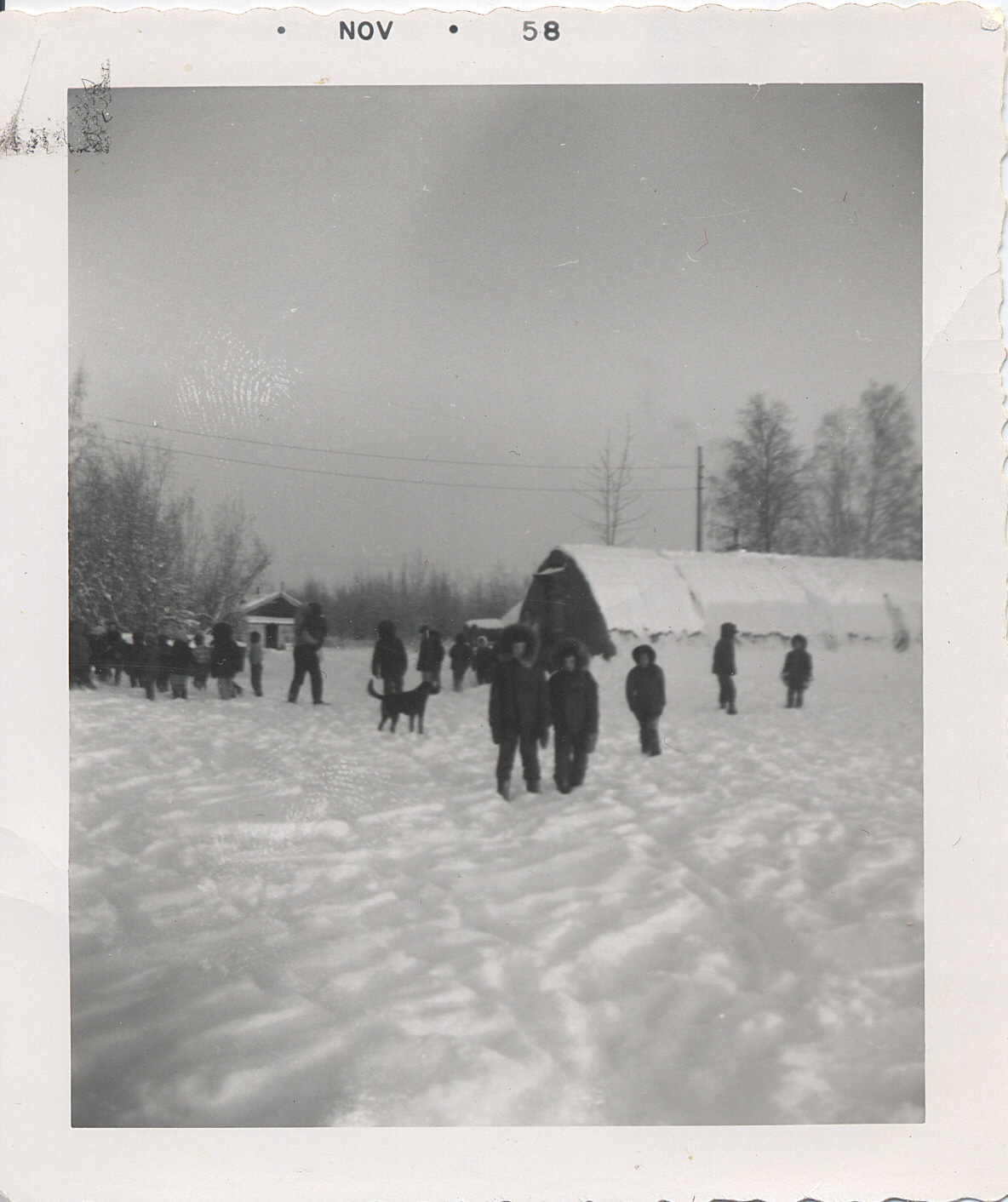
I replied, “Quonset huts, or shelter wells as some people called them, with oil stoves and with electricity strung from the hospital generator.  No plumbing, no windows. Can you imagine trying to hang a writing board on a round wall? Or put a bookshelf against a curved partition?”

School in Quonsets in Tanana

School in Quonsets in Tanana

The children laughed. The teachers shook their heads and grimaced.

“Do you know who this school was named for?” I asked.

Not a hand shot up. The adults nudged one another and whispered.

“Maudry Sommers. Her children were my classmates. I thought her son, Chris, was the cutest little boy I’d ever seen: curly red hair, freckles, and brown eyes – they were the only red-haired Athabascans on the Yukon River.

Maudry SommerSchool

Maudry SommerSchool

The girls giggled. The boys grunted.

“I saw Chris, downriver, at Galena, last year. At one time, he was the chief.”

The time flew by. I learned from their responses as much as I taught them.

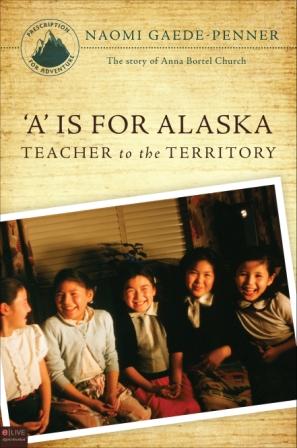
I concluded by saying, “You can read about school back then, in ‘A’ is for Alaska: Teacher to the Territory.

Marie Sommers is the girl on the far left

Marie Sommers is the girl on the far left

The younger students wanted to try on the mittens and touch the mukluks. The adults examined the handwork and stitching. The older girls thumbed through my books. I passed out bookmarks. The librarian purchased all four titles.

Mukluks and mittens are a part of my school memories, along with outhouses, insulation drifting down in the Quonsets, wearing corduroy elastic-waist slacks beneath my dresses, and snacking on government school subsidies of powdered milk mixed with snow, tomato juice, and sharp cheddar cheese.

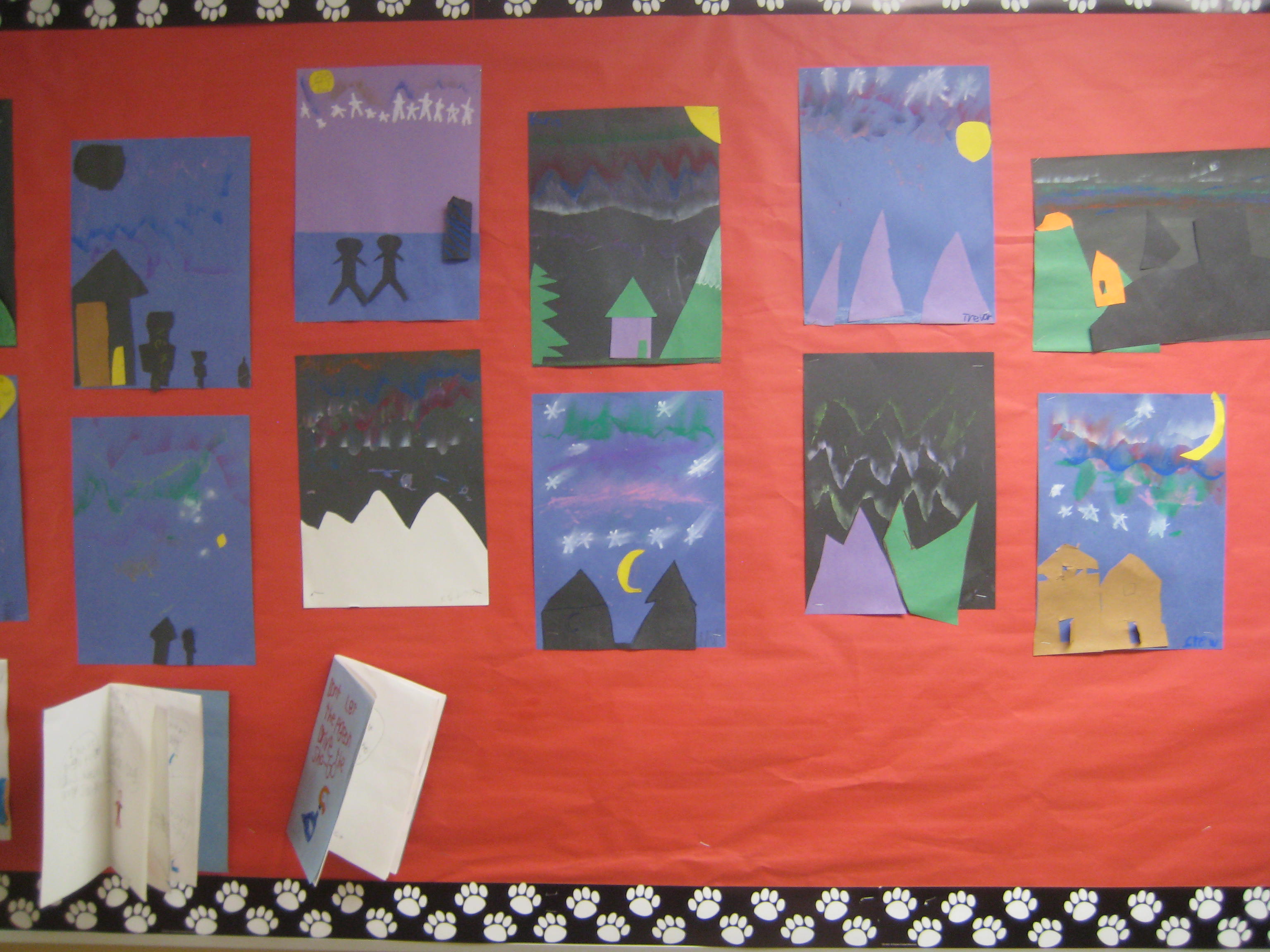
Student art in the hallway of the Tanana School

Student art in the hallway of the Tanana School

(Tanana is the location of the reality TV show, “Yukon Men.” I learned from the villagers that the show is not much about reality, but mostly conjured up drama.)

This article was first-published in the August/September 2013 issue of “The Country Register (KS)”  http://www.countryregister.com/crpublishers/kansas/pdfs/AS-13paperweb.pdf


Share this:

  • Share on Facebook (Opens in new window) Facebook
Like Loading...

Alaska Homesteading. Roots of the Gaede (GAY-dee) Eighty

05 Wednesday Jun 2013

Posted by Naomi Gaede Penner in Gaede-80 Homestead, Uncategorized

≈ 1 Comment

Showing slides to the students --from when I was a student. Wearing my mukluks and mittens that I'd worn there as a child.

Showing slides to the students –from when I was a student. Wearing my mukluks and mittens that I’d worn there as a child.

When I flew up to Alaska in mid-April, I didn’t spend much time on our family homestead; instead, I drove to Anchorage and Fairbanks to market my books and my Alaska History Study Guide at the homeschoolers’ IDEA curriculum fairs. One day I flew into Tanana, along the Yukon River, where I’d attended second and third grades. On my way back to the homestead, I stopped in Palmer and ate at my favorite restaurant — Turkey Red Café http://www.turkeyredak.com/

Now I’m flying back up to Alaska with the primary intention of attending the Kachemak Bay Writers’ Conference in Homer. This will be my first time to attend. I look forward to learning more about writing non-fiction, creative non-fiction, and memoirs; and doing research. I anticipate informal learning through talking to other authors, agents, and educators. http://writersconference.homer.alaska.edu/schedule.htm

I’ll be staying with Cherry Jones, author of Remarkable Alaska Women, which is part of the More than Petticoats series. http://www.amazon.com/More-than-Petticoats-Remarkable-Alaska/dp/0762737980

My time on the Gaede-Eighty homestead will be brief. A highlight will be roasting hot dogs over a small fire, probably out in front of the now-torn-down original hangar, with three generations of family members: sister and husband, brother and wife, niece, nephews. A typical drizzly evening won’t dampen our enthusiasm. That’s often the way it is – 50 degrees, drizzle, mosquitoes…all minimized by the nostalgic smell of wood smoke and the sizzle of hot dogs and the pop of burning branches. All these evoking memories of the first years on the homestead when our parents were chiseling home out of the wilderness and we kids, oblivious to their sweat and toil, ran through the woods exhilarated by the land claimed as ours, the cushy moss underfoot, the fragrance of wild roses, and  the larger game trails of moose and smaller ones of voles.

 How did life on the homestead begin…………..?

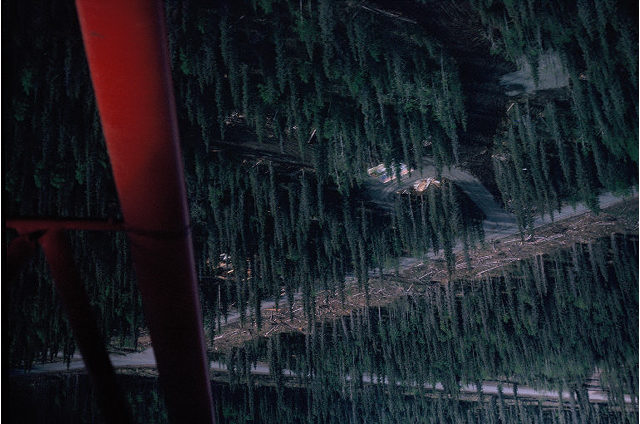
“In 1961, the major population of the central Kenai Peninsula consisted of 6,000 to 8,000 people scattered over a 25-mile radius. This included the strewn-out town of Soldotna, as well as the nearby older establishment of Kenai. At ground level, it didn’t look like much. A few people actually resided in these towns, but more lived on homesteads ranging from 40 to 160 acres. Homesteads could go unnoticed, since the many World War II veterans were exempt from the cultivation requirement. Their cabins were secluded and blended into the forests, rather than peeking out on the edge of a clearing. From an airplane’s vantage, one could see seemingly random roads twisting around swamps and the Kenai River, and meandering back into the spindly black spruce forest to simple log cabins, commonly 16 by 20 feet.

 Soldotna sat at the strategic juncture of two main roads: the Kenai Spur Road continued through Soldotna to Kenai and Nikiski (Ni-KISS-kee), while the Sterling Highway cutoff from Anchorage traveled toward the coastline and connected Kasilof (Ka-SEE-loff), Clam Gulch, Ninilchik (Ni-NILL-chick), Anchor Point, and Homer. There was no town center, just a collection of businesses tossed out along these two-lane highways. Two grocery stores, a gas station, a repair garage, a post office, a bar, an elementary school, several churches, a bank, and a hardware store provided basic services. Nothing was adjacent to anything else, so the simplest errands consisted of stops and starts. The nearest hospital was 90 miles away – flying through the turbulent Resurrection Pass mountain pass, or driving miles on a narrow, curving road where moose unexpectedly stuck their heads out of the woods and nonchalantly crossed over to the other side.

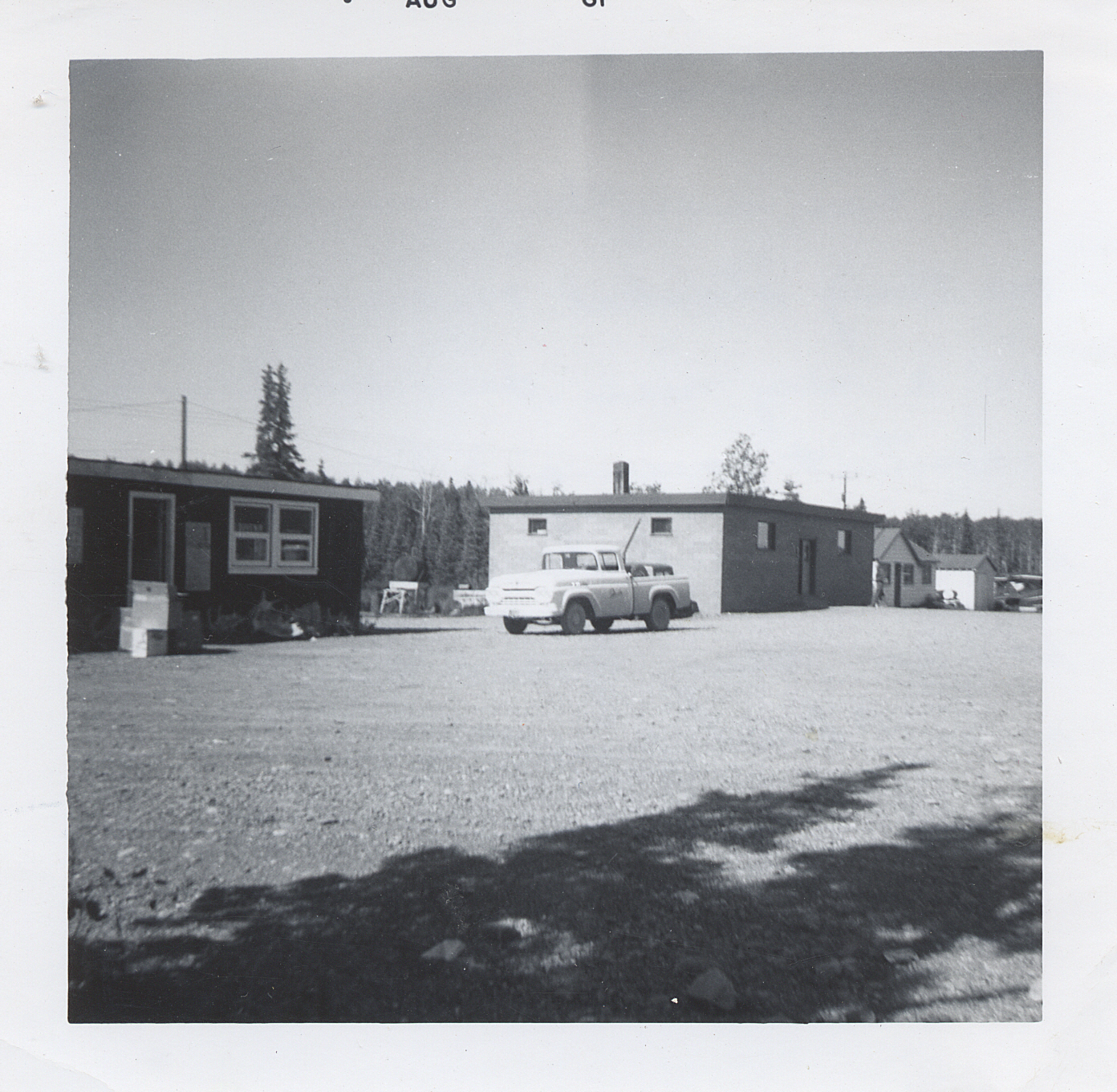
 Soldotna - 1961. Airstrip in town, behind the first house we lived in. Now Wilson Street.

Soldotna – 1961. Airstrip in town, behind the first house we lived in. Now Wilson Street.

To begin with, we lived in town. The house had a highway for a front yard and no nearby neighbors. My siblings and I turned a shabby greenhouse into a playhouse, a board into a teeter totter, and some muddy clay into a tea set.

Our first house, along the highway. Gravel front yard.  We called it "The Cold House." Our bed sheets froze to the wall at night.

Our first house, along the highway. Gravel front yard. We called it “The Cold House.” Our bed sheets froze to the wall at night.

Meanwhile, Mom unpacked boxes and went about creating home, while Dad patched up oil field workers and delivered babies. All the while, they searched for a homestead.

Finding a homestead was an adventure in itself. As much unclaimed land as there was on the peninsula, this, nonetheless, was not simple. It was not a Sunday jaunt with a realtor. Often, land was barely accessible. And there were scams, such as people selling homesteads that weren’t actually available. Then, too, so-called homesteaders tried to sidestep the requirements and still acquire the patent. When the Federal Land Office in Anchorage discovered shysters who talked big about homesteading but didn’t comply with the specifications of the Homestead Act, they took back the land and resold it.

 Carving home out of the wilderness.

Carving home out of the wilderness.

West of town, down rock-strewn Kalifonsky Beach Road, and off of Gas Well Road, my parents found 80 pancake-flat acres. No view. No river or creek. No hill. As the crow flies, the Cook Inlet beach lay three-and-a-half miles farther west, but we weren’t crows. They didn’t seem to care about the lack of interesting features. It was their land. A narrow, sparsely graveled dirt road cut across an edge, crossed a corner of another homestead and extended to a gravel pit on a third. Off this road, Mom and Dad chose to build a log cabin and, at the same time, our primary residence, positioning them 500 timbered feet apart. They planned to trim the trees away from the road so Dad could drop his red, tail-dragging PA-14 airplane through that slit in the tall spruce trees and park it by the house.  Describing this parcel to friends and family, they called it The Gaede Eighty.”

FH000001

From Kansas Wheat Fields to Alaska Tundra: a Mennonite Family Finds Home, chapter 1, “The Makings of a Homesteader.”

Share this:

  • Share on Facebook (Opens in new window) Facebook
Like Loading...

‘A’ is for Anaktuvuk: Teacher to the Nunamiut Eskimos — 20-some Years in the Making

22 Friday Mar 2013

Posted by Naomi Gaede Penner in Alaska

≈ 4 Comments

I’m really not sure how it happened, but twenty-some years ago, after I’d completed Prescription for Adventure: Bush Pilot Doctor, my second-grade school teacher, Anna Bortel (Church) and I sat across my dining room table and leafed through letters, newspaper clippings, and school newspapers she’d saved from her teaching experiences in Alaska; and then we projected Kodak slides against a blank wall.

Never did I think a video-trailer was in the future. I was writing with a pencil, mailing rewrites in stamped envelopes, and wondering how to turn slides into half-tones into photos in a book. It’s not always a bad thing to have a slow-growing project.
Why did I persist? I was captivated and inspired by Anna’s heart-warming, humorous, and amazing stories. Just as the Alaska spawning salmon swim upstream, so had this single woman pushed against a society that expected her to fit the mold of wife and mother.  When this rite of passage eluded her, Anna did not bemoan her singlehood. Instead, in 1954 she drove from Ohio, up the Alaska-Canada Highway, to Valdez, where snow was measured in feet and an Easter Egg hunt unheard of. There she taught for three years.

Her curiosity about Alaska wasn’t quelled. In 1957, she pushed farther north to Tanana, an isolated Athabascan village along the Yukon River. Teaching and living in drafty Quonset huts with freezing oil lines at 50 below zero added to her teaching rigors. Discouraged? Yes. Daunted? No. That’s where I met her. That’s when she became my mother’s best friend. That’s where she accompanied my physician father on a medical field trip to Anaktuvuk Pass, Alaska, where the last roving bands of Nunamiuts, and the only inland Eskimos in Alaska, followed the caribou.

The trip to Anaktuvuk Pass took her even farther north. While my father checked for ear infections, tuberculosis, and nutrition issues, Anna assessed the need for education. The elders of the clan were determined to provide education within their settlement, rather than send their children to boarding school. The obstacles were daunting for a school teacher: no school building, no tent or sod house available for a teacherage, no roads to transport building supplies, no airstrip, no wood for fuel except willows, no public services besides a post office, and few English-speaking adults and children. Simon Paneak and other elders begged her to return and teach – in a place where sled dogs outnumbered the 98 people.

 She returned to Tanana, She prayed. She waited. In 1960, Anna became the first permanent school teacher in Anaktuvuk Pass. Because of her willingness to live in a sod house, melt snow for water, use a kerosene lamp for light – and – teach  children that ‘A’ is for ALASKA, ‘B’ is for BEAR, and ‘C’ is for CARIBOU, and adults to write their names, an airstrip was build to haul in construction materials for a school. And, the Natives ceased their perpetual migration to settle in the middle of the wide, windswept pass.

In 1960, Ernest Gruening, U.S. Senator from Alaska, described the dilemma Alaskan educators face and the determination of the Native people to obtain an education. He held up Anna Bortel as the ideal teacher, “one able to comprehend their problem, one kind and sympathetic, and above all one able to adjust to all conditions that might face her.”

Over the course of 20-some years, Anna and I worked with her stories. She had the facts, details, conversations, and photos. I crafted her material into chapters with settings, additional facts, geography, flashbacks to childhood, foreshadowing, transitions, and conclusions. I expected the results would be one book. The word count was too high. The stories over-flowed into two books.
 ‘A’ is for Alaska: Teacher to the Territory covers the drive to Alaska, Valdez (1954 – 1957), and Tanana (1957-1960).

A is for AK web size

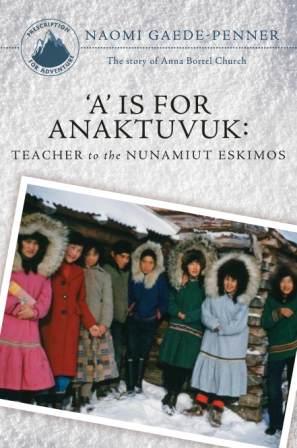
‘A’ is for Anaktuvuk: Teacher to the Nunamiut Eskimos grabs some pieces from the first book, to orient the reader, and then documents the history-changes of the Nunamiuts from 1960-1962 – all in humorous, heart-wrenching, and compelling stories.

A is for AP websze

I wanted Anna’s story to be written down –and shared with her family and friends. At the same time, given how my German-Russian Mennonite heritage is significant to me, I wanted the Nunamiuts to be able to know, read, remember, and pass along their traditions and heritage.

The Simon Paneak Museum is eager to use ‘A’ is for Anaktuvuk: Teacher to the Nunamiut Eskimos as a resource in the museum, for tourist awareness, school education, and resident pride.

Now, twenty-some years later, Anna’s story is told, a segment of the Nunamiut’s history is recorded, and a video-trailer is made. Now, Anna smiles from much deserved accolades and congratulations. Now, I smile that twenty-some years of work is completed.

Share this:

  • Share on Facebook (Opens in new window) Facebook
Like Loading...

Outhouse races, Snowshoe Softball, Snowball Fight Tournament, Dog Races = Fur Rendezvous

21 Thursday Feb 2013

Posted by Naomi Gaede Penner in Uncategorized

≈ 3 Comments

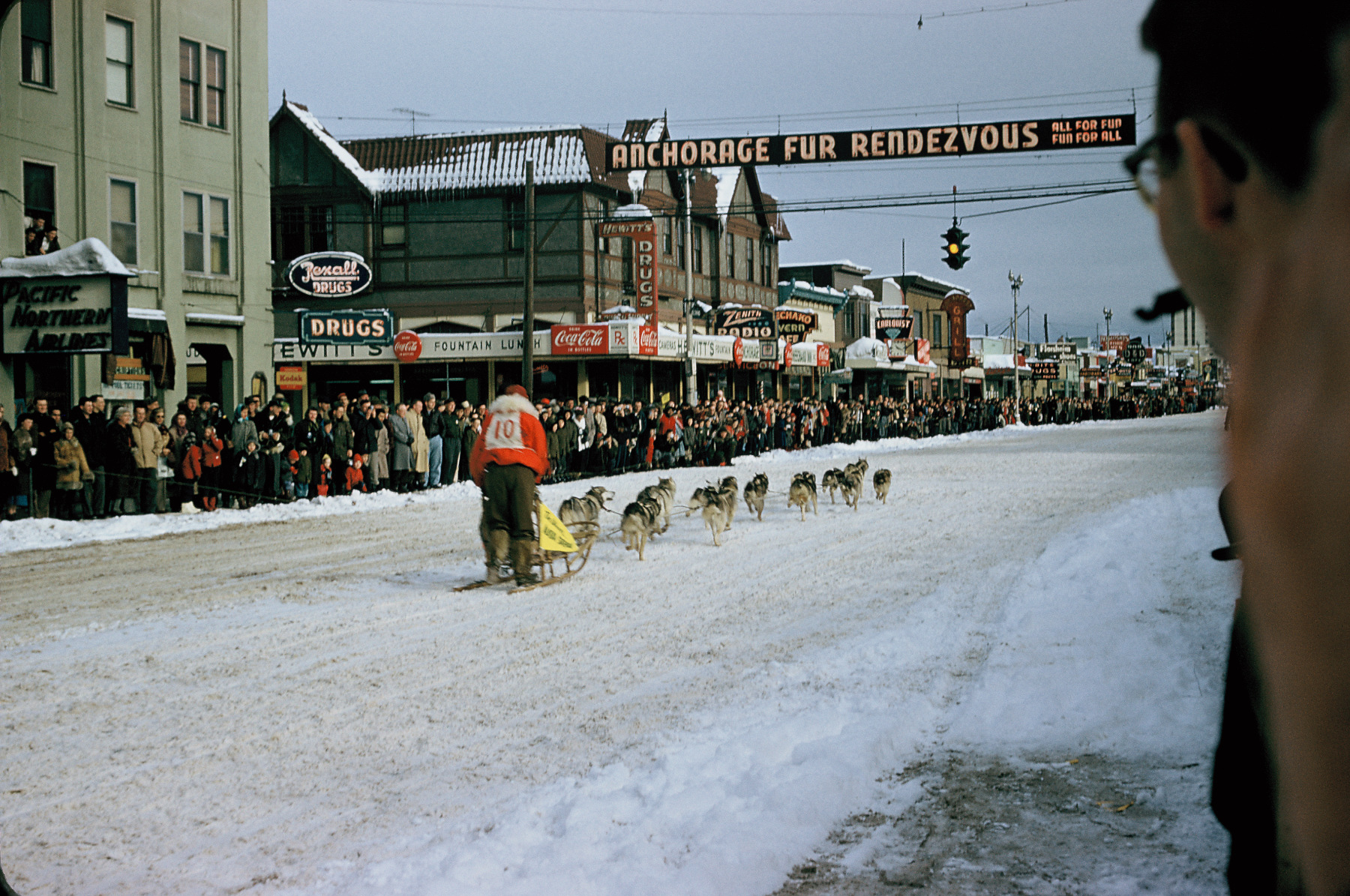
Fur Rendezvous, Anchorage, Alaska,  1956

Fur Rendezvous, Anchorage, Alaska, 1956

The 78th Fur Rendezvous starts tomorrow in Anchorage, Alaska, and runs through March 3, 2013. The event started in 1935. I’d love to see the Outhouse races, Snowshoe Softball, Running of the Reindeer, Great Alaskan Bed Races, Snow Sculptures, Snowball Fight Tournament, Ice Bowling – and more!

My one and only time at the Fur Rendezvous was …a long time ago…..

Naomi, Ruby, Ruth Gaede

Naomi, Ruby, Ruth Gaede

(Excerpt from Alaska Bush Pilot Doctor)

Anchorage, Alaska 1956

As told by Elmer E. Gaede

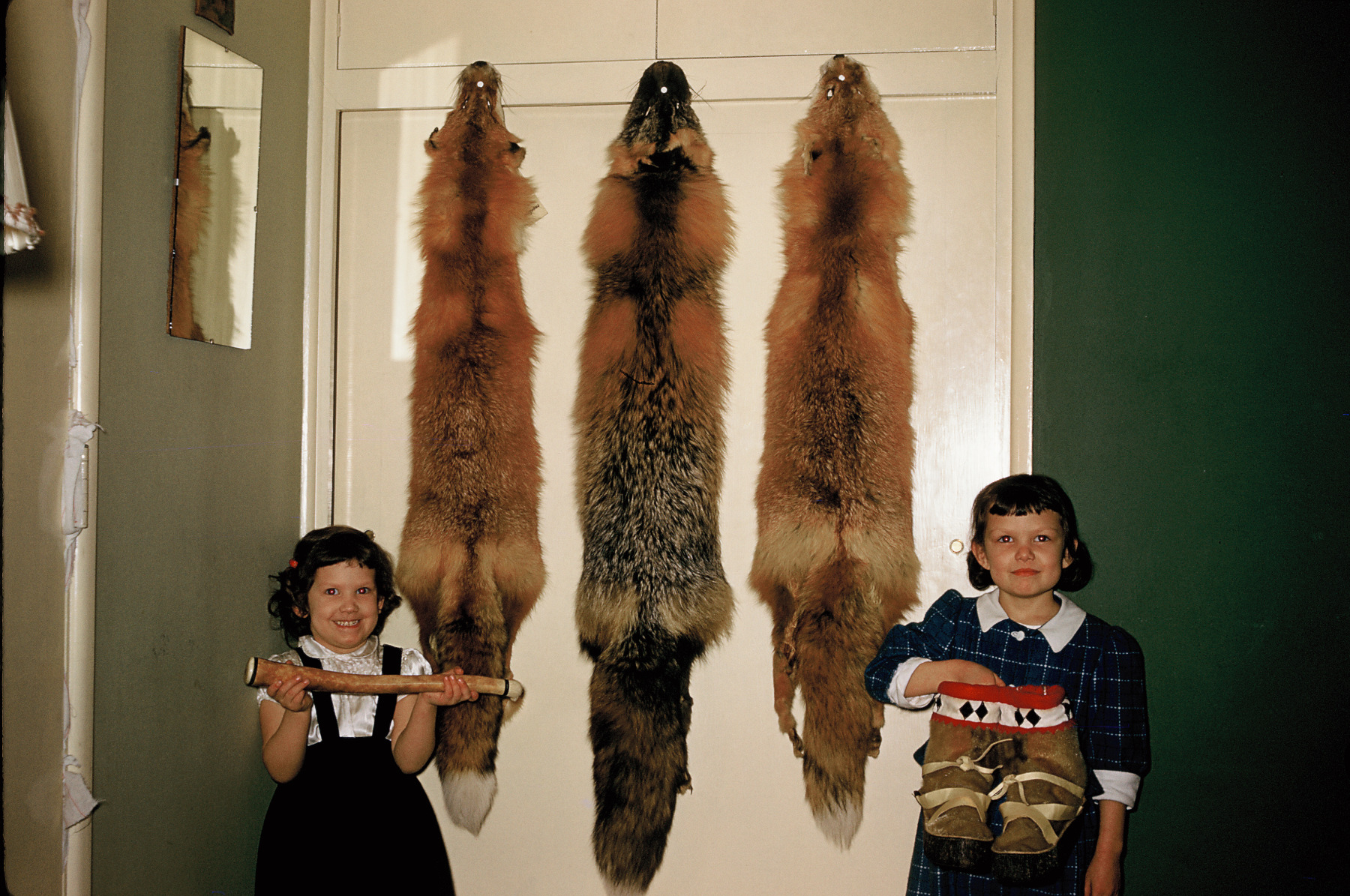
“The Anchorage Fur Rendezvous, held in February, provided more entertainment. Originally a celebration when trappers came to sell their winter’s cache of furs, this annual, ten‑day cabin‑fever antidote attracted crowds of Natives and whites. The hustle and bustle of dogsled races, dog‑pull contests, snow‑shoe races, and fur auctions nearly shut down 5th Avenue. In one of the open lots there was a platform with hundreds of raw furs, sectioned off for red fox, white fox, mink, beaver, muskrat, lynx, and wolverine. ..

…. At the first of the Rendezvous, I bid on the red fox and got two for $5 each. The next day, some of the same quality of fox went up to $20 each. I was told that I did well to bid early since the furs usually sell low the first few days before the buying interest is up. Later, when the buying fever was aroused, the prices would go up.

When the furs were brought in from the cold and into a warm room The odor went up later, too. Some of the furs came from villages where they had been tanned in barrels of human urine… I learned that in fur selection, one needs to use both eyes and nose.”

Ruth and Naomi with fox skins

Ruth and Naomi with fox skins

(Excerpts from http://www.anchorage.net/articles/anchorage-fur-rendezvous)

Fan favorites, such as the Outhouse Races, always draw a crowd. Dog teams and their mushers complete three 25-mile loops over three days. One of the newest events is Yukigassen, a team snowball fight tournament that joined the lineup in 2011.

 Native culture is celebrated in many ways.

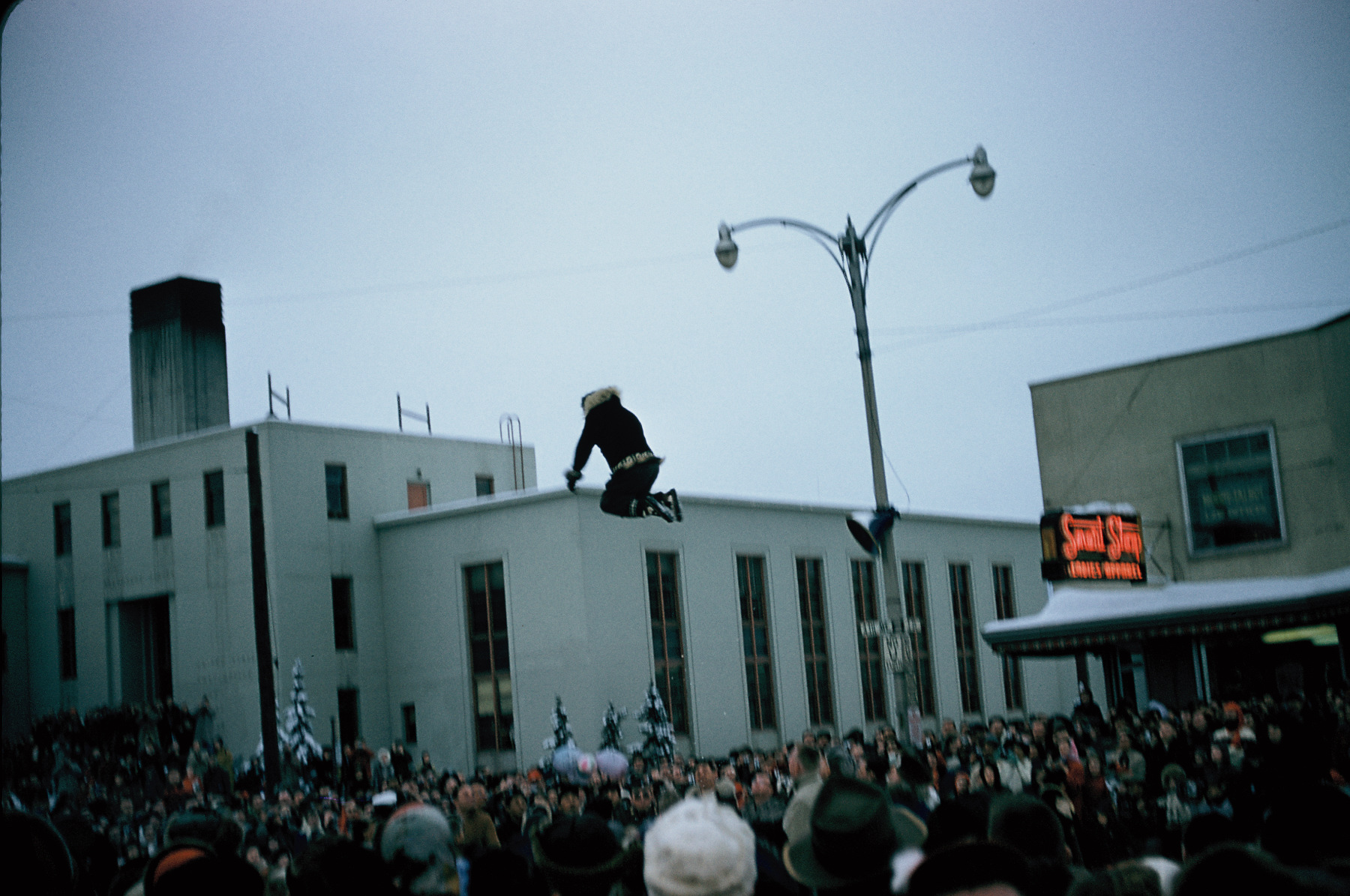
Blanket Toss at 1956 Fur Rendezvous

Blanket Toss at 1956 Fur Rendezvous

–        The Blanket Toss mimics the Alaska Native whaling tradition. Everyone can have a turn to either jump or grip the (walrus skin) blanket’s edge while tossing others as high as 20 feet into the air.

–       Arts and crafts are displayed.

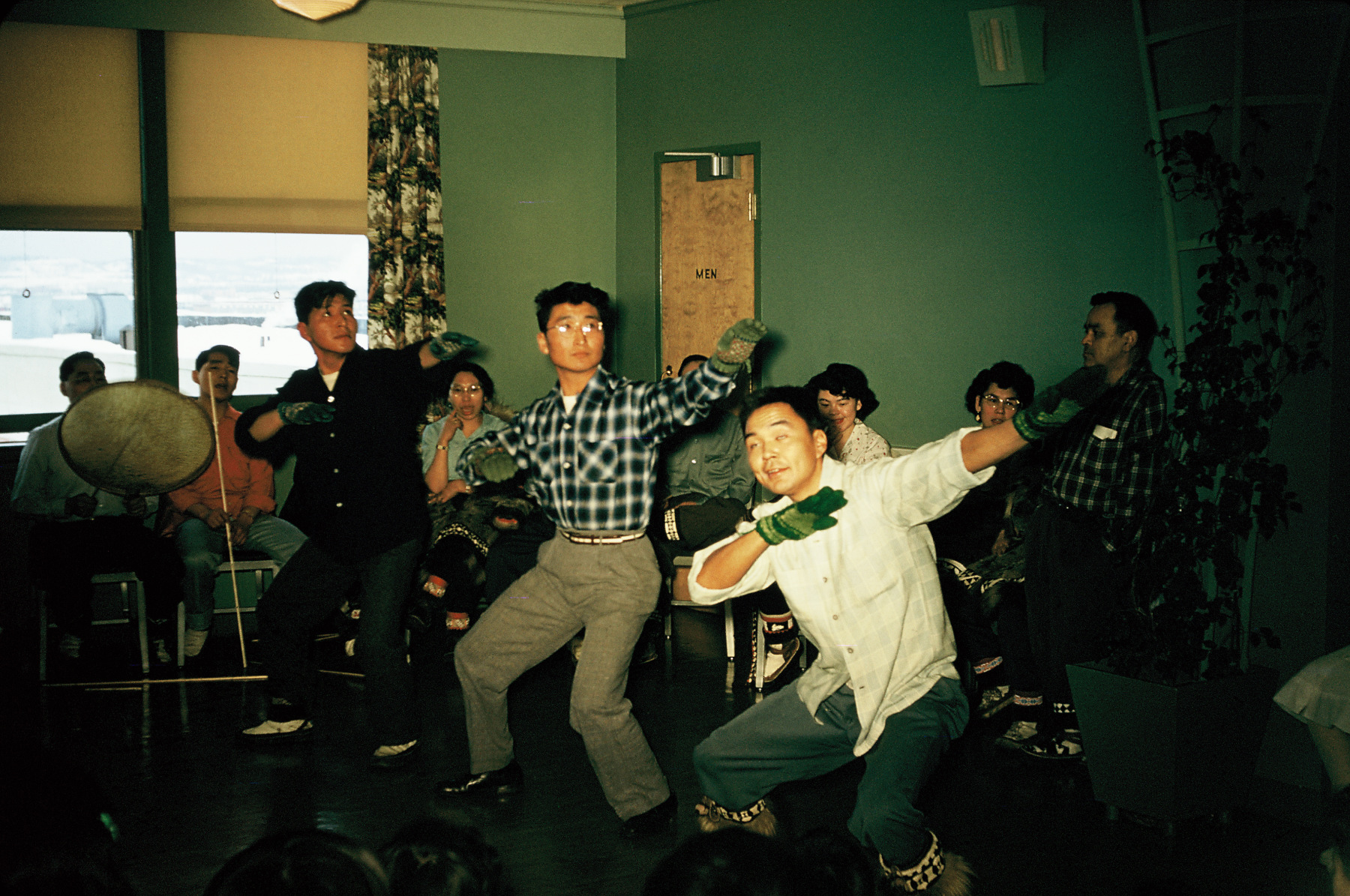
–       Tribal regalia, customs and culture vary greatly between Alaska’s distinct Native cultures. The Multi-tribal Gathering celebrates their diversity, joining cultural performers and visual artists in a one-day extravaganza

Fur Rendezvous - 1956

Fur Rendezvous – 1956


Fur Rendezvous - 1956

Fur Rendezvous – 1956

For more information, including the schedule of events and travel specials, visit http://www.furrondy.net/ or

Share this:

  • Share on Facebook (Opens in new window) Facebook
Like Loading...

Giving is Receiving: PrescriptionS for Adventure

22 Monday Oct 2012

Posted by Naomi Gaede Penner in Uncategorized

≈ Leave a comment

Tags

Service as Adventure

Rocky Mountain Mennonite Relief Sale – 2012

We think of adventures as hanging off cliffs, living in the middle of a jungle, fighting off zombies, outrunning a tsunami, or finding a hidden treasure. That’s not untrue, but that’s not the entire scope of “adventure.”

“Adventure” does not have a singular definition. It has multiple definitions: prescriptionS.

Adventure isn’t all about just-me either.

An adventure can come in the form of service. I support the service-work done by the Mennonite Central Committee. (www.mcc.org) I’ve put together health kits and school kits. I’ve sent money so families in poverty and famine stricken countries can purchase a cow or a chicken, pay for their children to attend school, or buy seeds to plant.

This last weekend, I went to a Mennonite Relief Sale where I gave and received at the same time. These sales are held across the United States and Canada. (http://reliefsales.mcc.org/)

The Relief sale I went to always sells German sausage, cheese, bierrocks, baked goods, pecans, and Neu Jahre Kuchen (New Year’s Cookies )– that are actually fritters. They have a big machine that turns boxes of apples into apple butter and apple cider. This aroma is mixed with that of corn popping. These sounds are blended with a barrel train filled with children and pulled by a small tractor.

These sounds are interrupted by that of a vintage John Deere tractor — putt..putt……putt, putt…..putt…a sound that is music to the ears of the farm folk who attend, and to some of us who are not farm folk, but remember that nostalgic sound on our grandparent’s farm.

And thus people stand around in the autumn sun and examine the tractor which is for sale in the live auction, right before lunch. Some have their pictures taken against the gleaming green restored tractor. Others mill around and then go inside the large metal and concrete exhibit hall to line up for a slice of pie, which is suitably located next to the ice cream booth.

Inside this county fairground exhibit hall are other booths, too: the Christmas booth; Craft booth; the Silent Auction tables with old books, vintage glassware, intricate lacework, yellowed pictures, and other memorabilia that people of a certain age reminisce about and people of a younger age ask questions about. The MCC booth describes the work the Mennonites do around the world, along with adventures that people can volunteer for, for hands-on service.

The live auction begins at 9:30 am and starts with the auction of a loaf of bread.  The bread represents the need of all people for the basic staff of life. It represents God as our spiritual Bread of Life. This year it sold for $1,100. Next up are old tools, wooden crafts of rockers and benches, large cross-stitched pictures, a hand-made dollhouse, collector china, quilt racks and quilt wall hangars. The list goes on.

At 1:30, the quilt auction takes place. It begins with hymn # 606 “Praise God from Whom.” There is no need for overhead projected words. There is no need for keyboards and drums. A simple pitch-pipe gives one note. Everyone stands. Everyone knows his or her part and sings in harmony and in accapella. It is a rich and poignant sound that whispers of traditions of Mennonite service and giving, and pulls generations together. I listen. I remember years of standing beside family members who are no longer with me. I’ve accumulated years of this tradition – and coming here brings me closer to those loved ones.

In late afternoon, the sun moves to the west, the pie and ice cream have sold out, the tractor is sold for nearly $5,000, the popcorn machine shuts down, children still beg for just one more train ride, and  I write one more check to Rocky Mountain MCC, and walk out with another quilt.

I have received much. I trust and pray that my dollars will give much to the world that hungers for the bread of life.

~ What do you give, that gives back to you, that makes you both a giver and a receiver? ~

Share this:

  • Share on Facebook (Opens in new window) Facebook
Like Loading...
← Older posts
Newer posts →

Enter your email address to follow this blog and receive notifications of new posts by email.

Prescription for Adventure Website:

Prescription for Adventure on Facebook:

Prescription for Adventure on Facebook:

Recent Posts

  • Garden Tales
  • Dr. Elmer and Ruby’s Missionary Trip to Russian Mission, Alaska
  • A Chilly Bucket List
  • The Suntanned Farm Girl
  • Wilderness Wife

My Books

Archives

  • April 2023
  • March 2023
  • July 2022
  • December 2021
  • May 2021
  • October 2020
  • August 2020
  • May 2020
  • July 2019
  • June 2019
  • March 2019
  • January 2019
  • December 2018
  • November 2018
  • March 2018
  • August 2016
  • July 2016
  • June 2016
  • May 2016
  • April 2016
  • March 2016
  • December 2015
  • September 2015
  • August 2015
  • July 2015
  • March 2015
  • January 2015
  • October 2014
  • August 2014
  • June 2014
  • May 2014
  • March 2014
  • February 2014
  • January 2014
  • December 2013
  • August 2013
  • July 2013
  • June 2013
  • April 2013
  • March 2013
  • February 2013
  • January 2013
  • December 2012
  • October 2012
  • September 2012
  • August 2012
  • June 2012
  • May 2012
  • April 2012

Categories

  • Adventures
  • Alaska
  • Alaska – Galena
  • Alaska – Tanana
  • Alaska Earthquake
  • Anna Bortel Church
  • Book Reviews
  • Caring and Compassion
  • Everyday life
  • Gaede-80 Homestead
  • Holidays and Special Occasions
  • Inspiring Adventures
  • Kansas
  • Mark
  • Mark Gaede
  • My Books
  • Outdoor Action
  • Personal Growth
  • School Teachers
  • Sibling Relationships
  • Soldotna
  • Telling Our Stories
  • The Bush Doctor's Wife
  • Uncategorized
  • Womens' Safety and Protection
  • Writing Workshops

Create a free website or blog at WordPress.com.

Privacy & Cookies: This site uses cookies. By continuing to use this website, you agree to their use.
To find out more, including how to control cookies, see here: Cookie Policy
  • Subscribe Subscribed
    • Prescription for Adventure
    • Join 25 other subscribers
    • Already have a WordPress.com account? Log in now.
    • Prescription for Adventure
    • Subscribe Subscribed
    • Sign up
    • Log in
    • Report this content
    • View site in Reader
    • Manage subscriptions
    • Collapse this bar
 

Loading Comments...
 

    %d